A giant black hole at the cosmic frontier
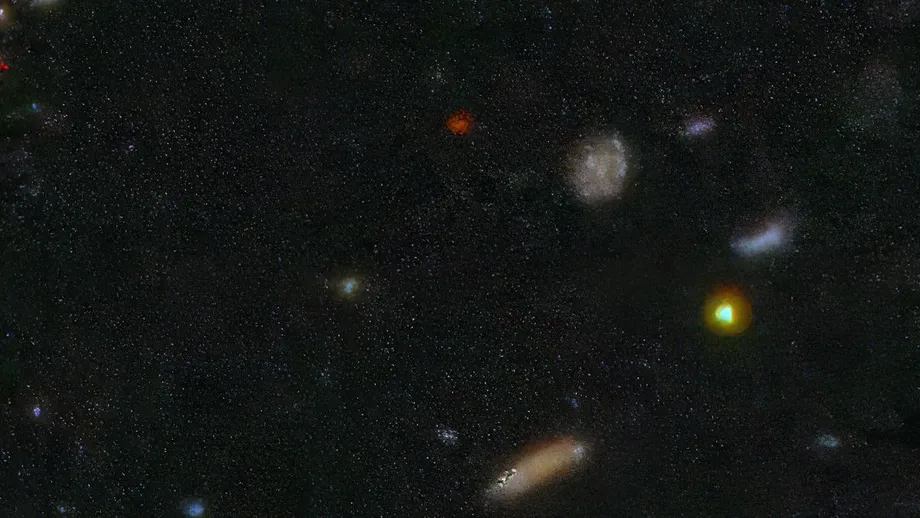
A quasar catalogued as J1504+6252 has become the most distant quasar confirmed so far, after astronomers measured its light from just 630 million years after the Big Bang. The European Space Agency announced the discovery on 24 November 2026, saying the Euclid space telescope had broken its own distance record. Nicknamed Dún Aonghasa, the object is the first quasar confirmed beyond a redshift of 8.
Contents
- A giant black hole at the cosmic frontier
- What makes this quasar visible across cosmic time?
- How one red point became a confirmed record
- Why is slow feeding such a puzzle?
- Which formation routes remain possible?
- A precise distance, but a less certain mass
- How Euclid is changing the early quasar census
- What the next observations can test
- Key Points
Its central black hole has an estimated mass of 360 million Suns, even though the universe was less than 5% of its present age when the observed light began its journey. That light shows the quasar as it appeared about 13.1 billion years ago. The universe itself is thought to be 13.8 billion years old, so 630 million years represents about 4.6% of its current age.
The previous record holder was also found by Euclid. ESA describes the new gain as 40 million years, while the study calculates it as roughly 39 million years. That difference equals about 6% of the universe's age at the time, a substantial interval when the first galaxies and black holes were developing.
Julien Wolf led the research as a postdoctoral researcher at the Max Planck Institute for Astronomy in Heidelberg and has since moved to the European Southern Observatory in Garching. The study by Wolf and colleagues appeared in Astronomy & Astrophysics, volume 715, article A356, with DOI 10.1051/0004-6361/202662243. Wolf explained why each earlier quasar matters to theories of black hole growth.
The closer to the Big Bang we find them, the faster their black holes must have grown or the more massive they must have been at birth, or both.
What makes this quasar visible across cosmic time?
A quasar is the brilliant core of a galaxy powered by a supermassive black hole that is consuming gas and dust. The material gathers in a rotating accretion disk outside the black hole. Friction and other processes heat the disk until it radiates enormous amounts of energy, sometimes outshining all the stars in the surrounding galaxy by factors of hundreds or thousands. Astronomers call such a galactic centre an active galactic nucleus.
That brightness makes quasars valuable beacons. Ordinary galaxies from the same era can be extremely faint, but a quasar can be studied across a much greater distance. Quasars were more common in the early universe than they are today and are thought to have reached their greatest numbers about 10 billion years ago. Their light also carries information about the black hole, the surrounding gas and the galaxy in which they reside.
The researchers chose the name Dún Aonghasa after a prehistoric stone fort on Inis Mór, one of Ireland's Aran Islands. The fort stands at the edge of a cliff rising 100 metres above the Atlantic. The comparison is geographical as well as poetic: the quasar sits at the present observational frontier for objects of its kind. Its full catalogue designation is J150452.291+625224.39, usually shortened to J1504+6252.
Redshift supplies the cosmic timestamp. As the universe expands, it stretches the wavelength of light travelling through space. At a redshift of 8.13, an observed wavelength is 9.13 times its emitted wavelength. Light that left Dún Aonghasa as ultraviolet radiation therefore arrives at Earth as infrared radiation. This stretching explains why infrared observatories were essential both for finding the candidate and for measuring its distance.
How one red point became a confirmed record
Euclid first identified the quasar among millions of sources in roughly 18 months of survey data. The team examined 3,644 square degrees of sky available in August 2025. Dún Aonghasa stood out because it was undetected in Euclid's visible light I_E band, down to a faint magnitude of about 26.2, yet appeared in the infrared Y_E, J_E and H_E bands. That pattern is expected when expansion has shifted almost all of an object's detectable light toward longer wavelengths.
Three selection methods helped separate the candidate from the multitude: an extreme deconvolution algorithm, an XGBoost machine learning classifier and the LePhare template fitting code. Their initial redshift estimates were 8.20, 8.21 and 7.98, averaging 8.13 with an uncertainty of 0.10. Those estimates justified spending time on much more detailed observations. The paper lists the following sequence.
- 18 January: The W. M. Keck Observatory in Hawaii supplied early observations.
- 12 May: The Hubble Space Telescope examined the candidate, adding further evidence.
- 15 and 16 May: The Large Binocular Telescope in Arizona supported the high redshift, in observations led by Silvia Belladitta.
- 26 June: The James Webb Space Telescope obtained the decisive spectrum.
- 24 November 2026: The study and discovery announcement were published.
The James Webb Space Telescope, launched on 25 December 2021, has a primary mirror measuring 6.5 metres across and detects wavelengths from 0.6 to 28 micrometres. It can detect objects up to 100 times fainter than Hubble can. Webb's NIRSpec instrument used its G395M setting to collect spectroscopy at medium resolution, separating the quasar's light into wavelengths that revealed recognizable features from hydrogen and magnesium.
A narrow hydrogen beta emission line yielded a systemic redshift of 8.129, with an uncertainty of only 0.005. Narrow lines trace gas moving more gently than the fast material close to the black hole, making them especially useful for measuring the object's overall redshift. The final result turned an intriguing infrared candidate into a precisely located landmark in cosmic history.
Why is slow feeding such a puzzle?
Dún Aonghasa already contains an enormous black hole, but it is consuming matter relatively gently. The research places its present feeding rate between 12% and 44% of the Eddington limit, depending on the mass calibration used. That limit describes a balance between gravity pulling gas inward and radiation pushing outward. Infalling gas heats and shines; if the light becomes intense enough, its pressure holds back additional gas and slows further growth.
Even feeding continuously at that limit does not produce instant growth. A black hole generally needs tens of millions of years to double its mass. Earlier theoretical estimates often allowed around one billion years of feeding and merging for black holes to reach millions or billions of solar masses. Dún Aonghasa had gathered hundreds of millions of solar masses within a universe only 630 million years old.
The team's growth calculations begin around redshift 20, approximately 450 million years before the quasar is observed. A seed of about 100 solar masses, similar to the remnant of an early massive star, would require extremely rapid and nearly uninterrupted growth. Feeding continuously at the Eddington limit from that starting era would instead require a seed close to 100,000 times the Sun's mass. The study also finds that mergers are unlikely to assemble such a heavy object by themselves.
The slow observed meal therefore points toward a more eventful past. The black hole may have experienced an early growth spurt, possibly including periods above the Eddington limit, before its feeding slowed. Another possibility is that rapid consumption has paused rather than ended. Either history would reconcile a mature, massive black hole with the comparatively modest amount of radiation seen today.
Which formation routes remain possible?
One broad proposal begins with light seeds: black holes left behind by the first massive stars, initially containing tens or hundreds of solar masses. These objects must do most of their growing through accretion, the astronomical term for gathering and swallowing surrounding matter. Dún Aonghasa makes that route demanding because so much mass must be acquired in so little time.
Direct collapse offers a larger starting point. In this scenario, a massive cloud of gas collapses under its own gravity and forms a heavy black hole without first going through an ordinary stellar stage. Seeds could contain tens of thousands of solar masses, with some cases discussed by the team approaching 100,000. Using reasonable growth rates, the researchers find that direct collapse is consistent with the quasar's observed mass.
The paper keeps the choice among formation pathways open. It also examines sequential runaway collisions in dense star clusters, where repeated mergers could build a heavy seed. Another calculation uses an illustrative history beginning with a primordial black hole of 5,000 solar masses. Primordial black holes are hypothetical objects formed in the first instants after the Big Bang, rather than through the death of stars or the collapse of later gas clouds.
Direct collapse may itself require unusual conditions, including suitable gas with very little enrichment from earlier generations of stars. Its rarity could help explain why relatively few quasars are known beyond redshift 7.5. If future observations reveal luminous quasars when the universe was only a few hundred million years old, even direct collapse could struggle to provide enough time. Primordial seeds would then deserve closer attention because they would begin growing almost immediately.
For Dún Aonghasa, the evidence narrows the plausible histories without selecting one. Its mass demands either a substantial head start, highly effective early growth or a combination of the two. Its present feeding rate supplies a snapshot of maturity, not a complete record of how that maturity was reached.
A precise distance, but a less certain mass
The redshift and the black hole mass rest on different kinds of measurement. The redshift of 8.129 comes directly from identified features in Webb's spectrum and carries the small uncertainty of 0.005. The mass is inferred from the widths of broad emission lines produced by fast moving gas near the black hole. Gas orbiting a heavier black hole moves faster, broadening those lines.
The team measured widths of about 3,160 kilometres per second for a hydrogen line and 3,740 kilometres per second for a magnesium line. A standard calibration converts the measurements into approximately 360 million solar masses. Other calibrations produce values from about 210 million to 780 million Suns. The quoted mass uncertainty is 0.43 dex, a logarithmic measure amounting to nearly a factor of three in either direction.
Those formulas were developed using better studied black holes at lower redshifts and then applied to one spectrum of a very young quasar. The mass range is therefore an essential part of the result. The feeding estimate of 12% to 44% of the Eddington limit changes with the adopted mass, while the distance record rests on the much firmer spectral measurement.
The present feeding rate is also brief when compared with the hundreds of millions of years needed for growth. Quasars can vary over much shorter periods, so a slow phase today cannot describe every earlier phase. Strong gravitational lensing, which could magnify the quasar and complicate its interpretation, is considered unlikely, although a modest magnification that the observations cannot resolve remains possible.
The distance record has a specific scope as well. Dún Aonghasa is the earliest confirmed luminous quasar, rather than a claim about every growing black hole. Webb has investigated fainter and partly obscured growing black holes at still higher redshifts, including one associated with the galaxy GN-z11. Those objects occupy a different observational category from the brilliant quasar found by Euclid.
How Euclid is changing the early quasar census
Euclid launched in July 2023 with a primary assignment unrelated to quasar records. Its main task is to investigate dark matter and dark energy, which together account for about 95% of the universe's matter and energy budget. The spacecraft carries a telescope with an aperture of 1.2 metres, a visible imaging instrument called VIS and the infrared instrument NISP. Its planned survey covers about 14,000 square degrees, more than one third of the sky, giving it the reach needed to locate rare objects as well as map cosmic structure.
Before Euclid's recent results, the quasar distance record stood at redshift 7.64, corresponding to about 670 million years after the Big Bang. Euclid then produced records at redshifts 7.69 and 7.77. Its July 2026 announcement included 31 newly identified ancient quasars, among them the object at redshift 7.77 that held the record until Dún Aonghasa.
The wider census is growing quickly. In about a year and a half, Euclid has announced 31 quasars from the universe's first billion years, including 12 beyond redshift 7. Before the July results, only three quasars were known beyond redshift 7.5; those discoveries raised the count to seven. Dún Aonghasa now supplies the first confirmed example beyond redshift 8.
The study forecasts between 8 and 23 quasars beyond redshift 8 across the full survey area of about 14,000 square degrees. Scaling that prediction to the 3,644 square degrees searched for this discovery gives an expectation of two to six such objects. These are small numbers, but each one can provide an independent test of black hole formation and growth.
Silvia Belladitta, a study coauthor at the Max Planck Institute for Astronomy and the INAF Bologna Observatory who led the Large Binocular Telescope observations, said the speed of Euclid's discoveries is central to their value.
This highlights how quickly Euclid is expanding our census of the most distant quasars. Each new discovery brings us closer to understanding how supermassive black holes formed and grew in the early universe.
What the next observations can test
Dún Aonghasa existed during the era of reionization, when the first stars and galaxies were taking shape and their radiation was changing the hydrogen gas between galaxies. Quasars act as bright background lights for studying that gas. Their spectra can reveal how opaque the intergalactic medium was and how it was becoming enriched with chemical elements produced by stars.
Early quasars also mark rare concentrations of matter, helping astronomers examine the densest regions of the young universe. Closer to home within each galaxy, researchers can compare the black hole's mass with that of its host. Black holes and galaxies appear to influence one another through gas flows, mergers and energy released during accretion, but the details of that relationship remain unsettled.
Future Euclid observations can establish whether Dún Aonghasa's slow feeding is unusual or common among heavy black holes from the same era. Webb can then confirm promising candidates, measure their spectra and examine their host galaxies. The researchers suggest that known luminous quasars may represent the fastest feeding end of a broader population, and that brighter examples could still await discovery.
No date has been given for the next observations of Dún Aonghasa. The immediate tests are clear: measure more objects, look for slower feeders and search still closer to the Big Bang. A larger collection would show whether direct collapse remains sufficient, whether early bursts above the Eddington limit were common, or whether more exotic seeds must be considered.
Key Points
- J1504+6252, nicknamed Dún Aonghasa, is the first quasar confirmed beyond redshift 8.
- Webb measured a systemic redshift of 8.129, with an uncertainty of 0.005, placing the observed light 630 million years after the Big Bang.
- The discovery extends Euclid's previous quasar record by about 40 million years.
- The black hole's nominal mass is 360 million Suns, with alternative calibrations spanning roughly 210 million to 780 million.
- It is feeding at only 12% to 44% of the Eddington limit, pointing toward a heavier starting seed, faster growth in the past or both.
- Euclid found the candidate in about 18 months of data, followed by observations from Keck, Hubble, the Large Binocular Telescope and Webb.
- Direct collapse is consistent with reasonable growth calculations, while the study keeps several formation pathways open.
- Future Euclid discoveries and Webb spectra will test whether this slow feeding giant belongs to a much larger early population.