A Landfill With a Deadline
Singapore's only landfill has a date attached to it: around 2035. The Semakau Landfill sits about 8km south of the main island and takes the ash left after the country burns waste it cannot recycle. On Wednesday, 25 November, the Singapore Environment Council (SEC), the non-governmental organisation that runs the National Environment Agency's packaging programme, used that deadline to argue for a much wider extended producer responsibility (EPR) system covering all packaging.
Contents
- A Landfill With a Deadline
- Why Packaging Is the Missing Piece
- What the Council Wants Producers to Pay For
- The Blue Bin Problem
- A Recycling Rate Moving the Wrong Way
- The Space Behind the Numbers
- The Government's Cautious Answer
- How the Drinks Scheme Has Performed So Far
- What Happens Between the Report and 2035
- What the Decision Means for Households and Businesses
- Key Points
Its report of 23 pages, Beyond BCRS: A Roadmap for Comprehensive Packaging Responsibility, says packaging makes up about a third of domestic waste, yet only plastic and metal drink containers face collection and recycling obligations under the Beverage Container Return Scheme (BCRS), which went fully live on 1 October. Producers of cardboard boxes, glass jars, food trays and plastic film pay nothing to collect or recycle their packaging. About 2,100 tonnes of waste arrive at Semakau each day, including 1,500 tonnes of ash and 600 tonnes of non-incinerable waste such as PVC and fibreglass.
The Ministry of Sustainability and the Environment (MSE) expects the landfill to reach capacity around 2035. More than half its capacity has been used since it opened in 1999, and its second phase, opened in 2015, more than doubled capacity at the time and set the 2035 timeline.
Why Packaging Is the Missing Piece
The BCRS covers a narrow slice of the waste stream. Consumers pay a refundable deposit of 10 cents on plastic bottles and metal cans and get it back when they return the container. Paper made up about 30 per cent of packaging waste in 2022, while glass and metal made up about 10 per cent, according to the SEC. Even among drink containers, about a third are not covered, mostly paper cartons and glass bottles. The council warns that drink makers could switch to those materials to avoid the scheme.
A framework covering many materials would cover plastics, paper, cardboard, glass and metals across industries. The SEC says the aim is not to recycle every material, which it calls unviable in Singapore, but to discourage the use of materials that cannot be recycled. Covering all materials would also stop producers from escaping obligations by changing packaging. The council argues that a single framework can share collection and processing systems across materials, while adding one material at a time could take as long or longer.
What the Council Wants Producers to Pay For
EPR makes companies that place packaged goods on the market pay for collecting and recycling the packaging after it is thrown away. Singapore already uses the model for e-waste and drink containers under the Resource Sustainability Act. The SEC's proposal would extend it to packaging producers and importers in every sector, with four main recommendations: cover more materials, build complementary collection channels, impose an eco-modulated fee, and strengthen collaboration between the public and private sectors.
The fee is the centrepiece. A flat fee depends only on a packaging item's weight and material, as in Norway. An eco-modulated fee also depends on how the packaging performs: whether recycling systems can handle it, whether it is made of one material or several, whether additives disrupt recycling, and whether it contains recycled material. France runs a bonus-malus system that can cut fees by up to 50 per cent for packaging designed with the environment in mind and raise them for packaging that cannot be recycled.
Singapore's version would start with a uniform rate because the country lacks the data to vary it. Fees would rise with the weight and quantity of packaging sold. Once life cycle studies are done, they would also rise with environmental impact. Composite or biodegradable packaging, which is hard to recycle at scale in Singapore, could pay more. Only firms with annual turnover above S$10 million must report how much packaging they use.
Fee revenue would fund recycling infrastructure, research into sustainable packaging and public education. The report says compliance costs might be passed on to consumers. It proposes no fee levels, cost estimates or recycling targets.
SEC executive director Cheang Kok Chung said the drinks scheme was a step, but not the whole answer.
The introduction of the Beverage Container Return Scheme is an important step forward, but addressing Singapore's wider packaging waste challenge requires us to look beyond beverage containers.
He added that a phased approach with government, industry and consumers would be needed to make a system that is environmentally effective and operationally viable.
The Blue Bin Problem
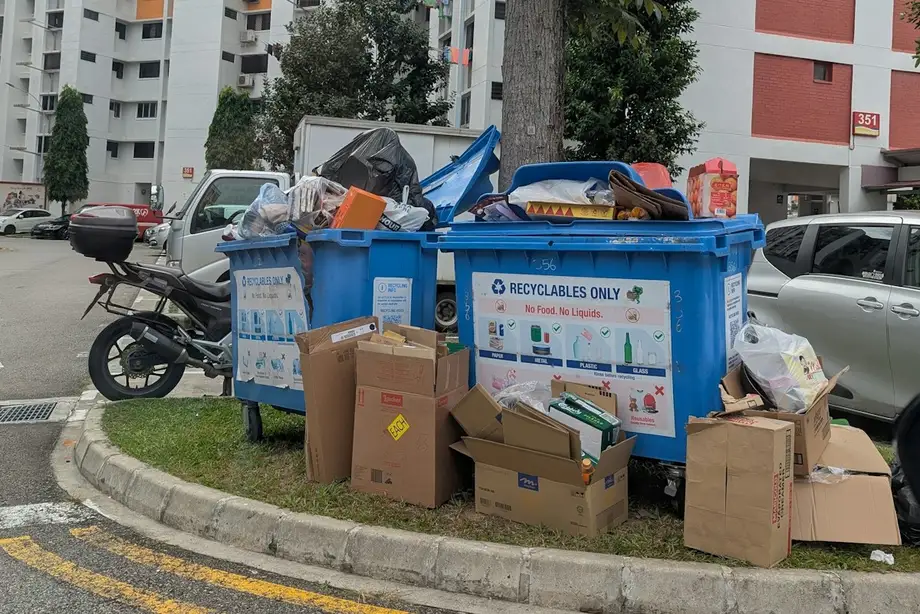
Under the National Recycling Programme, residents of public housing put mixed recyclables into communal blue bins. About 40 per cent of what goes in cannot be recycled, and the rate has not changed since 2018, Minister for Sustainability and the Environment Grace Fu told Parliament in April. The most common wrong items are e-waste, clothing and composite plastics such as toys, she said in a separate reply in February. Food and drink residue also contaminates recyclables.
Those items are sorted out and burnt, so about two in five of the items residents set aside for recycling end up as ash at Semakau. Fu did not say whether the ministry would set a target to bring the contamination figure down. Singapore has more than 80,000 blue recycling bins, and the SEC says contamination rates of up to 40 per cent are common.
The council wants separate collection routes for different materials alongside the blue bins, using collection from homes, central collection points and the reverse vending machines used by the BCRS. The aim is to give recyclers cleaner material. The SEC acknowledges that multiple collection pathways are resource intensive and that it is unclear which combination would best handle the mix of packaging waste.
A Recycling Rate Moving the Wrong Way
Singapore's domestic recycling rate, which covers households and shops, fell from 17 per cent in 2019 to 11 per cent in 2025. The national rate across all waste streams fell from 59 per cent to 52 per cent. The government's target is 70 per cent by 2030. Waste disposed rose from 3 million tonnes in 2014 to 3.3 million tonnes in 2024, even though Singapore generates less waste than a decade ago.
Waste sent to landfill per person per day remains about the same as the 2018 baseline, Parliament heard in 2025, despite the fall in waste generated. The government attributed lower recycling to higher freight costs, import restrictions by foreign countries and lower demand for recycled materials. The 2019 Zero Waste Masterplan set a target to cut waste sent to landfill by 30 per cent per person per day by 2030 from the 2018 baseline, alongside the 70 per cent recycling goal.
Packaging sits at the centre of that gap. Plastic makes up about 60 per cent of Singapore's packaging waste, yet only 4 per cent of plastic waste was recycled in 2025. Paper and cardboard recycling rates have fallen by 20 percentage points over the past decade.
The Space Behind the Numbers
Semakau is an engineered site, not a hole in the ground. A 7km perimeter rock bund encloses part of the sea off Pulau Semakau and Pulau Sakeng, and the bund is lined with an impermeable membrane and a layer of marine clay to contain leachate. The facility covers about 350 hectares, roughly half the size of Tengah town. Waste is burned first, reducing it to about a tenth of its original volume, and the ash is shipped to the landfill.
Four incineration plants process a combined 9,710 tonnes of waste a day. A new plant at Tuas Nexus is expected to add 5,800 tonnes a day, but the first phase has been delayed to 2027 onwards. NEA estimates that Singapore needs a new offshore landfill every 30 to 35 years and a new incineration plant every seven to 10 years at current rates. A REMEX Minerals facility at Tuas has recovered metal from incinerated remains since July 2015, cutting residue weight by about 10 per cent.
The government is also studying ways to use the landfill's contents. NEA and the Maritime and Port Authority of Singapore are carrying out a feasibility study to use landfilled materials in reclamation for Tuas Port, which could prolong Semakau's life and reduce imported fill. Plans are being explored for a 60 hectare solar farm on the landfill.
The bigger question is where waste goes after 2035. Singapore has no plans for where that waste will go once Semakau is full. MSE says there is no land for a landfill on the main island. The NEA warned in 2020 that incineration ash would have 'nowhere to go' by 2035 if nothing was done. Fu has given MPs no figures on how much space is left and no options beyond extending the landfill's life. Her reply in May 2023 promised an update 'at a suitable time when we have greater certainty of our plans'. A reply in October last year again listed only ways to make Semakau last longer.
Fu's reply to MPs in September did not say whether a site had been found for a successor landfill. It did not say what Prime Minister Lawrence Wong's plan to merge Pulau Semakau with nearby islands into a new 'Western island' meant for the landfill, or whether the 2035 projection still held. An answer may come with the refreshed Zero Waste Masterplan, due in 2027. Dr Janil Puthucheary said in June that the review would update projections of Semakau's lifespan, 'including measures to ensure sufficient landfill capacity beyond 2035'.
The Government's Cautious Answer
Janil Puthucheary, Senior Minister of State for Education and Sustainability and the Environment, was guest of honour at the report's launch. He said the government needed to see how the BCRS performed before considering an extension. The scheme was still in its early days, he said, and any next step would depend on Singapore's infrastructure, how businesses operate and costs across the supply chain.
We need to see how it performs on the ground, and we need to see how industry and consumers adjust. We need to see all this before we consider whether and how to extend the EPR approach to other types of packaging.
He said the next step required care because of Singapore's size and density.
Taking that next step needs to be done with some careful consideration. We are a small and dense city. What's workable here will depend on our infrastructure and on how our businesses operate.
Dr Puthucheary said the government needed to understand costs across the value chain so that any future system delivers results without placing an unnecessary burden on stakeholders. He added that businesses had a role in reducing packaging and designing for reuse even without an EPR scheme. He said the report was timely as Singapore reviews its Zero Waste Masterplan. He also pointed to the physical constraint that frames the debate: 'The amount of space that we have for landfill is extremely limited. The amount of space that we have for recycling plants is also equally limited.'
How the Drinks Scheme Has Performed So Far
The BCRS began in April with a refundable deposit of 10 cents on plastic bottles and metal cans. It went fully live on 1 October after a six month transition. More than 48 million containers were returned during that period, Dr Puthucheary said on Facebook on 1 October. No return rate has been published.
The scheme was first planned for 2022, then pushed to 2025 and again to 2026, the second time at the request of producers. Its arrival gives the government a test case for producer responsibility in packaging. Singapore's earlier e-waste EPR scheme, which began in 2021, offers a comparison. In the Ministry of Sustainability and the Environment's 2022 Committee of Supply speech, Minister Grace Fu said the appointed operator ALBA had collected around 3,500 tonnes of consumer e-waste, three times the annual amount under the previous voluntary partnership programme and about 8.5 per cent of consumer electronic and electrical equipment supplied in 2020.
The BCRS uses a deposit refund. The SEC's proposed packaging fee would work differently: producers and importers would pay into a system that funds collection and recycling, and the charge would vary with volume and design. The report says the fee would signal that packaging has an environmental cost and give producers an incentive to cut excess packaging and use less material.
What Happens Between the Report and 2035
The SEC proposes one to three years of studies and pilots to gather data and test collection. A framework across the island could follow within three to five years, subject to those findings. Every producer would pay the same flat rate at first, before the system moves to full eco-modulated charging. The government has not confirmed that it will adopt the timeline or the fee structure.
- 1999: Semakau opens as the world's first offshore landfill.
- 2015: Its second phase opens, more than doubling capacity at the time and setting the 2035 timeline.
- 2019: The Zero Waste Masterplan sets packaging EPR with the drinks scheme as the first phase, plus a 70 per cent recycling target for 2030.
- 2021: E-waste is brought under EPR.
- April 2026: The BCRS begins with a deposit of 10 cents on plastic bottles and metal cans.
- 1 October 2026: The BCRS goes fully live after a six month transition.
- 25 November 2026: The SEC releases its report on packaging responsibility.
- 2027: A refreshed Zero Waste Masterplan is due.
- 2030: Targets for 70 per cent recycling and a 30 per cent cut in waste sent to landfill per person per day from the 2018 baseline.
- 2035: Semakau is expected to reach capacity.
Two dates will show whether the proposal gains ground. The refreshed masterplan in 2027 is expected to update projections for Semakau's lifespan and set out measures for capacity beyond 2035. The first return rate to be published will show how quickly consumers have adapted to the deposit system. Neither has arrived.
What the Decision Means for Households and Businesses
For households, the immediate change is not a new charge. The BCRS deposit already applies to plastic bottles and metal cans, and the SEC's packaging fee would fall on producers and importers. The report says compliance costs might be passed to consumers, which means the price of packaged goods could rise if companies pass the fee through. The bigger household habit is sorting. Blue bin contamination has stayed at about 40 per cent since 2018, and the SEC's proposed collection routes are meant to make recycling less dependent on one mixed bin.
For businesses, the proposal introduces a reporting and fee system that goes beyond drink containers. Companies with annual turnover above S$10 million already report packaging use. Under the SEC's plan, producers and importers would face fees based on the weight and quantity of packaging they put on the market, with higher charges for harder to recycle materials. That gives packaging designers a reason to simplify materials and cut excess. The report says the framework should be phased to balance implementation efficiency with industry and infrastructure readiness.
For recyclers, separate streams could produce cleaner material and reduce the amount of recyclable material burned. The SEC says the government should help with land allocation, zoning and waste management planning for new recycling facilities, while industry should share practical knowledge of packaging. The council also says the aim is not to recycle every material, which it calls unviable in Singapore, but to discourage materials that cannot be recycled. That distinction matters because Singapore burns most of its waste, and every item that cannot be recycled adds to the ash sent to Semakau.
Key Points
- The Singapore Environment Council proposes EPR for all packaging, not only plastic and metal drink containers.
- It recommends eco-modulated fees on producers and importers based on packaging volume and environmental impact.
- Semakau Landfill is expected to be full around 2035, with about 2,100 tonnes of waste arriving daily.
- About 40 per cent of items in blue recycling bins cannot be recycled, a rate unchanged since 2018.
- Singapore's domestic recycling rate fell from 17 per cent in 2019 to 11 per cent in 2025.
- The BCRS returned more than 48 million containers during its six month transition, but no return rate has been published.
- The government says it will assess the drinks scheme before extending EPR to other packaging.
- The SEC proposes one to three years of studies and pilots, with a framework across the island in three to five years.
- No fee levels, cost estimates or recycling targets are proposed, and the government has not adopted the plan.