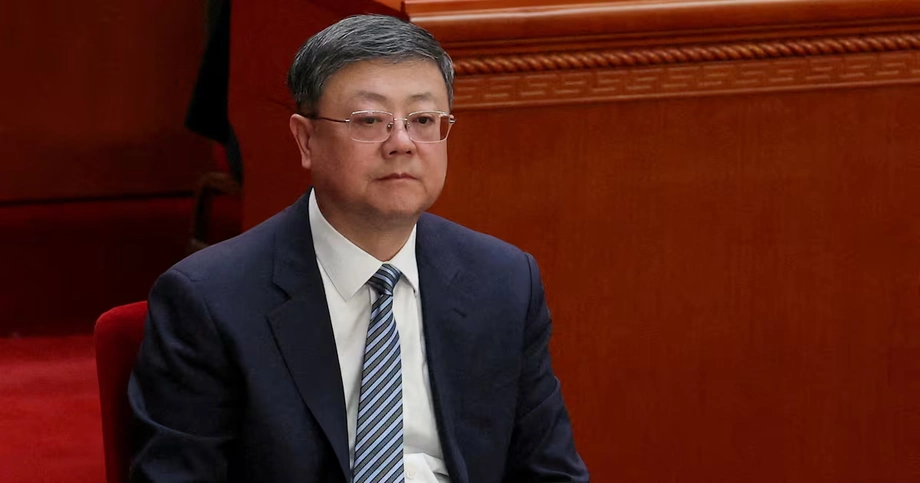
China's top anti-corruption bodies have placed Chen Jining, the Communist Party secretary of Shanghai and a member of the Politburo, under investigation, pulling one of the country's most prominent technocrats out of public view less than a year before a party congress expected to reset the leadership's top ranks.
Contents
- What Beijing said, and what it did not
- A scientist who climbed to the top of Chinese politics
- Why the Shanghai job no longer guarantees a way up
- Four Politburo members in a single term
- Shock on Weibo and in the seminar room
- Loyalty, expertise and a decade in Britain
- The succession question nobody can answer
- Foreign business counted Chen as an ally
- The 2006 precedent
- Key Points
The Xinhua News Agency announced late on Nov. 24 that Chen, 62, was suspected of "serious violations of discipline and law" and was being investigated by the Central Commission for Discipline Inspection and the National Supervisory Commission. The phrase is the standard formula Beijing uses in corruption cases, and no allegations, evidence or sums of money were disclosed. The two bodies work side by side: the commission enforces party discipline and the supervisory commission applies state law, and senior officials are usually examined by both at once.
Chen is the fourth member of the Politburo, which has 24 members, to be investigated since the body was elected in October 2022. The others were Xinjiang party chief Ma Xingrui and the two military leaders Zhang Youxia and He Weidong, and all three have since been expelled from the party. Chen is the first serving Shanghai party secretary to face a probe since Chen Liangyu in 2006, a case that ended with expulsion and 18 years in prison.
Shanghai's party secretary runs the country's financial capital and holds one of the most powerful regional posts in China. Eight former holders of the job were promoted to the Politburo Standing Committee over nearly four decades, according to Reuters. Xi held the post briefly in 2007 before joining the Standing Committee, as did former president Jiang Zemin and former premier Zhu Rongji. Chen's predecessor, Li Qiang, is now premier and sits on that committee, the party's most powerful body with seven members.
What Beijing said, and what it did not
Authorities have not disclosed the allegations against Chen, announced his removal from office or named a successor. Reuters reported that Chen could not be reached and that his whereabouts were unknown, and he has made no public statement.
Hours after the announcement, Shanghai's Communist Party Standing Committee held an expanded meeting that declared its "firm support for the decision of the Party Central Committee", according to a front page report in Jiefang Daily, the newspaper of the city's party branch. The paper said the city's leaders called for political discipline to come first and for central directives to be carried out. The committee said the case sent a strong signal that "the anti-corruption campaign will not pause or retreat, and that the fight against corruption is a protracted, all-encompassing battle".
A day later, Taiwan's Central News Agency asked about the case at the regular briefing of the Taiwan Affairs Office, Beijing's agency for relations with Taiwan. Spokeswoman Zhang Han tied the investigation to the leadership's discipline drive rather than to any change of policy toward the island.
The relevant news about Chen Jining has been released, and this fully reflects the firm determination of the party central committee with Comrade Xi Jinping at its core to persevere in advancing full and strict governance of the party.
Zhang said Beijing would keep supporting exchanges between the two sides, including the Taipei-Shanghai City Forum, which she described as an important institutional channel between the two cities that has played a positive role in cooperation. Shanghai is one of the mainland's main centres for work involving Taiwan, and whether the forum would proceed had been an open question in Taipei since the announcement.
A scientist who climbed to the top of Chinese politics
Chen was born in 1964 and built his career in environmental science rather than in the party apparatus. He earned a doctorate from Imperial College London in 1992 and spent about a decade in Britain studying and researching, a background that set him apart from nearly every other official of his generation. He returned to China and rose through Tsinghua University, Xi's alma mater, becoming its president in 2012.
He entered government in 2015 as minister of environmental protection, at a moment when Xi was making pollution control and ecological protection signature priorities. He became mayor of Beijing in 2017, oversaw the capital's preparations for the 2022 Winter Olympics and appeared at the closing ceremony of the 2018 Winter Paralympics in South Korea carrying the Paralympic flag. He joined the Politburo in 2022 and was appointed Shanghai party secretary that October, replacing Li Qiang.
Diplomats described him as charismatic, charming and personable, at ease with both Chinese officials and foreign counterparts. Analysts long treated him as a strong contender for the Standing Committee. Taisu Zhang, a professor at Yale Law School who studies Chinese law and politics, wrote that the case was "arguably the biggest political news to come out of China in a few years" and noted that Chen had been seen as "a near-lock for the politburo Standing Committee".
Why the Shanghai job no longer guarantees a way up
The route from Shanghai to the top has been treated for years as a reliable guide for diplomats trying to read Beijing's intentions. Wen-Ti Sung, a nonresident fellow at the Atlantic Council's Global China Hub, said that guide has stopped working.
There is no more straight-forward pathway from Shanghai party secretary to the Politburo Standing Committee.
Sung said political loyalty has become the main criterion for promotion. A senior Asian diplomat said Xi is "clearing the ground" before the congress by sweeping aside entrenched political customs and older networks to build a leadership line up that is more closely aligned with him.
Mao Shoulong, a professor of public administration and policy at Renmin University of China, wrote in a commentary on WeChat that the case carries a meaning beyond one man's fate. Chen, he wrote, was "an exemplar of someone who rose from the specialised field of environmental protection to the pinnacle of political power".
His downfall, therefore, is not merely that of an individual, but of an entire type of official, a model of political advancement, and a set of assumptions about the relationship between technology and politics, expertise and power, and competence and loyalty.
Four Politburo members in a single term
Chen's case is the latest in a run of investigations that has reached the innermost circle of the party. The sequence began with military leaders and a regional chief before moving to Shanghai:
- Zhang Youxia and He Weidong, both vice chairmen of the Central Military Commission, were investigated and later expelled from the party.
- Ma Xingrui, the party secretary of Xinjiang, was investigated and expelled.
- Chen Jining, the party secretary of Shanghai, was placed under investigation on Nov. 24, 2026.
The pace has no modern parallel. At the party's Fifth Plenum in October, leaders announced the expulsion of 33 Central Committee members, the largest such purge at a single plenum since the reform and opening period began in 1978. The same gathering put political loyalty at the centre of the agenda and vowed to keep removing what the party calls impurities and viruses from its ranks before the congress.
Xi framed the campaign in a speech in January. "No matter who they are, how high their position, or how great their contributions, anyone who engages in corruption will surely receive no leniency," he said.
Jean Christopher Mittelstaedt, a China expert at the University of Zurich, said the Chen case showed the drive was not slowing. "It sends a signal that there's no letting up in the anti-corruption drive and the party's 'self-revolution'," he said. "If anything, it continues to intensify."
Neil Thomas, an honorary senior fellow on Chinese politics at the Asia Society Policy Institute, described the investigation as the latest step in that campaign, the party's term for strict internal discipline. "Xi believes strict internal discipline is essential to transform the CCP into an effective self-regulating institution that avoids the fate of the Soviet Union and escapes China's historical cycle of rising and falling dynasties," he wrote on X.
Shock on Weibo and in the seminar room
The hashtag "Chen Jining under investigation" had drawn about 240 million views on Weibo by the following morning, with many users writing that they were "shocked" and "stunned" under posts from state media. The surprise came partly from the timing. Chen was last seen in public the previous week, holding separate meetings with the Chinese shipping group COSCO and with the chairman of the Swiss pharmaceutical firm Roche, according to state media. Senior officials usually vanish from view for long stretches before an investigation is announced.
Analysts also struggled to find a pattern. Sung said the case did not fit the usual categories of purge. "Chen's purge is particularly shocking in that he poses no military threat, and doesn't deviate from Xi on major symbolic issues like ethnic policy," he said. "But he got purged anyway, so far without even an explanation. The shock is bound to reverberate."
Loyalty, expertise and a decade in Britain
Akio Yaita, executive director of the Taipei-based Indo-Pacific Strategy Think Tank, said Chen had been regarded as a technocrat who kept a low public profile and had close ties to Xi, which made the case harder to explain. He pointed to Chen's long stay in Britain and his fluent English, which made him one of the leadership figures most familiar with Western ways of working.
At a time when Xi is turning China inward and putting distance between Beijing and Western capitals, in Yaita's reading, an official seen as close to the West can raise suspicion. Yaita said another open question is whether the investigation stops with Chen or reaches other Shanghai officials who worked with him.
Yang Jianli, founder of the group Citizen Power Initiatives for China, which is based in the United States, told VOA that anyone seen as a possible successor to Xi can become a target. "Xi Jinping cannot allow another center of power to emerge while he is trying to extend his rule and accomplish his political ambitions," Yang said.
The succession question nobody can answer
Xi has already broken with the practice of limiting leaders to two terms of five years each, and he is widely expected to seek a fourth term as party chief at the 21st National Congress in the second half of 2027. Chen's removal has revived attention to who might follow, a question the party has never answered in public.
Veteran journalist Fang Fei, speaking on the sidelines of a press conference in Taiwan, said there had been few public signs that Chen was under scrutiny before the announcement. She said successive investigations into senior officials could reflect internal competition for power, and that the opacity of how the party makes decisions makes it hard to judge who else might be implicated or whether rival factions were involved.
Cheng Xiaonong, an economist based in the United States, said in an earlier interview that the concentration of power in one leader, in place of the party's older model of collective leadership, has made succession harder to manage. The more power gathers at the top, he said, the more a departing leader may fear retribution, while naming a successor early risks letting that person build an independent base.
Tzeng Wei-feng, an associate research fellow at National Chengchi University's Institute of International Relations in Taiwan, said personal trust is likely to weigh more than professional record when the congress fills senior posts. He said the investigations into four Politburo members should be read alongside the Fifth Plenum's call for stronger oversight and sustained pressure in the anti-corruption campaign, and that the expanded powers of discipline authorities have given Beijing more leverage over local governments.
From this perspective, we can assess that those who remain in office are likely to be members of Xi's inner circle, such as Cai Qi, as well as those holding lower-risk positions, such as Wang Huning.
Cai Qi, a former mayor of Beijing, is director of the party's General Office. Wang Huning chairs the National Committee of the Chinese People's Political Consultative Conference, an advisory body. Tzeng said Shanghai's swift public pledge of support for the investigation suggested local officials would align themselves more closely with Beijing's line.
Foreign business counted Chen as an ally
Chen's time in Shanghai was closely watched by foreign investors, who had found the city harder to navigate since the coronavirus pandemic. An official with a European firm in the city said Chen told district officials to rebuild Shanghai's image, and that districts became bolder about trying new and striking things as a result.
French luxury group LVMH opened The Louis, a retail and exhibition pavilion shaped like a cruise ship on West Nanjing Road, a project widely read as a sign of foreign investor confidence in the city. Chen also championed artificial intelligence in both Beijing and Shanghai, and his final public engagements were with COSCO and Roche.
The 2006 precedent
The last Shanghai party secretary to be investigated was Chen Liangyu, whose case began in 2006. He was found to have misused funds, was expelled from the party and served 18 years in prison. The two cases share a job title and little else: Chen Liangyu was a local politician who had spent his career in Shanghai, while Chen Jining arrived from Beijing after a career in science and national government.
Yaita said Shanghai has historically had a difficult relationship with the central leadership even as it served as a launch pad for officials headed to Beijing. The city's response this week, a meeting held late at night and a front page pledge of loyalty, followed the pattern of local leaderships moving quickly to show where they stand.
Key Points
- Chen Jining, 62, the party secretary of Shanghai and a Politburo member, is under investigation for "serious violations of discipline and law", Xinhua announced on Nov. 24, 2026.
- The Central Commission for Discipline Inspection and the National Supervisory Commission are handling the case. No allegations, no removal from office and no successor have been announced, and Chen's whereabouts are unknown.
- He is the fourth of the 24 Politburo members elected in 2022 to be investigated, after Ma Xingrui, Zhang Youxia and He Weidong, all since expelled.
- The last serving Shanghai party secretary to be investigated was Chen Liangyu in 2006, who was expelled and served 18 years in prison.
- Trained as an environmental scientist with a doctorate from Imperial College London, Chen was president of Tsinghua University, environment minister and Beijing mayor before taking the Shanghai post in October 2022.
- Shanghai's party leadership held a late meeting to pledge loyalty to the Central Committee, and the Taiwan Affairs Office said the Taipei-Shanghai City Forum would continue.
- The investigation lands before the 21st National Congress in the second half of 2027, when Xi is widely expected to seek a fourth term.
- The hashtag about the case drew about 240 million views on Weibo by the next morning.