Motor Power Will Still Decide the Annual Bill
Malaysia's Transport Ministry has rejected a proposal to broaden the road tax formula for electric vehicles, confirming that motor power will remain the deciding factor. In a written parliamentary reply dated 25 November 2026, the ministry said the revised Motor Vehicle Licence (LKM) rates that took effect on 1 January were, on average, 85 per cent lower than those for petrol and diesel vehicles.
Contents
- Motor Power Will Still Decide the Annual Bill
- What Does the 85 Per Cent Figure Mean?
- From Budget 2022 to the First Paid Renewals
- How Does the Base and Block Formula Work?
- What Will Popular Models Pay?
- Why Did the Ministry Reject Wider Criteria?
- What Should Owners Check Before Renewal?
- How Does Home Charging Fit Into the Decision?
- Key Points
Deputy Transport Minister Datuk Hasbi Habibollah gave the same explanation in Parliament. He said the lower rates were intended to encourage motorists to choose vehicles that produce no carbon emissions and to support cleaner transport in Malaysia.
A Proton e.MAS 5 Prime rated at 58 kW will pay RM30 a year under the new schedule, while a Porsche Taycan Turbo GT producing 760 kW will pay RM6,715. The wide gap illustrates the policy that will remain in place: a more powerful motor generally brings a higher bill, irrespective of whether a legislator considers the vehicle's segment, prestige or performance to be a better measure.
Transport Ministry figures show that 174,686 electric vehicles had been registered nationwide by 31 August 2026. Passenger cars accounted for 130,229 of them, or 74.6 per cent. Subtracting that figure leaves 44,457 registrations in other categories, although the parliamentary reply did not itemise them. The policy therefore affects a substantial and growing fleet after several years in which an exemption kept many owners from seeing road tax charges on their renewals.
The LKM is the licensing charge commonly called road tax. Its wider legal framework sits in the Road Transport Act 1987. The ministry's answer leaves the present structure unchanged rather than proposing an amendment or a new formula.
What Does the 85 Per Cent Figure Mean?
The 85 per cent figure has been used in two different comparisons. The November 2026 parliamentary reply uses it for the average difference between the new electric vehicle rates and rates for vehicles with internal combustion engines. When the replacement structure was announced in June 2024, however, the same percentage described the average reduction from the previous electric vehicle rates. A detailed calculation guide published at that time put the average saving at 70 per cent against the outgoing electric vehicle calculation.
The ministry did not explain in its November reply how it compared motor power in kilowatts with engine capacity in cubic centimetres, or which vehicles were included in its average. Those are different physical measures: cubic centimetres describe the volume swept by an engine's pistons, while kilowatts describe how quickly a motor can deliver power. A motorist's own bill comes from the power band and block calculation, not from the national average.
EVGuru's model guide, which attributes its figures to official 2026 licence pricing for zero emission vehicles, provides more concrete comparisons. Its estimated savings against petrol equivalents range from 70 per cent for the Proton e.MAS 7 to 95 per cent for the Proton e.MAS 5 Prime. Other listed examples include 75 per cent for the BYD Dolphin, 80 per cent for the Tesla Model 3 RWD and 90 per cent for the front wheel drive Denza D9.
From Budget 2022 to the First Paid Renewals
Budget 2022 began the sequence that led to the current bills. Electric vehicles received a road tax exemption while the government prepared a replacement for an older calculation that had first been determined in 2019.
- 2019: The earlier electric vehicle road tax structure was determined.
- 1 January 2022: The exemption outlined in Budget 2022 began.
- 4 June 2024: The Transport Ministry announced the replacement schedule based on motor output, with rates arranged across 11 power groups.
- 31 December 2025: The electric vehicle road tax exemption ended.
- 1 January 2026: The revised rates took effect.
- 25 November 2026: The ministry confirmed in its written reply that motor power would remain the basis of the system.
The long exemption helps explain why some owners may have been unfamiliar with the outgoing calculation. Although an older schedule existed, many drivers did not encounter its full cost while their licences were exempt. The rates announced in 2024 are now appearing in annual renewal costs.
The 2024 announcement also said the power-based method would remain for at least five years and that rates would be reviewed every five years. That timetable points to the next review around 2029, roughly three years after the latest parliamentary reply. No exact review date was given.
How Does the Base and Block Formula Work?
A kilowatt equals 1,000 watts, so a motor rated at 150,000 watts appears as 150 kW in most vehicle guides. Motor power is also different from battery capacity. Power concerns how quickly the motor can do work, while battery capacity, measured in kilowatt hours, concerns how much energy the vehicle can store.
The Transport Ministry described the division between electric and combustion vehicles in its reply.
Currently, the road tax or LKM rate for a private vehicle with an ICE is based on total engine capacity (cubic centimetres). For electric vehicles, motor power (watts) is used to determine the LKM rate, and this rate increases in line with electric motor power.
Each electric vehicle first falls into a power group. A base charge covers the first part of that group, and a fixed amount is then added for every started block of roughly 10 kW. The word started matters: even a small amount of power entering another block triggers that block's full increment.
- Up to 100 kW: the base is RM20, followed by RM10 increments, with the group capped at RM70.
- Above 100 kW and up to 210 kW: the base is RM80, followed by RM20 increments, with a cap of RM280.
- Above 210 kW and up to 310 kW: the base is RM305, followed by RM30 increments, with a cap of RM575.
- Above 310 kW and up to 410 kW: the base is RM615, followed by RM50 increments, with a cap of RM1,065.
Proton's two locally relevant examples show the arithmetic clearly. The e.MAS 5 Prime produces 58 kW. The RM20 base covers output through 50 kW, and its remaining 8 kW starts one additional block. The result is RM20 plus RM10, or RM30. The BYD Dolphin Standard Range produces 70 kW and crosses two additional blocks, giving RM20 plus two increments of RM10, or RM40.
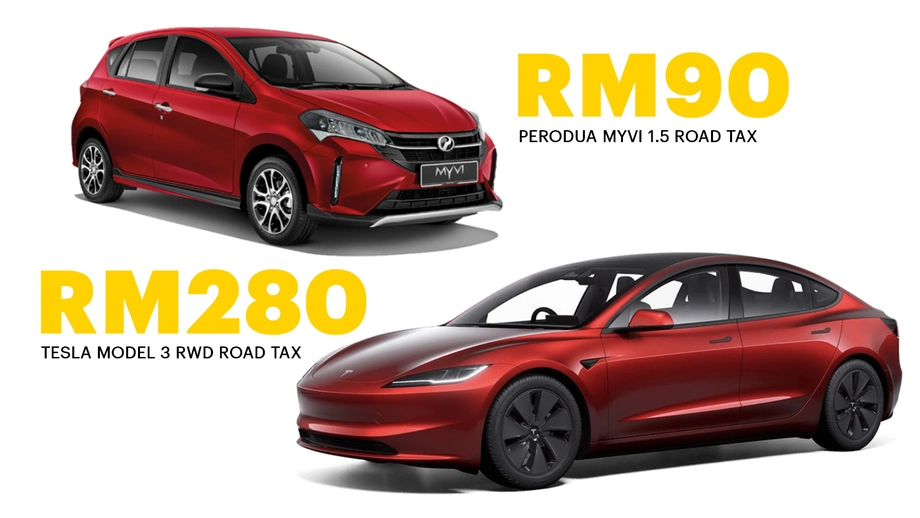
The Proton e.MAS 7 produces 160 kW and sits in the second group. Its RM80 base covers output through 110 kW. The remaining 50 kW creates five blocks, each costing RM20, so the total is RM180. A Tesla Model 3 RWD, assessed by the Transport Ministry at 208 kW, reaches RM280 after the RM80 base and ten increments of RM20.
What Will Popular Models Pay?
EVGuru's model table shows both the annual charge and, where supplied, its estimated saving against a petrol equivalent. These figures make the practical effect of the power bands easier to see than a national average.
- Proton e.MAS 5 Prime: 58 kW and RM30 annually, with an estimated saving of 95 per cent.
- BYD Dolphin Standard Range: 70 kW and RM40 annually, with an estimated saving of 75 per cent.
- BYD Atto 3: 150 kW and RM160 annually, with an estimated saving of 75 per cent. The same RM160 charge applies to the 150 kW Chery Omoda E5 and BYD Dolphin Extended Range.
- Proton e.MAS 7: 160 kW and RM180 annually, with an estimated saving of 70 per cent.
- Tesla Model 3 RWD: 208 kW and RM280 annually, with an estimated saving of 80 per cent.
- Denza D9: RM335 for the 230 kW front wheel drive version and RM485 for the 275 kW all wheel drive version. The guide estimates savings of 90 and 85 per cent respectively.
- Tesla Model Y: RM915 for the 378 kW Long Range version driving all four wheels, and RM1,015 for the 393 kW Performance version. Both listed savings are 75 per cent.
Higher outputs produce steeper bills because later groups have larger base charges and increments. The BMW iX xDrive50 produces 385 kW. It starts with the RM615 base for its group and adds seven increments of RM50, producing an annual total of RM965. The same RM965 figure applies to other models whose calculations land at the same point, including the 390 kW BYD Seal Performance.
The Porsche Taycan Turbo GT sits much further up the schedule. Its RM6,715 charge comes from a RM5,715 base and four increments of RM250. Under the outgoing electric vehicle calculation, its bill would have been RM17,494. The new amount is RM10,779 lower, a reduction of about 62 per cent. A separate comparison supplied with the model calculations put road tax for a W204 Mercedes-Benz C63 at RM16,566, showing how unusual the very top of the performance market can be.
Why Did the Ministry Reject Wider Criteria?
Mohd Azizi Abu Naim, the independent MP for Gua Musang, asked whether the government would restructure electric vehicle road tax by considering vehicle segment, prestige and performance rather than relying on motor capacity alone. His question raised a familiar issue for buyers: should a prestigious or expensive vehicle pay more even when its rated motor output is modest?
The ministry answered that more powerful electric vehicles generally cost more to buy and are larger and heavier. It treated motor output as a workable proxy for those characteristics under the current structure.
Therefore, motor power is used as the basis for determining EV LKM rates.
The ministry also pointed to the work behind the schedule when explaining why it would remain.
The existing LKM structure was determined based on a comprehensive study that has been conducted.
Datuk Hasbi Habibollah also raised the possibility that the government could consider a more comprehensive calculation in the future, taking account of vehicle categories and market position. His immediate answer nevertheless preserved the existing system, and no date or replacement formula was announced. For buyers now comparing two vehicles, showroom price and brand prestige do not create separate road tax additions; their rated outputs and positions in the power bands determine the annual charge.
What Should Owners Check Before Renewal?
JPJ records provide the starting point for an accurate calculation. Guidance for the 2026 system says the rated power appears on the electronic vehicle ownership certificate, known as the e-VOC, and through the MyJPJ portal. This is especially useful when a manufacturer does not prominently publish the figure. Tesla, for example, did not list the Model 3 RWD's output on its website in the material examined for the model calculations, while the Transport Ministry used 208 kW.
Vehicles with more than one motor are assessed on their total combined output. A vehicle with two motors rated at 150 kW each is therefore assessed at 300 kW, rather than receiving two separate calculations for 150 kW. This can move a vehicle into a group with a higher base and larger increments.
A guide to the 2026 rules also lists a 50 per cent reduction for electric vehicles in Langkawi, Pangkor and Labuan when motor output exceeds 100 kW. The Transport Ministry's parliamentary reply did not set out the eligibility details for that reduction. Owners relying on it should confirm their registration category and renewal amount with JPJ before budgeting.
How Does Home Charging Fit Into the Decision?
Home charging uses kilowatts as well, but a charger rating does not enter the road tax formula. Motor output determines the LKM bill, while the charger rating describes how quickly electricity can be supplied to the vehicle. Battery capacity, measured in kilowatt hours, determines how much energy can be stored.
EVGuru recommends a 7.4 kW smart wallbox for models including the Proton e.MAS 5, BYD Dolphin and BYD Atto 3. It lists 11 kW chargers for vehicles including the Proton e.MAS 7, Tesla Model 3 and Tesla Model Y, subject to the premises having a suitable electrical supply. For the Denza D9, including a version with a 103 kWh battery, it recommends a 22 kW wallbox.
Its installation guidance also calls for a Type B residual current device, which protects against dangerous current leakage including direct current leakage, for private and shared installations. Load management is recommended for terrace houses so charging does not overload the main supply during periods of high household demand. Surge protection is recommended to shield the vehicle's charging electronics from lightning-related power spikes. These measures affect installation cost, safety and charging convenience, while the LKM figures remain an annual licensing expense.
Key Points
- The Transport Ministry will keep electric vehicle road tax based on motor power, rejecting wider criteria covering segment, prestige and performance.
- The ministry says rates effective from 1 January 2026 average 85 per cent below those for petrol and diesel vehicles, although it did not explain the comparison method in its reply.
- The same 85 per cent figure was used in 2024 for average savings over the previous electric vehicle rates, while another calculation at that time gave 70 per cent.
- Malaysia had 174,686 registered electric vehicles by 31 August 2026, including 130,229 passenger cars.
- Annual examples range from RM30 for the Proton e.MAS 5 Prime and RM40 for the BYD Dolphin to RM280 for the Tesla Model 3 RWD and RM6,715 for the Porsche Taycan Turbo GT.
- The road tax exemption ran from 1 January 2022 until 31 December 2025, and the replacement schedule was announced in June 2024.
- Vehicles with multiple motors are taxed on combined output, and owners can check their rated power through their e-VOC or MyJPJ.
- The review timetable described with the 2024 announcement points to around 2029, but no exact date for the next review was given.