A national selection returns with 154,052 posts
Indonesia opens registration for 154,052 civil servant posts on 27 November 2026, the first nationwide CPNS selection since 2025 passed without one. Administrative and Bureaucratic Reform Minister Rini Widyantini announced the figure at a press conference at her ministry in Jakarta on Wednesday, 25 November 2026, after the National Selection Committee, known as Panselnas, met in plenary session.
Contents
- A national selection returns with 154,052 posts
- Forestry takes almost half of the quota
- Fewer documents to upload
- A 2024 test score can still be used
- Contract teachers and a maximum age of 35
- The legal footing and the fiscal limit
- From registration to an employee number in June
- What the selection asks of applicants
- Key Points
The national selection committee agreed on the recruitment of national priority civil servant candidates for 2026 totaling 154,052 positions.
CPNS stands for calon pegawai negeri sipil, or candidate civil servant. People who pass the selection become CPNS and are confirmed as full civil servants after a probation period. Applications go only through the SSCASN portal at sscasn.bkn.go.id, the online application system run by the National Civil Service Agency (BKN), and the window closes in early December 2026.
Officials had signalled a November opening earlier in the month, when the Supreme Court set out a request for 4,430 staff, made up of 1,600 prospective judges and 2,830 CPNS posts. The justice cluster now holds 19,016 of the posts announced this week.
Forestry takes almost half of the quota
Rini split the 154,052 posts into two groups. The first is 118,208 posts for the Quick Wins programme, known in Indonesian as Program Hasil Terbaik Cepat, and other programmes the president has designated as priorities. The second is 35,844 posts for other national priority sectors.
The Quick Wins group breaks down by field as follows:
- Forestry: 70,000 posts
- Lecturers and higher education technical staff: 26,614
- Health workers: 13,362
- Teachers and education personnel: 3,621
- Government internal audit: 2,007
- Nutrition services: 1,618
- Cooperative supervision: 986
Forestry alone accounts for 45% of everything on offer. Health workers and teachers together add up to 16,983 posts, about a quarter of the forestry allocation. The higher education line appeared as 26,214 in a schedule published alongside the announcement, against 26,614 in the breakdown the minister read out.
The second cluster covers the sectors the government classes as national priorities beyond that programme:
- Law, human rights, judiciary and corrections: 19,016 posts
- Statistics and development data: 7,285
- Food self sufficiency and the blue economy: 4,496
- Revenue and financial supervision: 2,867
- Building a superior national generation: 1,395
- Security, cyber and diplomacy: 785
Rini directed applicants to the SSCASN portal for the detail that matters most to them: how many posts each agency holds, what the positions are called and which qualifications each one requires.
Details of posts per agency, position and qualification can be seen on the official SSCASN portal from BKN.
Fewer documents to upload
BKN head Zudan said the document list has been cut back. An application letter and a separate statement letter, both required in 2024, are now one uploaded file.
In 2024 the documents were many, and we simplified them. There used to be an application letter and a statement letter; now they are combined and the application letter is enough. The statement is merged into the application letter, so only one document is uploaded.
A diploma no longer needs to be uploaded. A transcript takes its place, because it carries both the study programme and the grades, and some positions set minimum grade requirements.
There used to be a transcript and a diploma; now attaching the transcript is enough. Why the transcript? Because it already contains the study programme and the grades, since there are grade requirements for certain positions.
Passport photographs have also left the upload list. Asked about the photo requirement, Zudan was direct.
No more. We are making many simplifications to the document requirements.
Stamp duty on the statement may be paper or digital, and the signature may be handwritten, ordinary or digital. Those two choices matter to applicants in districts where a stamp office or a notary is hours away, and they remove one of the most common reasons a file is rejected before it is ever read.
The tests will run at the 36 BKN offices and at about 107 additional locations, an expansion aimed at candidates far from the cities where computer based testing already operates.
Around 107 new points were added to give easier access to colleagues who are far from BKN offices. In this selection system we have also opened online access. I ask participants to open their accounts early.
A 2024 test score can still be used
Candidates who sat the basic competency test, the SKD, in 2024 may carry that score into the 2026 selection instead of sitting the test again. Rini set one condition: the score can only be used for the same level of education.
Applicants for CPNS can use the SKD they obtained in the previous selection in 2024. It may be used with the same level of education.
The choice is exclusive. A candidate who uses the 2024 score cannot sit the 2026 test, and a candidate who sits the 2026 test loses the 2024 result, which covers one recruitment period only.
If an applicant chooses to use the 2024 SKD score, they cannot take the 2026 SKD.
The 2026 test runs on BKN's Computer Assisted Test system, with face recognition at the workstation and a score shown live on screen. The design removes the interval in which a result could otherwise be altered between the exam room and the announcement.
The exam uses CAT from BKN, equipped with face recognition and scores that appear live, so participants can see their score at that moment, which makes the result transparent and impossible to change.
Reusing an old score saves a candidate one trip to a test centre and one day of exams, but it also fixes the result before the new cycle begins. Anyone who believes a fresh sitting would produce a better score has to weigh that against losing the 2024 number entirely.
Contract teachers and a maximum age of 35
Teachers on PPPK contracts, the government's agreement based employment route, may enter the CPNS selection if they meet the standard age window of 18 to 35 years. Rini said the rule covers them.
PPPK teachers can take part in the selection if they meet the age requirement for CPNS applications, which is a maximum of 35 years under the applicable laws and regulations.
Zudan extended the opening to contract staff who already hold an employee number, including those on full time and part time PPPK terms.
For those who already hold an employee number from the PPPK route and part time PPPK, they may register in this selection in line with the applicable requirements and provisions.
Education Minister Abdul Mu'ti had described a wider door the same day. Speaking at the National Teachers Day ceremony at the Ministry of Primary and Secondary Education in Central Jakarta on 25 November 2026, he said teachers on PPPK contracts could sit the CPNS examination for teaching posts with no age ceiling at all, as part of efforts to improve teacher welfare.
PPPK teachers can take the CPNS test to become teachers without an age limit.
How a route without an age limit for teachers fits the 35 year maximum Rini cited has not been set out. The two statements were made at separate events on the same day, and neither came with a published implementing rule for the teacher stream.
The legal footing and the fiscal limit
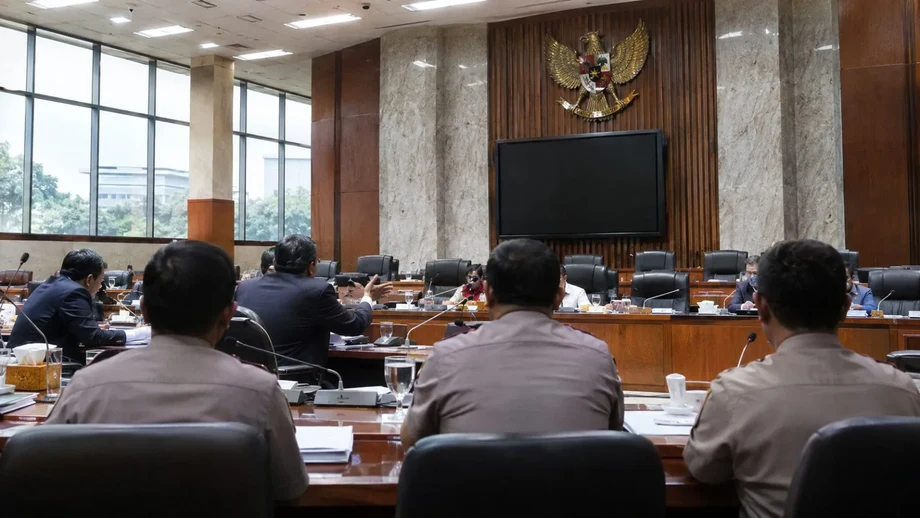
The quota and the calendar rest on Presidential Decree Number 7 of 2026, Keppres Nomor 7 Tahun 2026, and on a plenary decision of Panselnas taken with the Finance Ministry, the government internal audit body BPKP, BKN, the national research agency BRIN and the cyber and cryptography agency BSSN. The numbers also follow an agreement between the government and the House of Representatives on 6 November 2026 and a working meeting on 23 November 2026.
Rini tied the size of the intake to the budget, and credited the financial authorities with keeping the recruitment inside what the state can pay for.
Panselnas agreed on the recruitment of national priority civil servants for 2026 totaling 154,052 positions while maintaining fiscal health.
The committee's stated commitments include a process that is competitive, fair, objective and transparent, free of corruption, collusion and nepotism, and free of charge to applicants. Rini also listed the readiness work behind the opening: a shorter registration process, test material for general competencies and for competencies specific to each position, security and reliability of the computer based test, infrastructure and networks, and a complaints channel that answers applicants during the registration window.
From registration to an employee number in June
BKN's schedule runs to about 181 days from the opening of registration to appointment. The steps:
- 27 November 2026: registration opens on the SSCASN portal and closes in early December 2026.
- First week of December 2026: administrative selection begins, covering the announcement of results, the objection and response period, and the announcement that follows objections, scheduled for January 2027.
- January 2027: mapping of test locations and scheduling for the SKD.
- February 2027: SKD testing, scoring and the announcement of results.
- March 2027: location mapping and venue announcements for the field competency test, the SKB.
- March to April 2027: SKB in computer based form and in other formats, integration of scores, results and the objection period.
- From May 2027: appointment as CPNS.
- 1 June 2027: issue of the employee number, the NIP, for candidates who pass.
The administrative stage closes before the tests begin, so a missing document in December ends a candidacy months before anyone sits an exam. The objection windows in January and again in April are the two moments when a candidate can challenge a result, and both fall inside fixed periods rather than staying open on request.
What the selection asks of applicants
The calendar leaves little room for late decisions. Rini asked candidates to register early and read the requirements closely instead of queueing on the final days, when portal traffic peaks and a missing file has no time to be repaired.
If possible, prospective applicants should fill in early, read the requirements carefully and not wait for the last days to register.
The extra test sites matter most to candidates outside the cities where BKN already runs CAT centres, because the SKD is taken at an assigned venue on an assigned date rather than at home. Zudan asked participants to open their portal accounts before registration opens, so that identity checks and document uploads are not compressed into the first hours of the window.
Competition figures are not yet public. The government has not said how many people it expects to apply, and the number of posts at each agency, with the qualifications attached to each, will appear on the portal around the opening. How the 19,016 justice posts divide between the courts, the corrections service and the ministry's other units has also not been published.
Two numbers frame the season for applicants. The first is 70,000, the forestry allocation that is larger than every other field combined except higher education, and which will be filled from however many graduates in forestry, environmental and related studies apply. The second is 181 days, the distance between a form submitted in late November and an employee number issued on 1 June 2027.
Key Points
- Registration for 154,052 CPNS posts opens on 27 November 2026 through sscasn.bkn.go.id and closes in early December.
- Forestry holds 70,000 posts, 45% of the total, followed by 26,614 for lecturers and higher education technical staff and 13,362 for health workers.
- The 118,208 posts under Quick Wins and presidential priorities sit alongside 35,844 in other priority sectors, including 19,016 for law, human rights, judiciary and corrections.
- An application letter and statement are now one upload, the diploma is replaced by a transcript, and no passport photo is required.
- Candidates may reuse a 2024 SKD score at the same education level, but must choose between that score and sitting the 2026 test.
- PPPK teachers and other contract staff holding an employee number may apply within the 18 to 35 age window, while the education minister has said teachers face no age limit.
- SKD testing falls in February 2027, SKB in March and April, appointment from May, and the NIP on 1 June 2027.