Nine Months of Books, Scaled to a Full Year
Indonesia's state investment body, Badan Pengelola Investasi Daya Anagata Nusantara, booked a consolidated net profit of Rp203.4 trillion for the nine months from April to December 2025, the period covered by its audited accounts. Stretched to a full year at the same pace, the figure becomes Rp259.6 trillion, the number its chief executive placed at the centre of a briefing in Jakarta.
Contents
- Nine Months of Books, Scaled to a Full Year
- From Revenue to Net Profit, Line by Line
- What the Auditor's Opinion Means
- A Thousand Companies in One Report
- What Danantara Hands Back to the State Budget
- Assets, Equity and the 8.7% Return
- Borrowing Capacity and Where the Money Came From
- Two Executives Leave the Room
- Key Points
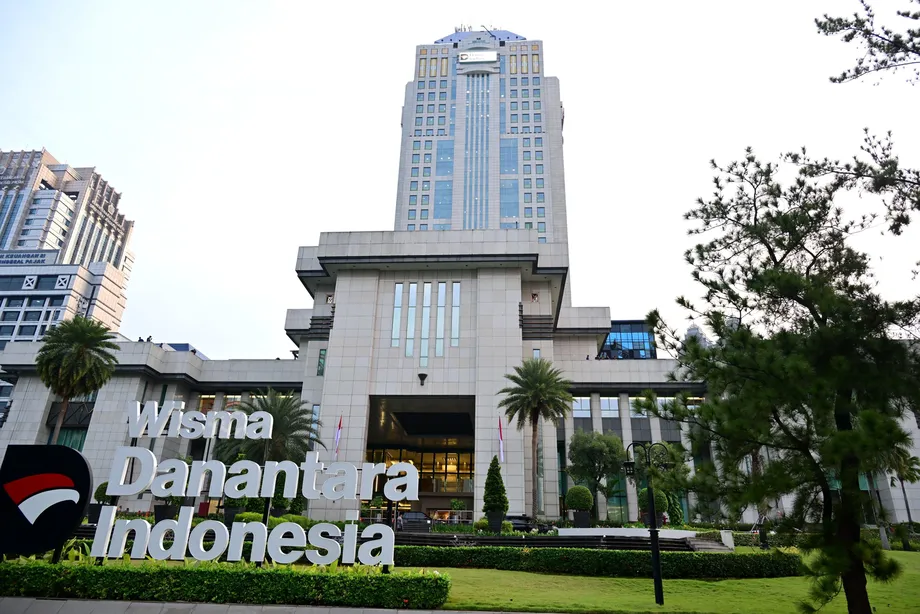
The fund is better known as Danantara. It was launched in March 2025 to hold the state's stakes in state firms and to invest on the country's behalf, the role sovereign wealth funds play elsewhere. Chief executive Rosan Roeslani presented the accounts at Wisma Danantara in Jakarta on Wednesday, 25 November 2026, hours after the national audit agency signed off on them.
Annualizing means scaling a partial period up to twelve months at the same monthly rate. It is a yardstick rather than cash the fund collected during 2025, and officials used it to show what a full year of work would look like for a body that only started operating in March. Rosan gave reporters both figures side by side.
If we look at these numbers, let me start with the first nine months, net profit of Rp203.4 trillion, from April to December 2025. And if it is annualized, for a full 12 months, it is Rp259.6 trillion.
The group behind the headline runs from finance to infrastructure, telecommunications and services. Its managers describe the report as the largest consolidation of its kind ever assembled in the country, and the reason the numbers reached the public in late November 2026 rather than earlier in the year.
From Revenue to Net Profit, Line by Line
Revenue for the 12 months came to Rp3,073.0 trillion. For the audited nine months it was Rp2,385.2 trillion. The results, as presented at the briefing:
- Revenue: Rp3,073.0 trillion for 12 months, Rp2,385.2 trillion for nine months
- EBITDA: Rp704.7 trillion and Rp552.5 trillion
- Operating profit: Rp520.1 trillion and Rp390.4 trillion
- Profit before tax: Rp367.4 trillion and Rp292.7 trillion
- Net profit: Rp259.6 trillion and Rp203.4 trillion
EBITDA stands for earnings before interest, tax, depreciation and amortization, a rough gauge of the cash a business throws off before financing costs and accounting charges. Danantara's Rp704.7 trillion on that measure compares with Rp520.1 trillion of operating profit, a gap of Rp184.6 trillion that reflects depreciation and amortization across ports, toll roads, power plants and other assets with long working lives.
Below the operating line, Rp152.7 trillion of financing and other costs separate operating profit from the Rp367.4 trillion booked before tax, and about Rp107.8 trillion of tax and similar charges separate that figure from the Rp259.6 trillion of net profit. Net profit equalled about 8.4% of revenue for the 12 months and about 8.5% of revenue for the nine audited months, so the annualized figure carries almost the same share of profit per rupiah of sales as the audited record.
What the Auditor's Opinion Means
Badan Pemeriksa Keuangan, the state audit agency known as BPK, issued a Wajar Tanpa Pengecualian opinion on the consolidated statements. Auditors call this an unqualified opinion, the cleanest verdict available: the accounts give a fair view of the group's finances and the examiner raised no exceptions.
Rosan said the signed statements reached him on the morning of the briefing and went to the fund's board of supervisors before the afternoon presentation.
This morning the consolidated financial statements were officially handed to us by the BPK at 10 am, and we have also passed them to the board of supervisors, so this afternoon we can report the consolidated financial statements.
He also thanked the auditors for the work behind the opinion.
We appreciate the BPK, which has worked with us and given an unqualified opinion.
A Thousand Companies in One Report
The consolidation covers more than 1,000 companies held under Danantara, with activities spread across banking, infrastructure, telecommunications and services. Nothing on this scale had been assembled in a single set of Indonesian accounts before, and the work explains much of the delay, according to the chief executive.
Danantara's first months went into structure rather than reporting. At the outset, Rosan said, the institution had three people, all appointed directly by the President, before teams were recruited and the organization was filled out.
The first six months of our activity were about building and strengthening the Danantara institution.
The price of that caution was time. Rosan said he would have preferred to publish sooner and chose instead to let the figures settle, with the statements then going through the audit.
We also wanted this to be faster, but what matters most is the accuracy and integrity of the data itself, and responsibility for those numbers.
He described the reporting exercise itself as unprecedented for the country.
This has taken a long time because more than 1,000 companies were consolidated. This is the first time in the history of the Republic of Indonesia that we present such a variety of business lines.
What Danantara Hands Back to the State Budget
Tax payments from the group to the government reached Rp567.2 trillion in 2025, a contribution to the state budget, known as APBN, that is more than twice the net profit reported for the same year. BPI Danantara itself, the investment body at the top of the group, paid Rp110 billion of income tax, a small share of the total because most of the levy is borne by the operating companies beneath it.
In supporting state budget revenue, the total tax paid by the Danantara ecosystem to the government in 2025 reached Rp567.2 trillion.
State capital injections into the firms under its management have fallen sharply. Penyertaan Modal Negara, the budget line that tops up state company capital, came to Rp4.7 trillion in 2025, down from Rp54.6 trillion in 2022, about a twelfth of the earlier figure. The assets held by those companies have moved the other way: fixed and productive assets rose by Rp400.7 trillion between March and December 2025.
Assets, Equity and the 8.7% Return
Total assets stood at Rp11,607 trillion, up 5.0% since the institution was formed, and total equity rose 5.6% to Rp2,980 trillion. Equity works out at roughly a quarter of assets, a ratio that puts most of the balance sheet on the liability side through the banks and infrastructure companies inside the group.
Return on equity for the 12 months was 8.7%, the figure that net profit of Rp259.6 trillion against equity of Rp2,980 trillion produces. Rosan said the calculation follows the basis used by other sovereign wealth funds so that Danantara can be set beside global peers on equal terms.
Borrowing Capacity and Where the Money Came From
Financing outstanding across the group reached Rp3,998.9 trillion at the end of December 2025. Between March and December of that year it added Rp267 trillion of financing, about 47% of it from domestic credit, or some Rp125 trillion.
The financing capacity for growth reaches almost Rp4,000 trillion, or about Rp3,998.9 trillion in outstanding financing at the moment.
Rosan framed productivity, not the size of the balance sheet, as the measure that matters to him.
Investment discipline, state firm transformation and governance will remain our priorities in the years ahead.
Two Executives Leave the Room
Partway through the briefing, Rosan and chief operating officer Dony Oskaria stepped out to take a phone call. They came back, posed for photographs with other senior officials, then excused themselves, saying the President had called them to the Istana Kepresidenan in Jakarta. Rosan handed the rest of the session to colleagues he addressed as Arif and Pandu.
Excuse me, Mr Dony and I must ask to be excused, because the President has summoned us to the Palace right now. Please continue with Mr Arif and Mr Pandu, thank you.
Reporters asked what President Prabowo Subianto wanted to discuss. Neither executive answered, then or on arrival at the palace.
Just a discussion. We do not know yet. I have only just finished the financial statement press conference.
The day's sequence ran on a tight clock:
- March 2025: Danantara is launched with three officials appointed directly by the President
- April to December 2025: the nine months covered by the audited consolidated statements
- 10 am, 25 November 2026: the BPK hands the signed statements to Danantara
- Around midday, 25 November 2026: Rosan presents the results at Wisma Danantara
- Before 3 pm: Rosan and Dony leave for the Presidential Palace
No agenda for the palace meeting was disclosed. The fund has not said when it will publish its next consolidated accounts, and the annualized numbers rest on the pace set in the nine audited months.
Key Points
- Danantara reported consolidated net profit of Rp203.4 trillion for April to December 2025, its first audited reporting period
- Annualized to 12 months, net profit comes to Rp259.6 trillion on revenue of Rp3,073.0 trillion
- EBITDA was Rp704.7 trillion and operating profit Rp520.1 trillion on the same basis
- Net margin was about 8.4% for 12 months and 8.5% for the nine audited months
- Total assets reached Rp11,607 trillion, up 5.0%, and equity Rp2,980 trillion, up 5.6%
- Return on equity came in at 8.7% for the 12 months
- The BPK gave the statements an unqualified opinion, the cleanest audit verdict
- The group paid Rp567.2 trillion in tax during 2025, while BPI Danantara itself paid Rp110 billion
- Outstanding financing reached Rp3,998.9 trillion, with Rp267 trillion added between March and December 2025
- State capital injections to state firms fell to Rp4.7 trillion in 2025 from Rp54.6 trillion in 2022
- Rosan Roeslani and Dony Oskaria left the briefing after being summoned by President Prabowo Subianto, without saying what would be discussed