A Small Primate at the Edge of a Gap
In the forests around Kadavur in Tamil Nadu, the slender loris does not need a wide road to be in danger. A gap of more than 0.3 metres between branches can be a barrier, because this primate cannot jump far and is poorly built for walking on the ground. A missing tree, a mining trench or a road through a forest fragment can turn a night of hunting into a risky journey.
Contents
- A Small Primate at the Edge of a Gap
- Why a Forest Baby Needs Connected Trees
- Which Lorises Live in India
- What Kadavur Was Built to Protect
- How Mining and Brick Kilns Squeeze the Sanctuary
- Roads, Ropes and the Search for Safe Crossings
- What Local Communities See at Dusk
- The Legal Shield Around a Small Animal
- A Short Timeline of the Kadavur Squeeze
- What Still Needs Answers
- Key Points
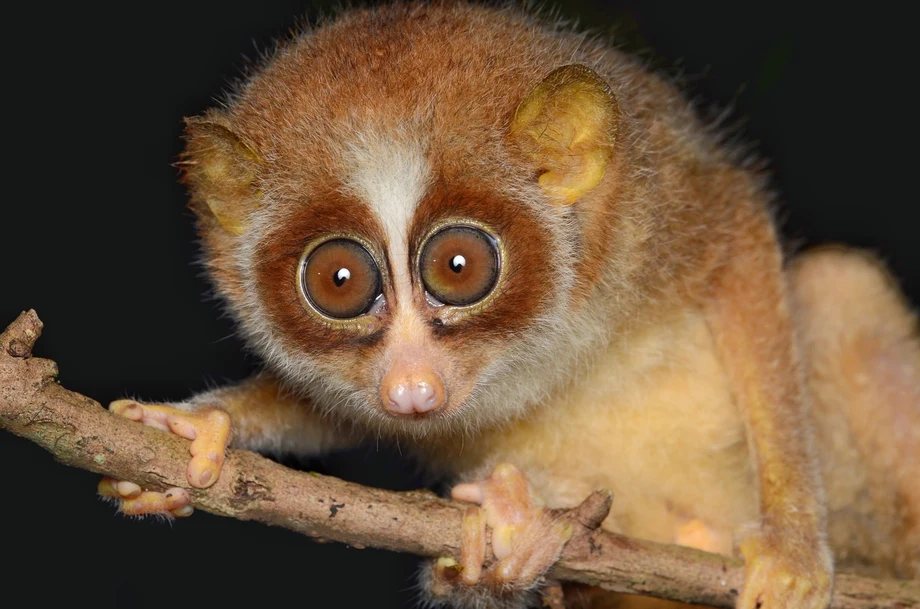
The animal is known as kaadu papa, meaning forest baby in Kannada, and as thevangu in Tamil. It is small, nocturnal and hard to see. Large eyes like saucers help it find ants, termites and small vertebrates after dark. Its limbs are long and thin, useful for gripping branches but not for leaping. It usually lives alone and communicates with screeches, whistles and clicks.
India's first sanctuary for the grey slender loris was established in October 2022 in the Karur and Dindigul districts of Tamil Nadu. It sits where the Western Ghats and Eastern Ghats meet. The sanctuary's area is given as 118 square kilometres, while a February 2025 description used 11,806 square kilometres. A 2022 study by the Salim Ali Centre for Ornithology and Natural History with the Tamil Nadu Forest Department estimated 8,844 grey slender lorises in the Karur forests and 8,412 in the Dindigul forests, a combined 17,256 animals.
Those figures make Kadavur more than a quiet patch of forest. They place it at the centre of an effort to keep a hidden primate connected to its food, shelter and mates. The task is difficult because much of the loris habitat is no longer continuous forest. Farmland, scrub, roads and mining edges break the canopy into islands. Lorises can still survive in those islands, but they pay a price each time they need to cross the spaces between them.
Why a Forest Baby Needs Connected Trees
Slender lorises are arboreal, meaning they spend most of their lives in trees. Their bodies are built for slow movement along branches, not for crossing open ground. A Wildlife Trust of India project, described in its canopy bridges study, says they cannot jump more than 0.3 metres and their anatomy is not suited for walking. A canopy bridge is a rope or natural link that lets an animal cross above a road instead of going down into traffic.
Honnavalli N. Kumara, principal scientist at the Salim Ali Centre for Ornithology and Natural History, has described what happens when forest cover breaks into small pieces. His words explain why lorises end up in farm hedges rather than deep forest.
Large areas of slender loris habitat are lost, forcing them to live in high density as refugees in remnant forests and agricultural hedges.
Down on the ground, a loris is small, slow and exposed. Vehicles can kill it. People can catch it more easily. Dogs and other predators become harder to avoid. For a forest animal that rarely descends, even a short trip between trees can become a major risk.
Which Lorises Live in India
There are two slender loris species in the world. The grey slender loris, Loris lydekkerianus, lives in southern India and Sri Lanka. The red slender loris, Loris tardigradus, lives only in Sri Lanka. The grey species has four subspecies, and India is home to two of them.
One is the Malabar grey slender loris, which lives in the wet evergreen forests of the Western Ghats. The other is the Mysore grey slender loris, a brownish grey animal found in drier forests and scrub. Its range is given as Karnataka, Tamil Nadu and Andhra Pradesh, while one February 2025 account also referred to Sri Lanka. The Wildlife Trust of India identifies the Kadavur animal as Loris lydekkerianus cabrera, commonly called the Mysore slender loris.
A few slender lorises also live in Bengaluru, where small parks and campuses hold isolated groups. These city animals show how the species can persist in pockets, but they also show the cost of isolation. A loris population in a park may be safe from a road for a moment, yet cut off from other groups and from the wider forest network that young animals need.
What Kadavur Was Built to Protect
The Kadavur Slender Loris Sanctuary was created in October 2022 as India's first sanctuary for the grey slender loris. Its position at the meeting point of the Western Ghats and Eastern Ghats makes it a landscape of mixed forests, scrub and farmland. The estimate of 8,844 lorises in Karur forests was 432 higher than the estimate of 8,412 in Dindigul forests, about 5% more.
Other wildlife in the landscape includes gaur, hedgehogs, bonnet macaques and grizzled giant squirrels. R. Kanchana, Conservator of Forests, Dindigul, said a research centre at Ayalur has been established. A project report for ecotourism and outreach was submitted to the state government in 2023. Ecotourism means wildlife focused visits, while outreach means work with schools and communities. Funding was still pending in February 2025.
The sanctuary's basic conservation problem is simple to state and hard to solve. Lorises need trees close enough together for safe movement. People need farmland, fuel, roads and livelihoods. When those needs overlap without planning, the forest becomes a patchwork, and the animal that depends on continuous cover is forced to adapt in dangerous ways.
How Mining and Brick Kilns Squeeze the Sanctuary
Near the Valayarumbu Aruvi waterfall, earth movers stood in an open field close to forest in February 2025. The landscape shifted between farmland and scrub forest, with Acacia, Anogeissus and Euphorbia in degraded patches and denser forest on higher ranges. A woman living near the path said lorises appear at dusk and announce themselves with whistles. She also said sightings had become rarer.
The area around the sanctuary lies within about 1 kilometre to 1.2 kilometres of the protected landscape in some places. Shanmugam Natarajan, a local activist with the Tamil Nadu Anti-Stone Quarry Movement, linked tree loss to road deaths and capture. He said animals forced down from trees face two dangers at once.
Deforestation forces lorises to crawl on the ground, making them easy prey for poachers and vehicles.
Illegal red soil mining and brick making have become a growing concern. These activities shifted toward Kadavur after the National Green Tribunal and the Madras High Court intervened in Coimbatore. In 2021, court orders shut 186 illegal brick kilns in Thadagam valley. Those kilns left trenches 15 metres to 35 metres deep. Operations later moved toward areas near the Western Ghats that are sensitive for ecology.
R Mohan Das, a geologist and activist, said miners in Kadavur target red gravelly soil, laterite and sandy loam, all useful for bricks. He said buyers push up farmland prices and damage the landscape. Firewood for kilns comes from nearby government land and farms, often less than two kilometres from the sanctuary.
These miners exploit private farmlands, government lands, and streams near the sanctuary.
Thadagam S Ganesh, a social activist from Coimbatore and coordinator of the Thadagam Valley Mineral Wealth Protection Committee, said illegal soil and brick operations break rules meant to protect land, water and conservation. The rules include approved mining plans, environmental clearance, pollution control and Hill Area Conservation Authority clearance.
Illegal red soil miners and brick makers violate key regulations, including approved mining plans, environmental clearance, pollution control, and conservation measures. They also build unauthorised roads and structures across streams without Hill Area Conservation Authority clearance.
R Mohan Das also described night excavation near the sanctuary. The material involved includes red soil, sand, clay and gravel from streams and ponds.
In Karur district, red soil, sand, clay, and gravel are mined from streams and ponds near the sanctuary at night, further degrading the environment.
Roads, Ropes and the Search for Safe Crossings
The Wildlife Trust of India supported a Rapid Action Project to find where lorises were being killed on roads and to test ways to help them cross safely. Teams used both field data and existing records. They monitored the Kadavur to Rasapatty Road, Kadavur Surumanapatty Road, Kadavur to Thargamapatty Road and smaller unpaved roads in and around Kadavur.
The Kadavur to Ayyalur road recorded the most loris roadkill casualties. No casualty count for that road was given. In the second stage, the team built artificial canopy bridges at accident hotspots. They tried coconut husk rope and polypropylene rope, along with single ropes, double ropes, triple looped ropes and ropes without loops. Each design was monitored every month.
By the end of the third month, lorises were using the double rope with loop bridge most often. The idea is practical: give an animal a route above the road so it does not have to descend into traffic. More checking is still under way on how stable and durable the bridge materials are.
Prajwal, the Rapid Action Project proponent leading the study, said flexible funding made it possible to work on a problem that had received little attention. He said systematic support reduced the stress of running a new field study.
I am extremely grateful to the Wildlife Trust of India for providing me with the Rapid Action Project. Without their funding, this study would not have been possible. Conducting a study on a nascent issue without proper funding is a challenge. However, the systematic funding and genuine support from WTI has made the study easier and less stressful.
Local acceptance also became part of the method. Prajwal said residents began telling him where they had seen lorises and what they knew about road deaths. That local knowledge helped identify hotspots.
People even eagerly informed me whenever they spotted a loris, and I was affectionately referred to as "antha thevangu payyan" (the slender loris guy), which eventually evolved into just "thevangu", a nickname that I cherished!
The project also launched Namma Thevangu, a student sensitization program around Kadavur. Activities included elocution, poster making and drawing. The 15 October account of the project was written by Raihanul Islam Sarkar, Programme Officer, Wild Aid Division.
What Local Communities See at Dusk
People living near the sanctuary know the animal by sound as much as by sight. Whistles at dusk can signal that lorises are active. One local name, Ramar thevangu, refers to a forehead marking that resembles the Hindu deity Rama. That detail shows how the animal sits inside local culture, not only inside wildlife surveys.
Some older practices put lorises at risk. The animals have been poached for black magic and talismans, and they are also illegally traded as exotic pets, for meat and for traditional medicine. M Palanivel, founder of the local nonprofit SEED Trust, said agroforestry and campaign work have changed behaviour. Agroforestry means growing trees on farms, which can give people income while keeping some tree cover for wildlife.
They no longer poach or use them for black magic.
Local livelihoods still depend on forest products other than timber, so conservation has to work with households rather than around them. Community reports of loris sightings helped the road crossing study. Student activities built awareness. The next test is whether those gains can survive pressure from mining, brick kilns and land conversion.
The Legal Shield Around a Small Animal
The grey slender loris is classified as Near Threatened on the IUCN Red List. The Wildlife Trust of India account notes that the species was moved from Least Concern to Near Threatened, reflecting worry about its future. In India, the animal receives the highest legal protection under Schedule I of the Wildlife (Protection) Act, 1972. Schedule I places strict limits on hunting, capture and trade.
The species is also listed in Appendix II of CITES, the Convention on International Trade in Endangered Species of Wild Fauna and Flora. Appendix II does not ban all trade, but it strictly regulates international commercial trade through permits and checks. That matters for a small primate sometimes targeted for the exotic pet market.
Legal protection and habitat protection do different jobs. A Schedule I listing makes it illegal to hunt or trade the animal. A connected canopy makes it possible for the animal to live normally. Kadavur needs both. Without intact forest links, law enforcement may protect a loris from a trap while the landscape still pushes it toward roads, farms and isolated patches.
A Short Timeline of the Kadavur Squeeze
The story of the Kadavur loris stretches across three decades. The dates show how legal protection, population estimates and new threats have arrived at different speeds.
- 1972: India's Wildlife (Protection) Act gives the slender loris Schedule I protection.
- 1996: A Dindigul study highlights the loris's reliance on Acacia trees and thin canopy links.
- 2021: Court orders shut 186 illegal brick kilns in Thadagam valley, leaving trenches 15 metres to 35 metres deep.
- October 2022: Kadavur Slender Loris Sanctuary is established in Karur and Dindigul districts.
- 2022: A Salim Ali Centre and Tamil Nadu Forest Department study estimates 8,844 lorises in Karur forests and 8,412 in Dindigul forests.
- 2023: A project report for ecotourism and outreach is submitted to the state government.
- October: The Mullipadi Panchayat Grama Sabha passes a resolution urging the district administration to protect lorises from illegal mining impacts.
- February 2025: Mining, roadkill and canopy fragmentation are described as pressing threats around the sanctuary.
- 15 October: The Wildlife Trust of India publishes its account of canopy bridges and the Namma Thevangu program.
After the Mullipadi resolution, the District Collector and the Department of Mining and Geology carried out checks in surrounding villages. A village administrative officer confirmed an inquiry into a brick unit and farmers excavating red soil for personal use. The outcome was not disclosed, and the District Collector had not responded to calls or emails by the time the account was published.
What Still Needs Answers
The scale of illegal mining in Kadavur is not clear because official data are lacking. Activists say mining groups work across private farmland, government land and streams, but the full area affected has not been set out in a public figure. That gap matters because the sanctuary's success depends on what happens outside its boundary as much as inside it.
Roadkill numbers also remain incomplete. The Kadavur to Ayyalur road was identified as the worst hotspot, but the study did not give a total. Canopy bridge use improved during monthly monitoring, yet the long life of coconut husk and polypropylene rope still needs more checking.
No date was given for a funding decision on the 2023 ecotourism and outreach proposal. No date was given for release of the inquiry findings into the brick unit and red soil excavation. Those are the practical next markers for communities, forest officials and researchers waiting to see whether protection on paper becomes safety on the ground.
Key Points
- The slender loris is a small nocturnal primate that depends on connected tree canopy and cannot jump more than 0.3 metres.
- Kadavur Slender Loris Sanctuary, established in October 2022 in Tamil Nadu, is India's first sanctuary for the grey slender loris.
- A 2022 study estimated 8,844 lorises in Karur forests and 8,412 in Dindigul forests.
- Roadkill, illegal red soil mining, brick kilns, logging, agriculture and trafficking all threaten the species.
- A Wildlife Trust of India supported study found the Kadavur to Ayyalur road had the most loris casualties and that lorises used a double rope with loop bridge most often.
- India gives the species Schedule I protection, while CITES Appendix II regulates international commercial trade.
- Community programs such as Namma Thevangu are building local awareness, but funding and enforcement questions remain open.