A Hotel Room at 38,000 Feet
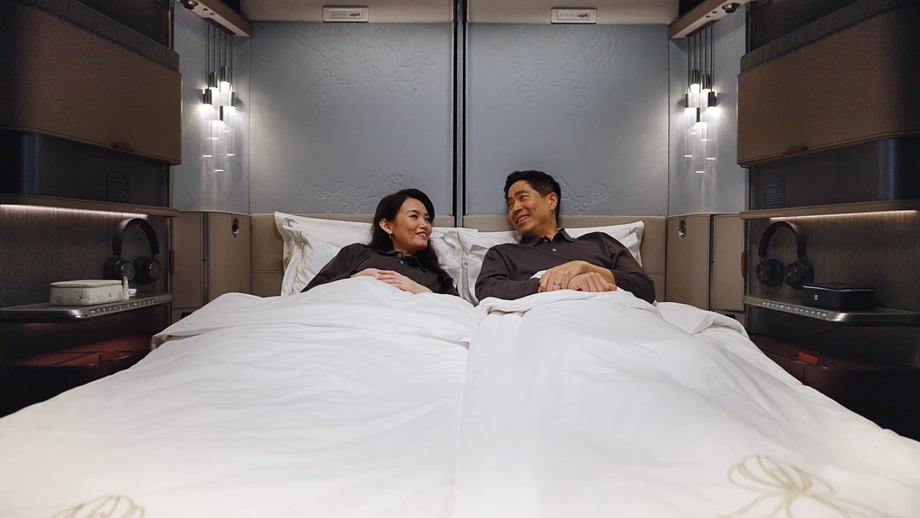
Singapore Airlines has opened the door on a first class experience that looks less like an airplane seat and more like a small hotel room. The carrier unveiled suites with curved walls, privacy doors, leather seating and a double bed it says is the largest in commercial aviation. The bed measures about 1.52 metres wide and 2.03 metres long, or 60 inches by 80 inches, the size of a standard bed in a United States hotel. The first cabins are due to enter service in the second half of 2027.
Contents
- A Hotel Room at 38,000 Feet
- Inside the Curved Private Suite
- Why Two Seats Can Become One Very Large Bed
- The S$2 Billion Programme Behind the Seat
- Business Class Gets Doors and a Shared Sleep Option
- Food, Screens, Wifi and Sleepwear
- The Airport Visit Is Part of the Product
- When Passengers Can Actually Use the New Cabins
- Why Privacy, Sleep and Weight Come With a Price
- Why Airlines Are Fighting Over the Front of the Plane
- Key Points
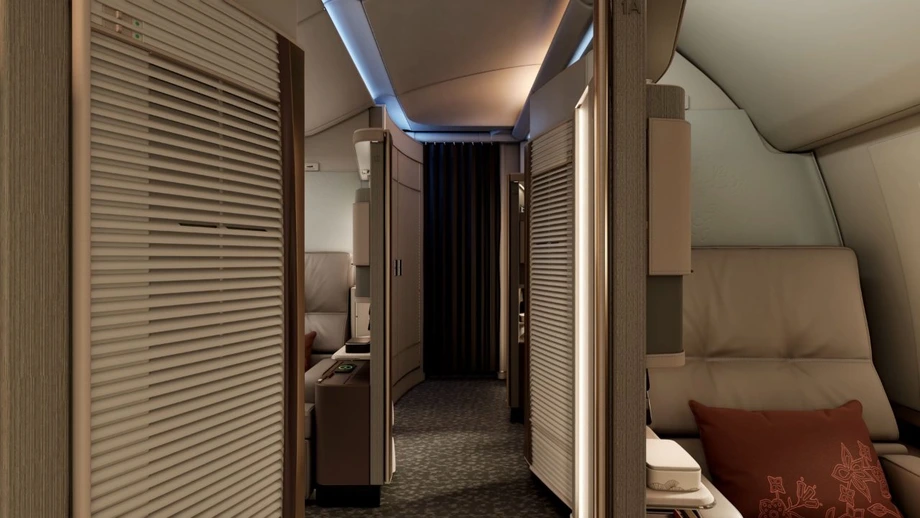
The center pair of suites can be joined. During the day, the space works as a lounge with two seats and an ottoman for eating face to face. At night, cabin crew make up a shared bed with a mattress topper, pillows and bedding. Each half of the bed is 76cm wide. The airline says the shape of the curved walls leaves enough room for a passenger to stand beside the bed before the doors are opened.
This is not a small refresh. Singapore Airlines is putting more than S$2 billion (US$1.6 billion, £1.2 billion) into next generation cabins, including 41 retrofitted Airbus A350-900 aircraft and the incoming Boeing 777-9 fleet. The programme also covers business, premium economy and economy. It is the airline's biggest cabin overhaul and arrives as other carriers chase wealthy travelers willing to pay for space, sleep and privacy.
Passengers will be able to divide a long flight into separate moments. A traveler can work at a seat, eat at a table, watch a film on a 32 inch screen, then sleep flat in a bed shared with a companion. For the airline, the gamble is that those moments will be enough to keep high paying customers loyal when competitors are spending heavily too.
Inside the Curved Private Suite
London design studio PriestmanGoode designed the first class suite, and Collins Aerospace built it. The cabin will have four suites on the Airbus A350-900ULR and six on the Boeing 777-9 in a 1-2-1 layout, meaning window seats, a center pair, window seats. In many airlines that layout would make the middle pair feel cramped. Singapore Airlines uses curved walls and staggered suites, so the pair forms a rounded capsule and the aisle bends around it. That design gives the center suite space to stand beside the bed and makes the window suites feel larger at different points along the cabin.
Doors and walls are 170cm high. That is not floor to ceiling, but it is high enough that a person walking past cannot easily see inside. A small gap in the slats is deliberate, giving crew a way to look in during an emergency. The seats are upholstered in Poltrona Frau leather, hand cut and stitched by Sabeti Wain Aerospace, with warm metal details, soft blue suede and five fluted pendant lights.
Each suite includes a 32 inch 4K screen, a leather lined vanity drawer, personal storage and a place for carry on luggage under an ottoman. First class seat pitch is 89.5 inches, bed length is 80 inches, and seat width is 23 inches, or 30 inches with armrests lowered. Those numbers matter because airline seats are measured tightly. A few centimeters can decide whether a passenger can turn over easily or reach the aisle without climbing over the bed.
Why Two Seats Can Become One Very Large Bed
Singapore Airlines describes the joined center suites as the largest double bed in commercial aviation. At 60 inches by 80 inches, the bed matches the nominal size of a queen mattress in a hotel. Etihad's Residence on the Airbus A380 has a bed listed at 82 inches by 47.5 inches, longer but much narrower. The Singapore Airlines design gives two people more room side by side, which is the point of a shared bed at 38,000 feet.
Singapore to New Jersey is cited as the airline's longest flight, with a scheduled time of 19 hours and 10 minutes. Ultra long range aircraft are built for routes of that length, where sleeping well can shape the whole journey. The A350-900ULR has carried only business and premium economy until now. Singapore Airlines plans to put first class on those flights because demand in premium cabins is stronger. Ong Wa Li, the airline's product chief, expects the new first class to reach more than half of the long haul fleet.
Goh Choon Phong, chief executive of Singapore Airlines, said the redesign followed a study of 5,000 frequent travelers, staff and industry experts through interviews, focus groups and surveys. He said passengers gave a clear message about what they wanted from the cabin.
We look closely at how our customers work, dine, relax, and rest while traveling, and what they value most." "Their feedback was clear: greater comfort and privacy, intuitive functionality and spaces they can flexibly adapt to their needs, whether they are working, resting or connecting with loved ones from 30,000 feet.
The comment explains the design beyond the headline bed. A suite has to work as an office, a dining room and a bedroom, often within one flight. The airline is selling control over time and space, not merely a wider chair.
The S$2 Billion Programme Behind the Seat
The investment covers a programme of 72 aircraft, a mix of Airbus A350-900s being retrofitted and Boeing 777-9 jets on order. Together, those aircraft will make up much of Singapore Airlines' long haul fleet. The S$2 billion plus total includes a S$1.1 billion A350 refurbishment plan announced in 2024. The Boeing 777-9 is expected to become the airline's new long haul flagship as the A380, which has smaller double beds, eventually retires.
Singapore Airlines' cash balance stood at S$9.1 billion at the end of June, giving the carrier room to keep spending. Chief commercial officer Lee Lik Hsin said most of the money goes into premium cabins because first and business seats cost far more each than economy seats. He said the airline has set no spending ceiling and will keep investing when needed to protect its position.
Lee said the airline sells more than seats. He described the mix of physical product, service and operations that Singapore Airlines believes sets it apart.
It is the hard product, the soft service, the operational excellence. And...it is our people.
In airline language, the hard product means the physical items passengers can see and touch, such as seats, screens, tables, lighting and doors. Soft service means the way crew deliver care. Singapore Airlines was named World's Best Airline at the 2026 World Airline Awards by Skytrax, ahead of Qatar Airways and Cathay Pacific. It has held the top commercial airline title six times, in 2026, 2023, 2018, 2008, 2007 and 2004.
Business Class Gets Doors and a Shared Sleep Option
Business class will receive sliding privacy doors for the first time on Singapore Airlines. It will also get double beds for couples, although the lower walls mean those spaces are not fully enclosed. The seat can become a fully flat bed, and adjustable central dividers let passengers choose more privacy or a shared area. Premium economy gets more comfort too, with up to 9 inches of recline and a leg rest with an adjustable footrest.
BMW's Designworks studio developed the new business seat, and Recaro Aircraft Seating will manufacture it. Wireless phone charging and smart controls are part of the package. The controls can remember a passenger's preferred seat position and lighting settings for later flights, which saves repeat adjustments on a long trip.
Lee said the four cabins were designed separately but share one purpose.
While each cabin has been designed individually, they are united by the same ambition to make the experience more comfortable, flexible, and rewarding for our customers,
The change gives business travelers some features once reserved for first class. It also puts Singapore Airlines into a tighter contest with carriers whose business cabins already sell privacy and paired seating as a major draw.
Food, Screens, Wifi and Sleepwear
The new KrisWorld entertainment system brings 4K touchscreens, spatial audio, Bluetooth headphone connectivity and more than 2,500 entertainment options to the premium cabins. 4K means the picture has roughly four times the detail of standard high definition. Spatial audio places sounds around the listener rather than only left and right. First class keeps its own 32 inch screen even when two suites are joined, so one passenger can sleep while the other watches a film.
On the Boeing 777-9, the charging setup changes during the rollout. The first 12 aircraft use Panasonic NEXT at 45 watts, while the following 19 use Astrova at 67 watts. Economy passengers on the Boeing 777-9 get 4K screens, Bluetooth audio and USB-C charging. Retrofitted Airbus aircraft keep USB-A ports, so many travelers will still use them into the late 2030s.
High speed internet is another part of the overhaul. Starlink wifi will be introduced on the Airbus A380, A350-900 long haul aircraft and A350-900ULR jets. Starlink uses satellites to deliver internet during flight, a service that has become a practical need for many passengers who work or stay in contact while traveling.
Dining covers more than 100 new and refreshed dishes across all cabin classes. Premium passengers can order poached Maine lobster with Champagne sauce, with a wider wine and spirits list alongside it. Suites, first and business class meals will be served on custom designed Christofle tableware. First class passengers will receive Sisley amenity kits and new 100% cotton sleeper suits. Business class passengers will get pyjamas for the first time and Byredo amenity kits. Premium economy kits will include Ink & Water products, while economy passengers will receive collectible travel pouches.
The Airport Visit Is Part of the Product
Singapore Airlines is also spending more than S$130 million (£76 million) on renovating and expanding SilverKris lounges worldwide, including at Singapore Changi Airport. The lounge work matters because first class service starts before boarding. A traveler with hours to spare can eat, shower or rest before stepping onto the aircraft, and the airline wants that part of the journey to feel connected to the cabin.
First class passengers in Singapore will get better lounge dining, priority immigration and security clearance, dedicated concierge assistance and buggy transfers between selected airport locations. The buggy service reduces long walks through one of the world's busiest transfer airports. The concierge service gives travelers one place to ask for help when plans change.
When Passengers Can Actually Use the New Cabins
The unveiling happened in November 2026, but the seats have a longer history. Singapore Airlines began planning them in 2018, when the expectation was that they would fly in the early 2020s. Boeing delays pushed the first use to 2027. The airline has not committed to which aircraft type will carry the seats first, and it has not confirmed launch routes, fares or a booking date.
- 2018: design work on the new seats began.
- 2024: Singapore Airlines announced the S$1.1 billion A350 refurbishment plan.
- November 2026: the new cabins were unveiled.
- Second half of 2027: the new products are due to enter service.
- 2027: Lufthansa, the launch operator for the Boeing 777-9, expects only a low single digit number of deliveries.
- Late 2027: Cathay Pacific expects its first Boeing 777-9.
- Early 2028: ANA expects its first Boeing 777-9.
The timing depends on certification, the process that confirms a seat is safe for a specific aircraft. Regulators check crash forces, fire conditions and evacuation needs. Lee said the airline faces a split problem: the new seats are approved for the Boeing 777-9, but the aircraft itself is not yet certified, while the seats are not yet certified for the A350.
The seats are certified on the 777-9, but the 777-9 aeroplane itself is not certified, and the seats have not yet been certified on the A350,
Boeing first targeted 777-9 deliveries around 2020. Certification setbacks, engine issues, the pandemic and tighter oversight by the U.S. Federal Aviation Administration pushed the date to 2027. Lee said the A350 certification delay moved the introduction back by about half a year. That matters for travelers because a cabin can be ready in a showroom long before regulators allow it to carry passengers.
Why Privacy, Sleep and Weight Come With a Price
Premium airline seats are expensive because they must be comfortable, durable and safe under strict rules. A first class suite has doors, screens, wiring, storage, lighting and a bed mechanism, all built into a small space that must behave safely in turbulence or a crash. That is why the S$2 billion programme covers far more than leather and champagne.
Dr Nyein Chan Aung, senior lecturer in industrial design at Monash University, said long distance travelers often treat sleep as something worth paying for. He explained the trade in direct terms.
Australians, look, we just accept that we're going to have to fly a long way no matter where we go." "If sleeping until you get to your target destination is critical, you're going to pay for it ... which is putting a price tag on sleep, to be honest.
Dr Aung said a single premium seat can cost as much as a new sports car because it is complex and handled with extreme care in production. He described what workers can see on aircraft factory boxes.
In manufacturing, if you go over to the Boeing factory or Airbus factory and they're unpacking one of the business class or first class seats, on the box you will actually see a picture of a Ferrari." "That's a reminder to the manufacturer to be extra careful, because a single chair costs as much as a new Ferrari and damaging one can be a very bad day.
Weight is the other challenge. Swiss first class suites weigh more than 500 kilograms, which required about 1.5 tonnes of tail ballast in Airbus A330 aircraft to keep the center of gravity in the right place. A pilot union criticized the extra fuel burn. Singapore Airlines' 170cm walls and doors are lower than some fully enclosed luxury products, but the deliberate gap for crew checks shows how safety rules shape even the most private cabin.
Dr Aung is also working on the other end of the aircraft. His Good Design Award winning economy concept, called Repose, adds side support for middle seat travelers so they can lean and sleep without adding seats or removing passenger capacity. He said comfort should not belong only to the richest travelers.
Sleep should be a basic right that everyone has access to no matter what environment they are in." "Not something that only the most privileged can afford.
Why Airlines Are Fighting Over the Front of the Plane
Singapore Airlines is not acting alone. Emirates, Lufthansa, Etihad Airways and Air France are investing heavily in cabin refurbishments. British Airways and United Airlines are also spending on premium cabins. Fuel costs have squeezed margins in economy, while demand for premium travel has stayed more resilient. That pushes airlines to win travelers who can pay high fares for a better seat, better food and a quieter journey.
First class is having a comeback after years when many airlines trimmed or removed it. Ben Rowan, director at PriestmanGoode, said first class has become a flagship product that helps airlines stand apart. He also pointed to a trend toward central double suites, the same broad idea behind the new Singapore Airlines cabin. PriestmanGoode has worked on luxury cabins for Lufthansa, United Airlines, Turkish Airlines, Riyadh Air and Transport for London.
Ben Smith, chief executive of Air France-KLM Group, said leisure demand has exploded. Some travelers book all four front first class seats for privacy, even when they do not need all the seats. Air France showed the scale of the market in spring 2026, when it offered a round trip ticket between California and the Côte d'Azur for €43,600 around the Cannes film festival. Its La Première cabin was named the world's best first class by Skytrax in September 2026, using curtains rather than high walls to give passengers adjustable privacy. At Paris Charles de Gaulle Airport, Air France sells lounge suites for €1,500 for up to three hours with foie gras, lobster, vintage Champagne and a double bed.
Other Asian and Middle Eastern carriers keep the pressure high. Emirates sells 26,800 first class seats a week and offers showers on its Airbus A380. Etihad has The Residence, while Qatar Airways, Japan Airlines, ANA and Cathay Pacific all compete for top tier travelers. Qantas plans a luxury first class for its Sydney to London ultra long flights from 2027. Singapore Airlines' answer is a private curved suite, a large double bed and a ground experience that begins at the lounge door.
Key Points
- Singapore Airlines unveiled first class suites with a double bed measuring about 1.52 metres by 2.03 metres, or 60 inches by 80 inches.
- The new cabins are due to enter service in the second half of 2027 on the Boeing 777-9 and retrofitted Airbus A350-900ULR aircraft.
- The programme covers 72 aircraft, including 41 retrofitted Airbus A350-900s, and forms part of a wider investment of more than S$2 billion.
- Business class will get sliding privacy doors, companion beds, wireless charging and seat controls that remember passenger preferences.
- The airline is adding more than 100 dishes, new entertainment, Starlink wifi, Sisley and Byredo amenity kits, sleepwear and S$130 million of lounge work.
- Certification of the seats and the Boeing 777-9 remains the main timing issue, and launch routes, fares and booking dates have not been confirmed.