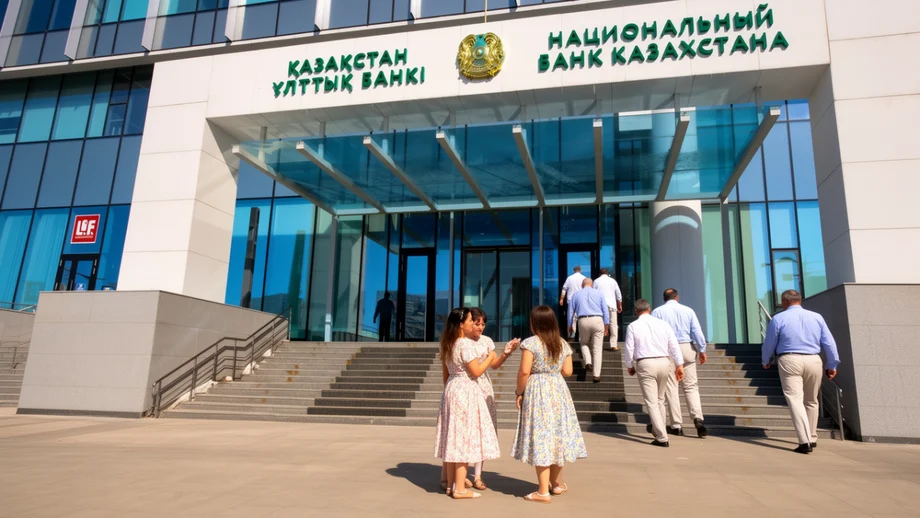
Deposit Growth Across Kazakhstan Financial Institutions
Total individual savings in Kazakhstan reached 30.7 trillion tenge at the end of September 2026, marking an increase of 16 percent or 4.2 trillion tenge over the course of a single year. Households across the country continue to place their money in traditional banking products to protect their purchasing power against inflation. At the same time, specialized term deposits inside banks that participate in the official deposit insurance system surpassed 27 trillion tenge by October 1, 2026, registering an annual expansion of 18.2 percent. A term deposit is a type of savings account where money is locked in for a set period in exchange for a higher guaranteed interest rate. Over a five-year period, these specific savings products expanded by more than 2.5 times, demonstrating that everyday savers increasingly rely on banking institutions to store their wealth. The steady accumulation of capital closely connects to broader financial planning topics, much like how workers monitor how regular payments from workers and employers could support larger future pensions when Kazakhstan weighs pension changes as national regulations evolve.
Contents
High interest rates offered by commercial banks serve as the primary engine driving these substantial financial inflows. By the end of the third quarter of 2026, certain specialized deposit lines offered returns reaching up to 18.6 percent per annum, while individual institutions rolled out specialized accounts with even higher yields. Bank RBK launched a cumulative deposit product named DREAM that provides annual reward rates reaching up to 19 percent. Another product called Smart introduced features such as daily capitalization, which calculates interest daily so that earnings generate additional returns at a faster pace. These competitive offerings create an environment where financial entities aggressively vie for household liquidity. While overall market figures paint a picture of broad expansion, individual institutions experience vastly different fortunes as consumer preferences shift toward specific providers.
Contrasting Fortunes Among Major Commercial Banks
While the overall sector expands rapidly, eight individual commercial banks experienced a collective loss of 184 billion tenge in retail deposits over the year. Alatau City Bank recorded the largest absolute drop, with its retail portfolio declining by 68.6 billion tenge down to 701.2 billion tenge. Eurasian Bank followed with a reduction of 57.1 billion tenge, bringing its total down to 1.1 trillion tenge, and Altyn Bank lost 35.2 billion tenge. Smaller institutions faced sharp proportional declines, including VTB Bank Kazakhstan, which dropped by 21.7 percent, and Shinhan Bank Kazakhstan, which fell by 36.5 percent. The most dramatic drop occurred at Zaman Bank, an Islamic financial institution where individual deposits collapsed by 93 percent down to 371 million tenge.
Citibank Kazakhstan registered an unusual movement where household deposits dropped from 2.6 million tenge completely down to zero. Market observers clarify that this specific change does not indicate a loss of consumer trust or a traditional retail bank run. Citibank operates primarily as a foreign subsidiary focusing on large corporate clients, particularly within the oil extraction sector, meaning everyday retail consumers were never part of its core business model. Conversely, other institutions experienced explosive growth that heavily outperformed the national average. Bank RBK expanded its term deposit portfolio by 48 percent, adding 251.3 billion tenge to reach a total of 774.8 billion tenge. Freedom Bank secured the second position with a 41.8 percent increase, followed by ForteBank with a 34.2 percent rise, Otbasy Bank with a 33.2 percent increase, and Home Credit Bank with a 25.8 percent growth rate.
Understanding the Mechanics of Modern Deposit Markets
Commercial banks rely on customer deposits to fund their lending operations, transforming idle savings into productive economic capital. When savers deposit money into accounts featuring daily capitalization or fixed terms, the institution gains a stable pool of capital to issue loans for consumer purchases, mortgages, and business ventures. The cost of funds represents the average interest rate a bank must pay to attract those deposits from the public. To generate profits, an institution must lend out that capital at interest rates higher than its cost of funds while successfully managing operational expenses and potential loan defaults. Rapidly growing institutions often utilize digital onboarding tools and aggressive promotional campaigns to capture market share from competitors.
Smaller institutions and foreign subsidiaries face unique pressures when larger domestic players offer lucrative returns like the 19 percent rates seen on specialized accumulation accounts. Savers naturally migrate toward institutions providing higher yields and greater convenience through mobile applications. At the same time, seven banking entities registered a combined contraction of 87.2 billion tenge specifically within their term deposit portfolios over the corresponding annual period. This divergence highlights a highly competitive landscape where retail clients actively shift their capital to maximize returns. Economic stability depends heavily on this dynamic interplay between household savings behavior and institutional lending strategies.
Chronology of Recent Deposit Market Developments
- October 2026: Total retail deposits across all commercial banks in Kazakhstan reach 30.7 trillion tenge.
- October 1, 2026: Aggregate term deposits inside insured banking institutions surpass 27 trillion tenge, reflecting an 18.2 percent annual growth rate.
- Third Quarter 2026: Selected deposit categories across the national banking sector offer average peak annual yields of up to 18.6 percent.
- Annual Period Ending Late 2026: Eight domestic financial institutions collectively shed 184 billion tenge in retail deposits, led by Alatau City Bank.
- Corresponding Annual Period: Bank RBK expands its term deposit portfolio by 48 percent, adding 251.3 billion tenge in new savings.
Comparative Analysis of Sector Growth Rates
Market expansion remains unevenly distributed among the various participants operating within the financial ecosystem. The leading five institutions by growth rate captured a disproportionate share of the 4 trillion tenge added to the sector over the past year. Bank RBK achieved growth that exceeded the sector average by more than 2.5 times, pushing its total term deposit portfolio to 774.8 billion tenge. Freedom Bank and ForteBank secured the next positions with annual portfolio expansions of 41.8 percent and 34.2 percent respectively. Meanwhile, the seven institutions experiencing contractions saw a combined withdrawal of 87.2 billion tenge from their term savings accounts. This polarization demonstrates that consumers actively evaluate institutional stability, digital accessibility, and reward rates before committing their personal capital.
Long-term indicators confirm that the broader retail savings environment remains exceptionally robust despite the isolated losses recorded by a handful of banks. Over the preceding five-year span, total term deposits expanded by more than 2.5 times, translating to a steady annual compound growth rate of 21 percent. This multi-year expansion underscores a profound structural shift in how households manage their finances, moving away from holding physical cash toward utilizing regulated banking products. High interest rate environments combined with state deposit insurance provide strong incentives for citizens to park their earnings in formal financial channels.
The Essentials
- Retail deposits in Kazakhstan reached 30.7 trillion tenge by late September 2026, representing a 16 percent increase over twelve months.
- Total term deposits within the deposit guarantee system exceeded 27 trillion tenge, growing by 18.2 percent annually.
- Bank RBK led all institutions in growth, expanding its term deposit portfolio by 48 percent to reach 774.8 billion tenge.
- Eight commercial banks experienced a combined retail deposit reduction of 184 billion tenge during the year.
- Alatau City Bank registered the largest absolute decline among shrinking portfolios, dropping by 68.6 billion tenge.