Higher utility bills meet a difficult inflation outlook
The International Monetary Fund has recommended that Kazakhstan gradually raise utility tariffs to cover suppliers' costs, while avoiding automatic increases tied to the previous year's inflation. The advice comes as the fund forecasts inflation of 9.6% at the end of 2026 and warns that public spending and infrastructure investment could keep prices rising rapidly.
Contents
- Higher utility bills meet a difficult inflation outlook
- Why the IMF wants tariffs based on costs
- What the proposed increases mean for households
- Why inflation remains the central constraint
- Construction must produce more than a spending surge
- The budget and state enterprises need a shared limit
- What the IMF proposes for interest rates and lending
- Growth continues, but oil disruptions weigh on the outlook
- Reforms and the next assessment
- Key Points
The recommendations were presented after an IMF mission led by Amina Lahreche held consultations in Almaty and Astana from November 4 to 17, 2026. Its concluding statement, published on November 17, calls for a predictable system that reflects actual utility costs and helps finance repairs and modernization.
Kazakhstan's Ministry of National Economy has already approved a gradual tariff plan through 2029. Timur Kosymbayev, chairman of its Committee for the Regulation of Natural Monopolies, has outlined possible cumulative increases of about 65% for heating, 70% for electricity and 100% for water by the end of that period.
The IMF's recommendation connects two pressures facing households: aging infrastructure needs investment, while higher bills can make an already expensive cost of living harder to manage. The fund expects inflation to fall to 8.4% in 2027 and approach the National Bank's 5% target only by 2029.
The proposed response reaches beyond utility pricing. The IMF also wants tighter control of government spending, closer oversight of state enterprises and monetary policy restrictive enough to bring inflation down. Together, those recommendations seek to finance necessary improvements without pouring money into the economy faster than it can produce goods and services.
Why the IMF wants tariffs based on costs
The IMF recommends moving utility charges toward cost recovery. In simple terms, suppliers should collect enough revenue to pay for the services they provide and support the investment needed to keep those services working.
The fund favors a transparent framework based on actual costs and a longer planning horizon. It opposes automatically adjusting tariffs by the previous year's inflation rate. Such automatic increases would carry past price rises into future bills, even when a supplier's own costs develop differently.
The Ministry of National Economy identifies several costs behind Kazakhstan's planned increases: wages, equipment, machinery and fuels such as coal, fuel oil and gas. Investment under the national program to modernize energy and utility infrastructure adds another funding requirement.
The ministry has illustrated how investment costs could be spread out. If a major repair requires 5 billion tenge, only a portion, for example 500 million tenge, would enter the tariff calculation in the first year, with the remaining burden distributed across later years. The purpose is to avoid charging consumers the entire investment cost at once.
Nurlan Bolatbayev, deputy chairman of the natural monopolies committee, said average deterioration across the sector exceeds 50%. Without investment, he said, deterioration increases by 2% to 3% annually. That gives the tariff debate an immediate practical dimension: maintaining heating, electricity and water networks requires money as well as a pricing formula.
What the proposed increases mean for households
Kosymbayev's projections put water at the center of the largest potential increase. Water tariffs are expected to rise by an average of about 20% annually, reaching roughly twice their starting level by 2029. He put the current average water payment at about 1,200 tenge and said it does not fully cover basic treatment and delivery costs.
Electricity increases are projected at 11% in 2026, 14% in 2027, 15% in 2028 and 16% in 2029. Applied successively, those figures produce an increase of about 69%, close to the committee's estimate of 70%. Each year's percentage applies to the price reached after the previous increase.
Heating tariffs are projected to rise by 10% in 2026 and 17% in 2027, with an 11% increase cited for 2029. The committee estimates the cumulative increase at about 65% by the end of 2029.
These are the committee's projections. The IMF recommendation gives no specific percentage increase or implementation date for individual utility providers.
Housing assistance is intended to help eligible families whose utility spending exceeds a locally determined share of household income. The thresholds cited are 5% in some regions and 10% in others, with local budgets covering eligible costs above the applicable limit. For households with little spare income, that support will matter alongside the pace of tariff increases.
Why inflation remains the central constraint
Kazakhstan's annual inflation rate was 9.2% in October 2026, compared with the National Bank's target of 5%. The IMF expects inflation to reach 9.6% by December, then ease to 8.4% at the end of 2027.
The forecast points to a slow reduction in price pressure. Even if inflation falls as projected, prices would continue rising, just less quickly. A lower inflation rate does not mean household bills return to their earlier levels.
The IMF identifies renewed utility tariff increases, larger government spending, additional National Fund transfers and spending by state enterprises as sources of pressure. It also says underlying inflation and expectations of future price increases remain elevated.
Lahreche, chief of the IMF mission to Kazakhstan, described the public sector's role at a November 17 briefing:
"Demand pressures are largely coming from the public sector spending this coming year. And withdrawals from the National Fund are going to push additional financing into the economy," she said.
More spending supports purchases, jobs and construction. When the supply of goods, workers or services cannot expand quickly enough, buyers compete for the same resources and prices rise. The IMF therefore wants the government's budget decisions and the National Bank's inflation policies to work in the same direction.
Construction must produce more than a spending surge
The IMF's projections account for planned withdrawals of approximately 6.5 trillion tenge from the National Fund through 2029 to finance infrastructure and construction. The government has also proposed naming 2027 the Year of Nationwide Large-Scale Construction.
The fund recognizes Kazakhstan's need for public investment. Its concern is whether projects generate enough lasting economic benefit to match the money spent. Better infrastructure can help businesses transport goods, reduce interruptions and produce more with the same resources.
Lahreche explained the connection between productivity, meaning how much an economy produces from its resources, and price stability:
"With productivity gains, there's more income that can be distributed in the economy without necessitating an increasing price," she said.
The IMF recommends rigorous assessment of whether projects are worth their cost, realistic budgets, transparent selection and procurement, and monitoring during construction and after completion. Lahreche also pointed to reliable information, accountability and audits.
Those recommendations connect directly to utility bills. Consumers are being asked to help finance modernization over several years. Careful purchasing and construction oversight can help ensure that the money pays for working infrastructure rather than avoidable costs or poorly selected projects.
The budget and state enterprises need a shared limit
The IMF wants Kazakhstan to save additional oil revenue when prices are favorable, collect more revenue outside the oil sector and gradually remove ineffective tax exemptions. These steps would reduce the budget's dependence on unpredictable oil income.
The fund also recommends a clear budget framework covering several years, a prudent limit on government debt and binding restrictions on all transfers from the National Fund. Saving during stronger periods would leave more resources available when oil revenue weakens.
State enterprises are another focus. Their borrowing, lending, guarantees and investment plans should be coordinated with the national budget, according to the IMF. Otherwise, spending through public companies can add stimulus even when the government is trying to restrain its own expenditure.
This activity is often called quasi fiscal activity: public companies carry out lending or investment with effects similar to government spending, although it may sit outside the main budget. Looking at those activities together gives policymakers a fuller picture of how much demand the public sector is creating.
The IMF also warns about public investment displacing private investment. Heavy state borrowing can compete with private businesses for financing, while large public projects can compete for workers, materials and construction capacity. Its recommendation is to coordinate these demands rather than manage each public institution in isolation.
What the IMF proposes for interest rates and lending
The IMF considers an increase in the National Bank's base interest rate justified and recommends keeping monetary policy sufficiently restrictive until inflation settles near the target. The base rate helps influence borrowing costs across the economy; higher financing costs tend to slow credit and spending.
The fund also wants the National Bank to remove more surplus money from the banking system for longer periods. It recommends issuing central bank notes more regularly, with longer maturities and market interest rates. Banks buying those securities temporarily place funds with the central bank instead of keeping them available for other uses.
A more regular range of securities could also help establish a yield curve, showing the interest rates paid for lending over different periods. That gives banks and investors a reference for pricing other financial products.
The IMF assesses Kazakhstan's banks as adequately capitalized, liquid and profitable, with limited risks to financial stability. It recommends retaining lending safeguards that have helped slow unsecured consumer borrowing and contain household debt burdens.
Mortgage lending requires close attention because it is growing quickly. The fund also recommends safeguards and oversight when the state provides credit guarantees or transfers public lending portfolios to commercial banks. For households, the policy balance involves containing inflation while watching how higher bills and borrowing costs affect debt repayment.
Growth continues, but oil disruptions weigh on the outlook
The IMF forecasts economic growth of 4.6% in 2026 and 4.8% in 2027. Real GDP grew about 4.5% in the first ten months of 2026, compared with growth of 6.5% in 2025. The fund attributes the slowdown mainly to interruptions in oil production.
Investment and several industries continued expanding. Fixed capital investment, spending on assets such as buildings and equipment, rose 4.9% to 18.3 trillion tenge in January through October. Machinery manufacturing grew 22.2%, pharmaceuticals 50.9% and agriculture 5.2%.
The IMF expects oil output to remain broadly unchanged in 2027, leaving activity outside oil, supported by public spending, as the main driver of growth. Existing disruptions to production and exports already affect its forecast.
Further interruptions remain a risk, including along the Caspian Pipeline Consortium route used to export Kazakh oil. Lower hydrocarbon prices, weaker growth among major trading partners and tighter global financing conditions could also hurt the economy.
The fund recommends diversifying export markets and transport routes to reduce exposure to those shocks. Stronger foreign direct investment and productivity gains from infrastructure and digital investment could, meanwhile, lift growth above its forecast.
Reforms and the next assessment
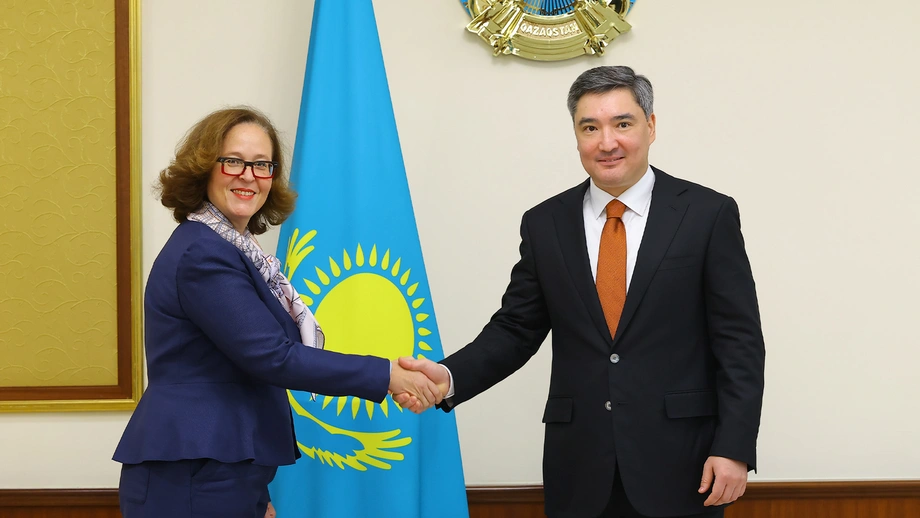
Prime Minister Olzhas Bektenov met Lahreche on November 16 to discuss the mission's findings and cooperation with the IMF. He outlined institutional reforms, including the new Constitution that entered into force in July, and government efforts to develop the digital economy. Government agencies are expected to review the fund's proposals.
The IMF wants faster, transparent restructuring and privatization of state enterprises, better corporate governance, stronger property rights and contract enforcement, and a better business environment. It also recommends developing capital markets so companies have more ways to raise financing.
Those changes are part of the same economic strategy as tariff reform: strengthen the ability to produce and invest while limiting excessive demand. The immediate milestones are:
- November 4 to 17, 2026: the IMF mission held consultations in Almaty and Astana.
- November 16: Bektenov and Lahreche reviewed the mission's findings.
- November 17: the concluding statement was published and Lahreche presented preliminary findings.
- January 2027: the IMF expects publication of its staff report containing the final assessment.
- Through 2029: Kazakhstan's utility tariff plan and planned infrastructure financing extend across this period.
The January report is the next assessment to watch. For consumers, the practical issues are how providers' costs translate into local tariffs, how investment improves services and whether eligible families receive housing assistance as bills increase.
Key Points
- The IMF recommends gradual utility tariff increases based on actual costs, without automatic indexing to past inflation.
- Kazakhstan's committee projects cumulative increases through 2029 of about 65% for heating, 70% for electricity and 100% for water.
- The IMF forecasts inflation of 9.6% at the end of 2026 and 8.4% at the end of 2027, approaching 5% by 2029.
- Planned National Fund withdrawals of about 6.5 trillion tenge through 2029 are included in the IMF's projections.
- The fund calls for tighter spending controls, coordinated oversight of state enterprises and careful infrastructure project selection.
- Economic growth is forecast at 4.6% in 2026 and 4.8% in 2027. The final IMF staff report is expected in January 2027.