Factories and construction lead the gains
Kazakhstan's economy grew by 4.5% in January through October 2026 compared with the same period a year earlier, according to preliminary Bureau of National Statistics figures released by the Ministry of National Economy on November 10. Growth accelerated from 4.2% over the first nine months, with manufacturing and construction among the strongest expanding sectors.
Contents
- Factories and construction lead the gains
- How growth gathered pace during 2026
- Manufacturing grows faster than industry as a whole
- Growth extends across services and agriculture
- Oil exports remain a major constraint
- Factories report weak demand despite higher output
- A 6.5 trillion tenge infrastructure plan takes shape
- What the numbers mean for household budgets
- Key Points
The ministry estimated that the non-resource sector grew by 5.6%, providing the main contribution to economic growth. Manufacturing output increased by 9.3%, while construction rose by 13.1%. Pharmaceuticals recorded the fastest expansion among the manufacturing industries listed, with production up 50.9%.
The figures bring together two different developments: stronger production outside raw material extraction and continued pressure on oil output and exports. Kazakhstan planned to produce about 96 million tonnes of oil in 2026, but accidents at major fields and restrictions affecting its main export route complicated that target.
Real gross domestic product, or GDP, measures the value of goods and services produced after adjusting for price changes. The 4.5% increase therefore describes growth in economic activity, with the effect of changing prices removed.
How growth gathered pace during 2026
Kazakhstan's growth rate increased from 4.1% in the first half of 2026 to 4.2% for January through September, then reached 4.5% for January through October. Each figure compares a cumulative period with the corresponding months of 2025.
The latest acceleration amounts to 0.3 percentage points. A percentage point measures the difference between two percentage rates: subtracting September's cumulative figure of 4.2% from October's 4.5% gives that increase. October's activity is included in the new total, alongside the preceding nine months.
The non-resource sector also gained momentum, moving from growth of 5.4% over nine months to 5.6% over ten months. Its latest expansion rate was 1.1 percentage points above GDP growth, illustrating why the ministry identified it as the main source of support.
Kazakhstan recorded GDP growth of 6.5% for the whole of 2025. The latest cumulative rate for 2026 is lower, although the periods cover different lengths of time. Together, the figures show an economy gaining speed within 2026 while running below the previous year's annual pace.
Manufacturing grows faster than industry as a whole
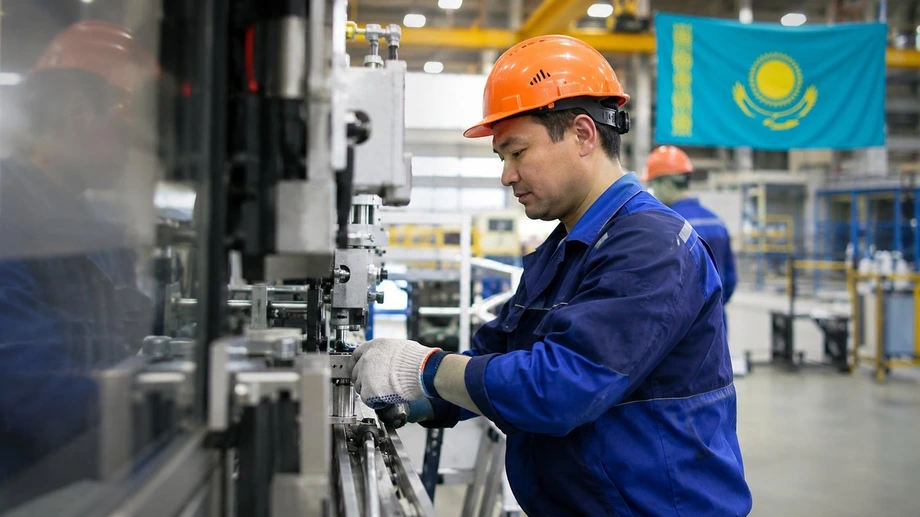
Manufacturing growth accelerated from 8.6% over nine months to 9.3% over ten months, an increase of 0.7 percentage points. That was more than twice the economy's 4.5% growth rate and well above the 3.5% increase in industrial production as a whole.
Manufacturing covers the processing of materials into products, including medicines, machinery and food. The broader industrial total also includes activities such as extraction. Their different growth rates help explain how factories could expand rapidly while industry as a whole grew more slowly.
The ministry's manufacturing breakdown showed gains across all seven industries it listed:
- Pharmaceuticals: 50.9%.
- Fabricated metal products: 30.4%.
- Machine building: 22.2%.
- Chemicals: 21.9%.
- Rubber and plastic products: 18.1%.
- Food products: 13%.
- Construction materials: 5.4%.
Medicines and fabricated metal products posted particularly steep increases, while machinery and chemicals also expanded by more than one fifth. Food production grew faster than the manufacturing average, and construction materials recorded a more modest increase.
An industry's contribution to GDP depends on both its growth rate and its size. A large industry growing steadily can add more output than a small industry expanding rapidly. Calculating how much each manufacturing branch added to national growth requires its weight in the economy as well as its production increase.
Growth extends across services and agriculture
Construction led the other major sectors listed by the ministry, with growth of 13.1%. Transport and warehousing expanded by 7.5%, trade by 6.2%, agriculture by 5.2% and communications by 4.9%.
The breadth of those gains matters for how economic activity reaches different businesses. Construction involves building work; transport and warehousing move and store goods; trade connects products with buyers. Agriculture and communications added further sources of expansion beyond factory production.
Construction's growth rate was almost three times the GDP rate, while transport and warehousing also expanded considerably faster than the economy. Trade, agriculture and communications each grew above 4.5%, though their rates were closer to the national figure.
Businesses across these sectors therefore experienced a wider expansion than the manufacturing figures alone suggest. The picture includes more production, more building activity and increased movement and sale of goods, rather than growth concentrated in a single industry.
Oil exports remain a major constraint
Kazakhstan began recovering raw material production in August after a decline in July associated with export restrictions through the Caspian Pipeline Consortium, known as CPC. The route carries more than 80% of Kazakhstan's exported oil to foreign markets.
Much of that oil comes from the Tengiz, Kashagan and Karachaganak fields. With such a large share of exports using one system, restrictions on the route can affect how much oil producers are able to send abroad and, in turn, their production decisions.
The planned output of about 96 million tonnes in 2026 faced pressure from both export constraints and accidents at major fields. Those difficulties help explain the contrast between strong manufacturing growth and the slower increase in total industrial output.
Minister of National Economy Serik Zhumangarin identified falling oil production, a stronger tenge and slower consumer lending as obstacles to growth in October. His assessment connected pressures on extraction with conditions affecting exporters and domestic spending.
A stronger currency can make goods priced in tenge more expensive for foreign buyers and reduce the amount of tenge earned from foreign currency revenues. Slower growth in consumer lending can also limit purchases financed through borrowing. Both channels matter alongside the physical ability to produce and export oil.
Factories report weak demand despite higher output
Kazakhstan's October manufacturing purchasing managers' index, or PMI, stood at 49.4, below the 50 threshold separating expansion from contraction in the survey. Manufacturing businesses reported weak demand and a shortage of orders even as cumulative production figures showed substantial growth.
The PMI asks companies about changes in business conditions, including areas such as output and orders. A reading below 50 indicates a decline in surveyed activity compared with the preceding month. At 49.4, the October reading was slightly below that dividing line.
The manufacturing production figures cover January through October compared with the same ten months of 2025. The PMI describes more recent changes reported by surveyed firms. A strong cumulative increase can therefore sit alongside weaker conditions toward the end of the period.
For factory managers, the combination makes new orders an important consideration. Production already completed contributes to the cumulative growth figure, while incoming orders help businesses decide whether to maintain output, buy materials or commit to further work.
A 6.5 trillion tenge infrastructure plan takes shape
President Kassym-Jomart Tokayev announced in an address on October 28 that 2027 would be the year of People's Construction. The planned building programme includes roads, hospitals, schools and stadiums across Kazakhstan.
Infrastructure projects are expected to receive 6.5 trillion tenge from the National Fund, with money released in instalments through 2029. The programme creates a future source of public spending alongside the construction sector's existing expansion of 13.1%.
The schedule separates the current production figures from the spending programme ahead. January through October growth describes work already carried out during that period; the announced fund transfers extend into the following years.
Government calculations estimate that the additional spending could add up to 0.8 percentage points to price growth over 12 months. Public spending can increase demand for labour, materials and equipment as projects move ahead. The estimate sets out a potential price cost alongside the planned infrastructure investment.
What the numbers mean for household budgets
Kazakhstan recorded inflation of 12.3% in 2025, alongside GDP growth of 6.5%. Those figures describe different parts of the economy: one measures rising consumer prices, while the other measures increased production after adjustment for prices.
Families experience economic change through wages, employment, prices and spending power. Assessing their position during 2026 requires current inflation figures, wages adjusted for price changes and information about household consumption. Those measures show how much people can buy with their incomes.
The infrastructure programme brings that relationship into focus. Roads, hospitals and schools would add public facilities, while spending on their construction would create demand for goods and work. The government's estimate of an additional price effect identifies a cost that household budgets could also face.
The GDP and sector estimates remain preliminary and may be revised by the Bureau of National Statistics. No date was given for final figures. The main dates and periods shaping the economic picture are:
- 2025: GDP grew by 6.5%, and inflation reached 12.3%.
- First half of 2026: GDP growth was 4.1%.
- July and August 2026: raw material production declined amid CPC export restrictions, then began recovering.
- January through September 2026: GDP grew by 4.2%, and manufacturing expanded by 8.6%.
- October 28, 2026: Tokayev announced the construction initiative for 2027.
- November 10, 2026: the ten month figures put GDP growth at 4.5% and manufacturing growth at 9.3%.
- Through 2029: planned National Fund payments for infrastructure are to be released in instalments.
Key Points
- Kazakhstan's real GDP grew by 4.5% in January through October 2026, up from 4.2% over nine months.
- The non-resource sector expanded by an estimated 5.6% and provided the main contribution to growth.
- Manufacturing grew by 9.3%, led in percentage terms by pharmaceuticals, fabricated metal products and machinery.
- Construction expanded by 13.1%, while transport, trade, agriculture and communications also grew.
- Oil production faced field accidents and constraints affecting CPC, which carries more than 80% of exported Kazakh oil.
- October's manufacturing PMI was 49.4, with businesses reporting weak demand and insufficient orders.
- A planned 6.5 trillion tenge infrastructure allocation extends through 2029; the government estimates an additional price effect of up to 0.8 percentage points over 12 months.