A Lost Prehistoric Site Found Again
Researchers in Mongolia have successfully relocated a giant dinosaur tracksite that had remained lost for more than 70 years. The site was originally mentioned in a brief two-page account by a Mongolian geographer decades ago, but it lacked precise location details and photographs. Without clear documentation, the location vanished from scientific records. A joint scientific expedition returned to the area in 2024 to search for the lost prints, eventually identifying 31 fossilized footprints in the Saijrakh area of northern Mongolia, also referred to as Saizhurakh. Detailed paleontological and geological studies followed in 2025, culminating in a formal announcement on April 2 at Okayama University of Science.
Contents
Scientists from multiple academic institutions participated in the rediscovery. The research team included members from the Institute of Paleontology at the Mongolian Academy of Sciences, the National University of Mongolia, and Okayama University of Science. The findings were published on March 19 in the international academic journal Ichnos, authored by Buuvei Mainbayar and his colleagues. Dr. Shinobu Ishigaki, who serves as the Honorable Director of the Museum of Dinosaur Research at Okayama University of Science, and Masato Fujita, a professor in the Department of Dinosaur Paleontology at the same university, announced the results at a university press conference.
Understanding the Ancient Landscape
The newly found tracks are preserved within the Shinekhudag Formation, a geological layer made of sediment deposited in a large lake approximately 120 million years ago during the Early Cretaceous period. Most of this rock formation consists of fine black clay laid down on the lake floor. However, geologists have identified thin sand layers interbedded within the clay. These sandy deposits formed during periods when the lake level dropped significantly, exposing wet sand and mud flats above the water line. Dinosaurs wandering through the area stepped onto these exposed surfaces, leaving deep impressions that were later buried under fresh sediment and preserved over millions of years.
During the Early Cretaceous, Earth experienced a warm global climate while flowering plants began to diversify rapidly across landscapes. Dinosaur populations in Asia were actively dispersing into North America during this era. Mongolia serves as a crucial geographical bridge for comparing animal communities between East Asia and North America. Despite this importance, fossils from the Early Cretaceous have remained relatively scarce in Mongolia, mostly consisting of small or medium animals like Harpymimus, Psittacosaurus, Zavacephale, and Choyrodon. No definitive dinosaur tracksites from this specific time window had ever been confirmed in the country until now, making this discovery the oldest known dinosaur tracksite in Northeast Asia.
Giants of the Early Cretaceous
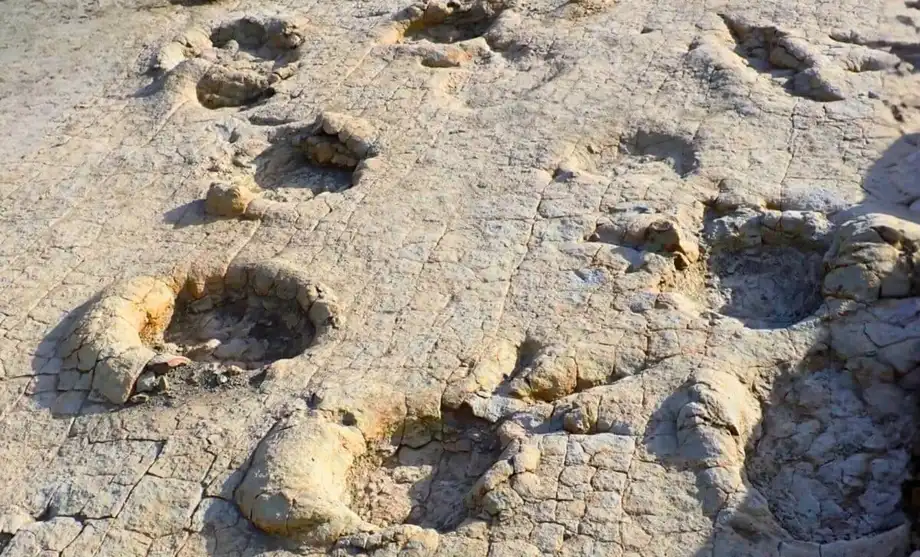
The 31 discovered footprints provide physical records of movement for some of the largest animals that ever lived. Researchers identified trackways left by two massive long-necked herbivorous dinosaurs known as sauropods, alongside five separate trackways created by large carnivorous theropods. Both plant-eaters and meat-eaters crossed the same bedding surface, offering direct proof that large dinosaurs inhabited regions as far north as northern Mongolia. Previously, evidence of large predators from this timeframe had been documented in China, South Korea, and Japan, but similar records were missing across Mongolia and eastern Russia.
The two sauropods were similar in size, leaving hind footprints that measure approximately 70 centimeters in length. Their body lengths are estimated to exceed 15 meters, which equals nearly 49 feet. The two sauropod trackways largely overlap, indicating that one animal walked first and another followed along nearly the same path at a slightly slower pace. Researchers noted that modern elephants exhibit similar behavior, stepping into the tracks left by the animal ahead of them. The forelimb impressions preserve both primitive features, such as a medially projecting first-digit claw, and derived features like soft-tissue pads, suggesting the tracks were made by titanosauriform sauropods moving with a wide stance.
The Apex Predators of Northern Asia
Carnivorous dinosaurs left an even more striking mark on the ancient lakebed. The largest theropod footprint discovered measures up to 57 centimeters across, featuring widely splayed toes. Based on these measurements, researchers calculated that the body lengths of these predators ranged between 7.4 and 8.8 meters, which is roughly 24 to 29 feet long. These dimensions make them the largest Early Cretaceous predators ever documented in the region.
The five theropod trackways point in various directions without any alignment that would suggest the animals traveled as a coordinated pack. Instead, the footprints indicate that multiple large predators crossed the same area independently within a short window before the mud hardened. The high concentration of overlapping tracks suggests the location served as a frequently used passageway rather than an isolated spot visited only once.
Dr. Shinobu Ishigaki and Masato Fujita presented the details of these apex predators during the April press conference, explaining how the findings shift previous assumptions about northern interiors. Some scientists previously wondered if harsh continental winters made northern Asian interiors inhospitable for colossal creatures. The new footprints demonstrate that large predators and massive herbivores thrived in these northern landscapes despite seasonal climate shifts.
Timeline of the Discovery
- About 70 years ago: A Mongolian geographer reports the discovery of dinosaur footprints in a brief two-page account lacking precise location details.
- Mid-20th century to recent years: The site is effectively lost among the vast landscapes of the Mongolian steppe due to insufficient documentation.
- 2024: A joint expedition by the Institute of Paleontology at the Mongolian Academy of Sciences and Okayama University of Science relocates the site with help from local residents.
- 2025: Researchers conduct a detailed paleontological and geological study of the 31 footprints at the Saizhurakh location.
- March 19, 2026: The research team publishes their findings in the academic journal Ichnos.
- April 2, 2026: Dr. Shinobu Ishigaki and Professor Masato Fujita formally announce the discovery at a press conference at Okayama University of Science.
Future Prospects for Paleontology in Mongolia
The rediscovery of the Saijrakh tracksite opens new avenues for regional research. Gravel-bearing sand layers identified near the footprints suggest favorable conditions for the preservation of skeletal material. Future scientific expeditions plan to target these surrounding rock exposures in search of bones, teeth, and other body fossils belonging to the track-making dinosaurs. Researchers also intend to survey nearby outcrops for additional tracksites that could further illuminate ecosystem evolution linking East Asia, Far Eastern Russia, and North America.
Footprint evidence reveals details about dinosaur behavior, foot anatomy, and movement that skeletal remains alone cannot provide. By documenting how giant herbivores and predators interacted with an ancient lakeside environment, the rediscovery bridges a major gap in the fossil record. A location overlooked for decades now stands as a vital window into the prehistoric world of northern Asia.
At a Glance
- Researchers rediscovered a lost dinosaur tracksite in the Saizhurakh area of northern Mongolia after 70 years.
- The site preserves 31 footprints dating back approximately 120 million years to the Early Cretaceous Shinekhudag Formation.
- Finds include two sauropod trackways exceeding 15 meters in length with hind footprints measuring about 70 centimeters.
- Five theropod trackways indicate large predators between 7.4 and 8.8 meters long roamed the region.
- The discovery represents the oldest known dinosaur tracksite in Northeast Asia and was published in the journal Ichnos.