A New Cosmic Visitor Enters Orbit
Earth has gained a temporary second moon, known scientifically as 2026 QQ8. This tiny asteroid measures approximately 1 to 2 meters in diameter, which is roughly the size of a human adult. Hungarian astronomer Krisztián Sárneczky initially spotted the object on August 20, 2026, while working as a research coordinator at the Konkoly Observatory. He originally designated the object as Sar2901 while searching for near-Earth asteroids during clear night observations. At first, the object resembled ordinary space rocks or artificial debris, but precise orbital calculations later revealed its true nature as a natural celestial body.
Contents
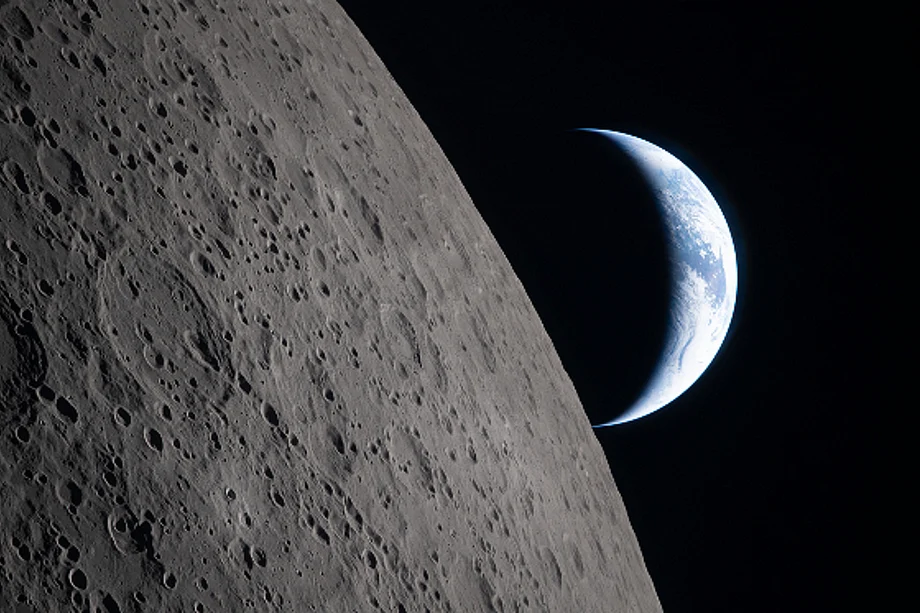
International Astronomical Union Minor Planet Center officially announced on October 29, 2026, that the asteroid had been captured by Earth's gravity. The celestial body crossed into Earth's Hill sphere in April 2026, which is the specific region around a planet where its gravitational pull dominates over the sun's influence. While the permanent Moon has accompanied Earth for roughly 4.5 billion years, this new visitor represents a transient phenomenon known among astronomers as a minimoon. Such temporary companions are natural objects pulled into irregular loop orbits around our planet before eventually escaping back into the broader solar system.
Confirming the Origin of a Faint Object
Astronomers faced initial uncertainty regarding whether 2026 QQ8 was a natural asteroid or a piece of defunct human-made space debris. Some theorists, including Harvard professor Avi Loeb, even speculated that the object might be connected to historical space missions such as a lost panel from Apollo 13. Because the asteroid appears extremely faint and small through telescopes, researchers required weeks of follow-up observation to establish its identity. Scientists tracked how solar radiation affected the movement of the object over several weeks to confirm its natural composition.
Specialized instruments played a crucial role in verifying the origin of the space rock. Researchers utilized the Lowell Discovery Telescope located in Arizona, United States, alongside the 2.2-meter telescope at the Mauna Kea Observatory in Hawaii. These advanced observations confirmed that the object possessed no connection to known artificial spacecraft. International Astronomical Union Minor Planet Center officially cataloged the body after gathering sufficient tracking data to map its distinct kidney-shaped orbit.
The asteroid belongs to a specific class of space rocks called Aten asteroids, which are near-Earth objects that cross into the orbit of our planet and maintain orbits closer to the sun than Earth itself. Furthermore, the object is a member of the Atira group of space rocks, whose orbits lie primarily inside Earth's orbit and periodically intersect it. Matthew Payne, director of the Minor Planet Center, described the observational challenges of tracking these small bodies during an interview with CNN. He explained that most minimoons remain difficult to detect with standard equipment because they are extremely small, distant, and travel at high speeds across the night sky.
Journey From the Asteroid Belt
Most near-Earth objects originate within the asteroid belt, a vast region situated between the orbits of Mars and Jupiter that contains millions of rocky bodies. Over millions of years, gravitational interactions alter the orbits of these objects, occasionally sending them drifting into the inner regions of the solar system. When a near-Earth asteroid approaches our planet at a sufficiently slow velocity, it avoids simply flying past and instead draws closer under gentle gravitational influence. The combined gravitational pull of Earth and the permanent Moon gradually modifies the original trajectory of the rock, placing it into a temporary loop around our world.
Astronomers have identified approximately 40,000 near-Earth objects to date, while cataloging roughly 1.5 million objects across the entire solar system. Major observational initiatives continue to expand our understanding of the cosmos, such as the Legacy Survey of Space and Time conducted by the Vera C. Rubin Observatory in Chile. That decade-long project utilizes the world largest digital camera and is expected to expand the known catalog of solar system objects from 1.5 million to 5 million. Future facilities like this will help scientists discover more transient companions that currently go unnoticed.
Trajectory and Departure Timeline
The temporary orbit of 2026 QQ8 will conclude soon, as the asteroid prepares to leave the sphere of influence surrounding our planet. The object is expected to break free from Earth's gravity in early December or January, resuming its independent journey around the sun. At its closest approach, the asteroid reached a distance of approximately 568,000 kilometers from Earth, which is roughly 1.5 times the average distance between Earth and the permanent Moon. Because of this separation, the object poses zero risk of collision with our planet.
- August 20, 2026: Hungarian astronomer Krisztián Sárneczky discovers the object and provisionally names it Sar2901.
- April 2026: The asteroid crosses into Earth's Hill sphere and enters a temporary orbit.
- October 29, 2026: International Astronomical Union Minor Planet Center officially classifies and designates the object as 2026 QQ8.
- December 2026 to January 2027: The minimoon is projected to escape Earth gravity and return to its solar orbit.
- 2058: The asteroid is not expected to make another close pass near Earth until this future year.
Understanding Collision Safety and Atmospheric Entry
Public interest surrounding newly discovered space rocks often involves questions about potential impacts on Earth. Astronomers emphasize that 2026 QQ8 presents no threat whatsoever to our world. Even if the tiny asteroid were to encounter our atmosphere, its small size of only 1 to 2 meters would prevent it from reaching the ground intact. Friction generated during atmospheric entry would cause the rock to disintegrate completely before impact.
Matthew Payne, director of the Minor Planet Center, addressed safety concerns regarding the small asteroid during an interview with CNN by explaining the exact outcome of a hypothetical impact. He stated,
At best, you would get a bright meteor in the sky and a bit of a bang.
This means observers on the ground would likely witness nothing more than a bright flash of light resembling a shooting star, accompanied by a minor sonic boom, rather than any destructive event.Frequency of Temporary Moons
The appearance of 2026 QQ8 represents a normal occurrence in the dynamic environment of the solar system rather than a rare anomaly. Astronomical records show that Earth has captured similar temporary companions in the past. Previous documented examples include the asteroid 2006 RH120, which orbited Earth for about one year, and 2020 CD3, which stayed for approximately three years. Other recent visitors include 2020 SO and 2024 PT5, alongside quasi-moons like 2025 PN7 that share an orbital period with Earth while actually orbiting the sun.
Temporary companions generally stay in orbit for periods ranging from a few weeks to several months before continuing their travels. Matthew Payne noted the statistical frequency of these visitors during his interview with CNN, explaining,
On average, we estimate that there is roughly one minimoon around Earth at any given time.
He further noted that while one might be present, the population fluctuates so that our planet occasionally hosts two or none at all during any given year.The Essentials
- Asteroid 2026 QQ8 measures between 1 and 2 meters across and was captured by Earth gravity in April 2026.
- Hungarian astronomer Krisztián Sárneczky discovered the celestial body on August 20, 2026.
- International Astronomical Union Minor Planet Center officially cataloged the object on October 29, 2026.
- The asteroid passes near Earth roughly once every decade in a kidney-shaped orbit and will not return this close until 2058.
- The temporary minimoon is projected to leave Earth orbit in December 2026 or January 2027 to continue orbiting the sun.