Civilians Prepare for Conflict Inside Taipei Classrooms
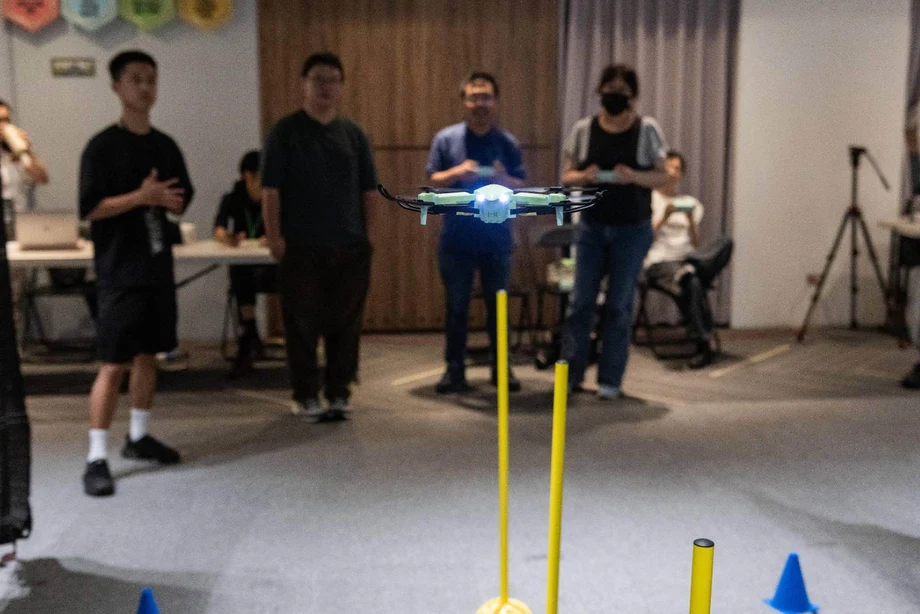
Ordinary citizens gathered inside a nondescript office building in Taipei to learn how to operate small quadcopters, similar to those deployed on European battlefields. Instructors guided participants through obstacle courses designed to simulate tactical drone operations during potential conflicts. Tang Tsung-yi, an instructor overseeing the sessions, explained the broader philosophy behind the training. Deterrence comes not only from military strength but also from the preparedness and will of civil society as a whole, according to Tang. The Kuma Academy, also known as the Black Bear Academy, organized these educational sessions. Established in 2001 to build societal resilience, the non-profit organization now boasts 20,000 members across Taiwan, with women making up the majority of participants. In addition to drone piloting, the academy offers courses in first aid, self-defense, and media literacy designed to counter disinformation. Participants also encounter a prominent motto on classroom walls, attributed to the Roman writer Vegetius: If you desire peace, you must first prepare for war. Tang emphasized that this preparation focuses on survival rather than combat, teaching citizens where to hide and how to protect their families if hostilities erupt.
Contents
Anxiety about a potential Chinese invasion remains palpable across the island. Generals, analysts, and politicians have frequently noted that China's military, significantly upgraded under President Xi Jinping, could be ready to mount an operation by 2027. Although most observers believe Beijing has not fixed a specific invasion date, military pressure has intensified. In the weeks following the United States midterm elections, China conducted major military exercises around Taiwan that simulated a complete maritime and aerial blockade. Earlier in November 2026, 100 Chinese naval vessels encircled the island in one of the largest deployments to date. These drills preceded a high-profile summit in Shenzhen between Xi, U.S. President Donald Trump, and Russian President Vladimir Putin. During this gathering, often compared to the 1945 Yalta Conference, the leaders discussed global order and strategic stability. Although the meeting produced few concrete agreements, the symbolism of Trump and Putin standing alongside Xi heightened anxieties in Taipei regarding Washington's long-term commitment to the island's defense.
Diplomatic Friction Follows the Shenzhen Summit
Diplomatic statements emerging from the Shenzhen meeting triggered intense political debate and official denials across the Taiwan Strait. Chinese state media reported that during bilateral talks on November 19, 2026, at the Qilinzhuang guesthouse, Trump explicitly stated that the United States does not support Taiwan independence. This marked the first time state media directly attributed such phrasing to the American leader. Taiwanese authorities swiftly challenged these reports. Chiu Chui-cheng, chairman of Taiwan's Mainland Affairs Council, stated on November 21, 2026, that preliminary checks indicated the state media reports were false and represented typical external communication maneuvers by Beijing. Foreign Minister Lin Chia-龙 similarly urged observers to rely solely on official statements from Washington, emphasizing that U.S. policy toward Taiwan remained unchanged. Academic observers offered varied assessments of the diplomatic friction. Chang Wu-yue of Tamkang University noted that avoiding support for formal independence reflects longstanding American policy, while Wang Hong-jen of National Cheng Kung University warned that Taipei must issue a solemn clarification if similar wording appears in official U.S. documents. Bonnie Glaser of the German Marshall Fund observed that Beijing appeared to be leveraging personal relationships and improved bilateral atmospheres to encourage American restraint on Taiwan.
The diplomatic maneuvering coincided with discussions regarding major military procurement packages. Taiwan is currently awaiting final approval for a proposed $14 billion arms sale from the United States. This package is designed to support the development of the T-Dome, an integrated air defense network intended to combine radar systems, automated command and control networks, and Patriot missile interceptors. The proposed acquisition follows a record $11.1 billion weapons package approved in December 2025. Su Tzu-yun, a military expert at the Institute for National Defense and Security Research, highlighted the strategic value of integrating these defensive components to enhance overall resilience. However, the timing of these sales has faced political complexities. Trump previously described arms sales as a useful negotiating chip with China, and his administration's focus on other geopolitical conflicts, such as the war in Iran, has heavily depleted American missile stockpiles. Despite these competing priorities, analysts like William Chung of the INDSR pointed out that the current U.S. administration has approved substantial military hardware for Taiwan, suggesting that underlying strategic trajectories remain supportive even amid conciliatory rhetoric.
Building a Domestic Defense Industrial Base
Taiwan is accelerating efforts to build a domestic defense industry free from Chinese components, a strategy promoted heavily by President Lai Ching-te under the banner of a non-red supply chain. This initiative aims to establish independent production capabilities for military hardware, particularly unmanned aerial vehicles. Investment in drone technology has surged as the island seeks to transform itself into a primary production hub for democratic nations. Official trade data indicates that drone exports grew by more than 700 percent during the first half of 2025, driven largely by European demand from countries such as Poland and Czechia. Additional international sales include a £36 million purchase by Saudi Arabia in June 2025. Furthermore, the government approved a £5.7 billion, six-year drone program in August 2025 with the objective of manufacturing more than 100,000 drones per month by 2030. These industrial initiatives mirror lessons learned from international conflicts, where low-cost, rapidly adaptable unmanned systems have altered the nature of modern warfare. By developing these capabilities locally, Taiwan hopes to insulate its military supply chains from foreign interference and external economic pressure.
Industrial expansion has encountered occasional administrative hurdles and legal scrutiny. Prosecutors in Taoyuan detained two senior executives from Jiin Ming Industry, a precision metal manufacturer listed under stock code 3230, following raids across six locations on October 8, 2026. Investigators alleged that the company and its subsidiary, Yingsheng International, supplied military drones containing prohibited Chinese chips and lenses while submitting false certificates of origin to acceptance authorities. The Taoyuan District Court ordered vice chairman and general manager Jian Haoting and business director Chen Yangcheng detained starting October 9, 2026, with visitation prohibited under suspicion of violating the National Security Act and committing fraud. Company representatives stated that defense contracts accounted for roughly 1.1 percent of total revenue through September, and management operations continued normally under temporary leadership. While investigators probed the origin of the physical components and the accuracy of accompanying paperwork, no evidence emerged indicating that the delivered aircraft were compromised, hacked, or used to transmit sensitive operational data to external actors.
Lessons Learned from Foreign Conflicts
Taiwanese citizens and military volunteers have closely monitored conflicts abroad to extract tactical lessons for home defense. A notable example is a former Taiwanese military serviceman known as Chal, who traveled to Ukraine in 2022 to fight as a foreign volunteer against Russian forces. Operating within an air defense unit tasked with intercepting Iranian-designed Shahed drones, Chal observed firsthand how modern combat has been revolutionized by unmanned aerial systems. Speaking from Ukraine, he noted that contemporary battlefields are dominated by aerial observation and targeted strikes, prompting military planners in Taipei to rethink traditional defensive doctrines. Instructors at organizations like the Kuma Academy frequently incorporate Ukrainian combat experiences into civilian training modules, emphasizing low-cost manufacturing, rapid deployment, and decentralized operational tactics. These instructional methods aim to prepare everyday citizens for asymmetric warfare, ensuring that local communities can maintain basic functions and provide mutual support if regional stability collapses.
The broader geopolitical environment features a complex interplay between superpower negotiations and regional deterrence. During past military exercises, such as the Justice Mission operations conducted in late December 2025, China's People's Liberation Army deployed dozens of aircraft and naval vessels to simulate comprehensive blockades and precision strikes against key maritime ports like Keelung and Kaohsiung. These drills demonstrated Beijing's growing anti-access and area-denial capabilities, which are specifically designed to impede the movement of external military forces seeking to intervene in a regional crisis. William Yang, a senior analyst for Northeast Asia at the Crisis Group, noted that such exercises send powerful signals to allies regarding the difficulties of breaking a potential blockade. Public opinion within Taiwan reflects a cautious and sometimes skeptical view of foreign security guarantees, with surveys indicating that only a minority of the population regards external powers as fully dependable. Consequently, political leaders and civil society groups continue to emphasize self-reliance, domestic technological innovation, and comprehensive societal preparedness as the primary bulwarks against future aggression.
Chronology of Recent Developments
- December 2025: The United States approves a record $11 billion arms sale to Taiwan, while China conducts extensive military blockade drills named Justice Mission 2025.
- May 2026: Taiwan's parliament passes a $25 billion special defense spending bill to support military modernization and domestic arms production.
- October 8, 2026: Investigators execute search warrants at six locations connected to Jiin Ming Industry over allegations involving prohibited components in military drones.
- November 19, 2026: U.S. President Donald Trump and Chinese President Xi Jinping hold a bilateral summit in Shenzhen on the sidelines of the APEC Economic Leaders Meeting.
- November 21, 2026: Taiwan's Mainland Affairs Council officially refutes state media claims regarding American statements on Taiwan independence.
The convergence of civil defense training, industrial expansion, and shifting diplomatic alignments highlights the multifaceted challenges facing modern Taiwan. As local communities practice drone piloting and emergency preparedness, policymakers navigate delicate international negotiations and defense procurement timelines. The ongoing evolution of asymmetric warfare capabilities ensures that societal resilience will remain a central pillar of the island's long-term security strategy.
The Essentials
- Civilians in Taipei are actively participating in civil defense courses organized by groups like Kuma Academy to learn drone piloting and emergency survival skills.
- Chinese state media reported that U.S. President Donald Trump stated a lack of support for Taiwan independence during discussions in Shenzhen, prompting official denials from Taipei.
- Taiwan is advancing a $14 billion proposed American arms package to support its multi-layered T-Dome air defense network.
- Domestic manufacturing initiatives aim to build a non-red supply chain for military drones, with exports experiencing significant growth despite occasional procurement investigations.
- Volunteers with international combat experience in Ukraine have contributed tactical insights regarding unmanned aerial defense to domestic preparedness efforts.