Gold Prices Drop Sharply Across Bangladesh
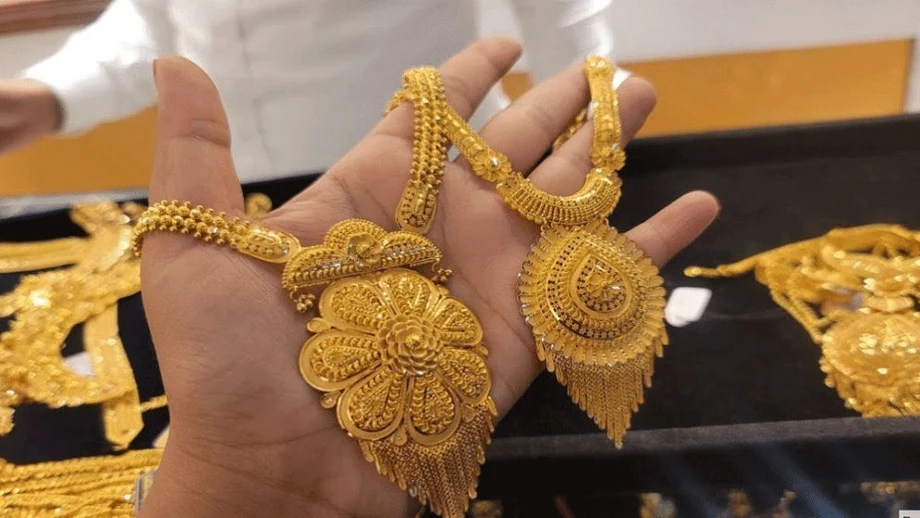
Gold prices in Bangladesh have fallen significantly after remaining on an upward trend for most of the year. The Bangladesh Jewellers Association decided to cut gold prices for the ninth consecutive time. Under the latest decision made at a meeting of the BAJUS Standing Committee on Pricing and Price Monitoring at around 9:30pm on Saturday, November 21, the price of 22-carat gold was reduced by Tk 6,182 per bhori to Tk 194,964. As a result, the price dropped by Tk 17,146 per bhori in just two days. The revised rates took effect across the country from Sunday, November 22.
Contents
- Gold Prices Drop Sharply Across Bangladesh
- Understanding the Bhori and Carat System
- Record Highs and the Journey Down
- Global Market Pressures and International Declines
- Economic Factors Behind the Worldwide Drop
- Expert Insights on Market Volatility
- A Detailed Timeline of Recent Price Cuts
- Consumer Uncertainty and Silver Price Revisions
- The Bottom Line
The price of 21-carat gold was set at Tk 186,216 per bhori, while 18-carat gold now costs Tk 159,972 per bhori. Traditional method gold is priced at Tk 130,345 per bhori. Government-imposed VAT is already included in the announced selling prices, meaning jewellery shops cannot collect VAT separately from customers. Buyers still have to pay making charges, which vary depending on the design of the jewellery. For jewellery exchanges, a 9 percent deduction applies, excluding making charges and the value of stones, while purchases carry a 15 percent deduction on the same basis.
Understanding the Bhori and Carat System
In Bangladesh, gold is traditionally measured in units called bhoris, where one bhori equals 11.664 grams. The purity of gold is measured in karats, with 24-carat being pure gold. Because pure gold is too soft to make durable jewellery, it is mixed with other metals like copper, silver, or zinc to create 22-carat, 21-carat, and 18-carat gold. The number indicates the proportion of pure gold in the alloy, meaning 22-carat gold contains 22 parts of gold and 2 parts of other metals.
Traditional method gold refers to old or recycled gold ornaments melted down and crafted into new pieces without official hallmark standards. Making charges are labour fees charged by jewellers to shape raw gold into wearable art. Tejabi gold refers to pure refined gold bars traded in the local bullion market before jewellers use them to craft ornaments.
Record Highs and the Journey Down
Domestic gold prices reached unprecedented heights earlier in the year, driven by international market trends. On January 29, the price of 22-carat gold climbed to a record Tk 286,001 per bhori. The price of 22-carat gold first crossed the two lakh bhori milestone on October 6 of last year. It rose further to Tk 217,382 on October 20 before dropping to Tk 193,809 on October 29. The price then rebounded above the two lakh threshold, where it remained for over a year until the recent steep declines.
Before the consecutive price reductions began, a bhori of 22-carat gold jewellery cost Tk 229,664, including VAT. That was Tk 28,518 higher than the current price. The domestic gold market last saw prices at this level around 13 months ago.
Global Market Pressures and International Declines
International gold prices have been falling sharply, creating a domino effect on local markets. In global spot markets, the price of gold per ounce dropped significantly, reaching around 3,514 dollars on Friday, November 21. An ounce is a standard unit of weight for precious metals, roughly equal to 31.103 grams. This global drop represents a decline of more than 2,000 dollars an ounce over the past year and marks one of the largest weekly percentage drops for the precious metal in months.
Dewan Aminul Islam Shaheen, chairman of the BAJUS Standing Committee on Pricing and Price Monitoring, explained that domestic adjustments directly reflect international trends. He stated that the global market has experienced sustained downward pressure.
We have calculated that over the past year, the price of gold per ounce in the global market has fallen by more than two thousand dollars. In that continuation, it has decreased in the domestic market as well.
Economic Factors Behind the Worldwide Drop
Financial analysts point to several macroeconomic factors driving down the global price of gold. Central banks, particularly the United States Federal Reserve, have maintained strict monetary policies and high interest rates to combat inflation. High interest rates strengthen the US dollar and increase yields on government bonds, which are fixed-income investments. Because gold does not pay interest or dividends, investors often prefer bonds and cash when interest rates are high.
Global stock markets, especially companies tied to artificial intelligence technologies, have also experienced sell-offs. Investors facing losses in technology stocks often sell other assets, including gold, to raise cash. This forced liquidation creates heavy selling pressure across commodity markets.
Chris Weston, head of research at Pepperstone, described the market environment. He stated that the gold market faces a complex mix of macroeconomic headwinds and forced asset liquidation.
Expert Insights on Market Volatility
Market analysts monitoring the precious metals sector believe further downward movement is possible. Vijay Valecha, chief investment officer at Century Financial, noted that recent declines stem from mutually reinforcing negative forces. He explained that a strong dollar creates additional pressure on gold while AI stock sell-offs prompt investors to pull cash out of various asset classes without necessarily moving funds into safe havens.
Frank Walbaum, a market analyst at NAGA.com, pointed out that breaking previous support levels has pushed prices toward lower psychological thresholds. He suggested that if prices remain below key levels, further declines could follow before long-term investors step back into the market.
A Detailed Timeline of Recent Price Cuts
Domestic prices fell rapidly over a two-week period following a brief series of hikes. After three increases over four days added Tk 12,072 to reach Tk 229,664 per bhori on November 5, BAJUS initiated a sequence of reductions:
- November 6: Cut by Tk 2,741 to Tk 226,923 per bhori
- November 11: Cut by Tk 2,741 to Tk 224,182 per bhori
- November 12: Cut by Tk 2,216 to Tk 221,966 per bhori
- November 13: Cut by Tk 2,158 to Tk 219,808 per bhori
- November 14: Cut by Tk 2,216 to Tk 217,592 per bhori
- November 18: Cut by Tk 2,216 to Tk 215,376 per bhori
- November 19: Cut by Tk 2,216 to Tk 212,110 per bhori
- November 20: Cut by Tk 10,964 to Tk 201,166 per bhori
- November 22: Cut by Tk 6,182 to Tk 194,964 per bhori
Consumer Uncertainty and Silver Price Revisions
The sudden plunge has created mixed reactions among local consumers and investors. Some potential buyers view the price correction as an opportunity to purchase gold at a lower cost after months of prohibitive prices. Others hesitate, fearing that continued international drops could push domestic prices down further.
Alongside gold, BAJUS also adjusted silver prices downward in previous revisions. Silver rates vary by quality, with traditional and graded silver ornaments following separate pricing schedules determined by weight and purity standards.
The Bottom Line
- Gold prices in Bangladesh fell below two lakh taka per bhori for the first time in a year, with 22-carat gold priced at Tk 194,964.
- The Bangladesh Jewellers Association implemented nine consecutive price reductions over a two-week span, cutting a total of Tk 34,700 per bhori.
- Global spot gold prices dropped near 3,514 dollars per ounce due to US interest rate policies and broader financial market liquidations.
- Industry officials confirmed that local rates are adjusted strictly in response to downward movements in international bullion markets.