A financing inquiry, not a bid
SoftBank founder Masayoshi Son has stopped actively considering a possible acquisition of South Korean memory chipmaker SK Hynix after exploring whether Wall Street institutions could help finance a deal that was described as worth about $1 trillion.
Contents
The discussions were reported on November 20, 2026. A SoftBank spokesperson later said Son was no longer actively considering the transaction, but the spokesperson's exact statement and its original context were not provided. No formal offer has been disclosed, and SK Group, which controls SK Hynix, has given no indication it plans to sell.
The scale is striking. SK Hynix had a market value of about $580 billion, or roughly 777 trillion won, while the reported $1 trillion price was put at about 1,346 trillion won. That would be around 569 trillion won above the company's market value. The proposed figure was an estimate of a possible transaction, not an agreed price.
The reported figures also leave a valuation question. A 40% premium on a $580 billion market value would come to about $812 billion, rather than $1 trillion. The stated price and premium therefore do not line up on those assumptions, and no detailed offer or calculation has been made public.
The immediate story is less about a deal being struck than about how far Son was willing to explore a purchase, and the financial, political and ownership barriers that stand in its way.
Why SK Hynix matters to the AI boom
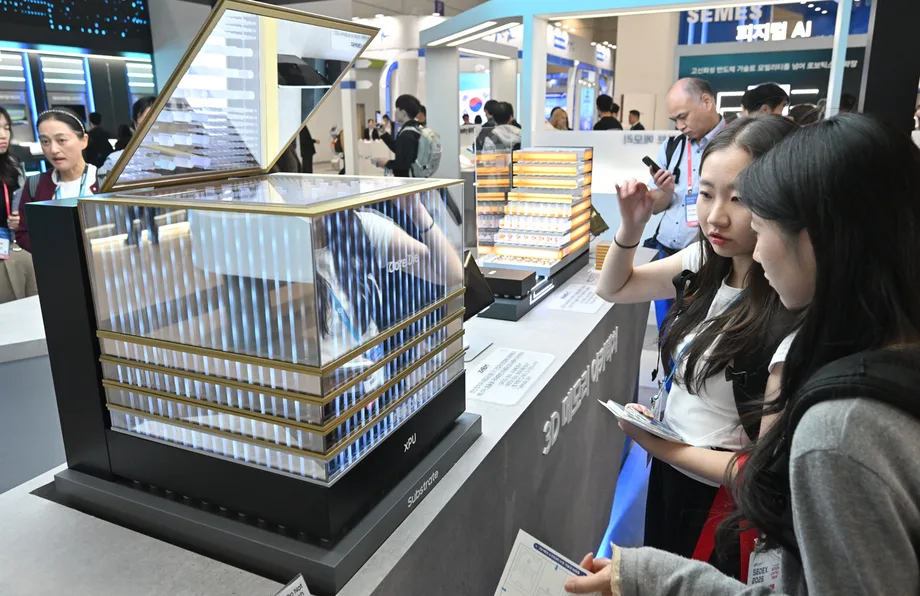
SK Hynix is one of the world's leading suppliers of high bandwidth memory, or HBM. This type of memory sits close to a processor and moves large amounts of data quickly, helping advanced AI chips handle the demanding calculations used to train and run artificial intelligence systems.
Demand for HBM has grown alongside the construction of AI computing systems. SK Hynix, Samsung Electronics and US based Micron Technology are the main companies competing in this market. Strong demand has lifted memory makers' profits and share prices, while making reliable supplies of memory a strategic concern for companies building AI infrastructure.
For SoftBank, ownership of SK Hynix could have connected several parts of its AI portfolio. The group has investments in chip design company Arm, data center and energy businesses, chipmaker Ampere, DigitalBridge, Intel and OpenAI. Memory is a key component between chip design and the computing systems that run AI services. A direct stake in a major memory supplier could have given SoftBank a stronger position across that chain.
Could SoftBank finance a purchase this large?
Even for a company accustomed to large deals, a purchase near $1 trillion would be an extraordinary financing test. SoftBank has invested $64.6 billion in OpenAI and used its Arm shares as collateral. Collateral is an asset pledged to support borrowing; if a borrower cannot meet its obligations, the lender may have rights over that asset.
Son has also used asset sales and pledges to fund earlier transactions. SoftBank bought Arm for $32 billion, and in 2017 Son partnered with sovereign wealth funds to launch the $100 billion Vision Fund. Those examples show the group has assembled major pools of capital, but they are far smaller than the sum under discussion for SK Hynix.
No indication has emerged that Wall Street institutions were prepared to provide financing on the scale such a takeover would require. A large borrowing package could also put pressure on SoftBank's balance sheet and on the value of assets pledged to lenders. The inquiry into funding appears to have been an early test of whether the idea could be made financially possible.
The two dates that mark the public course of the idea are:
- November 20, 2026: News emerged that Son had contacted Wall Street institutions to explore financing for a possible SK Hynix acquisition.
- November 21, 2026: SoftBank's position was reported as being that Son was not actively considering the deal.
South Korea's approval and SK Group's decision
Money would be only one obstacle. South Korea places strict limits on foreign acquisitions involving core technology assets. The framework is set out in Article 11-2 of the Industrial Technology Protection Act and Enforcement Decree provisions 18-3 and 18-5; the revised law took effect on February 21, 2020. For a holder of national core technology developed with state research and development funding, an overseas acquisition or merger is subject to prior approval by the Minister of Trade, Industry and Energy. For a holder without state research and development funding, advance notification is required. The law also requires the target company to notify the ministry when a foreign investor pursues an acquisition, extending that duty to holders without state funding. Which requirements apply to a particular transaction depends on the target's status and the circumstances; no information establishing those facts for SK Hynix has been made public.
SK Group's position is just as important. The group controls SK Hynix and has not signaled that it wants to sell. Even if SoftBank found willing lenders and addressed regulatory concerns, a transaction would still depend on the seller's willingness to negotiate.
Those barriers help explain why exploring financing is not the same as launching a bid. The reported discussions did not produce a public offer, a disclosed agreement with SK Group or a stated timetable for government review.
What the figures mean for shareholders
A takeover proposal can raise a company's shares because investors expect a buyer to pay more than the current market price. A premium is that extra amount. In this case, the reported 40% premium would imply a large increase over the stated $580 billion market value, while the separate $1 trillion estimate would imply a still higher valuation if the same market value is used.
With SoftBank no longer actively considering the deal, shareholders have less reason to expect a near term price increase tied to a takeover offer. The company's value will continue to depend on its business and the demand for memory used in AI systems. The change removes one possible source of deal speculation, while leaving the broader competition for HBM in place.
The difference between market value and a potential takeover price matters for readers. Market value is the stock market's current valuation of a company. A buyer may offer more to persuade shareholders to sell, but the size of any premium depends on the actual offer and the company's share price at that time. Here, neither a formal offer nor a confirmed transaction value exists.
What SoftBank might consider instead
Alternatives could include a minority investment, a joint venture or a multi year supply agreement. A minority investment would give SoftBank a stake without buying control. A supply agreement could secure access to memory without requiring the group to purchase the manufacturer. No such arrangement has been announced.
These options would involve different levels of cost and control. A full takeover would give SoftBank direct ownership of SK Hynix, but would also bring the largest financing burden and the greatest regulatory scrutiny. A smaller investment or commercial partnership could connect the companies while requiring less capital, though it would not give SoftBank the same control over production or supply.
For now, the decisive unknowns are whether SK Group ever wants to sell and whether SoftBank returns to the idea in another form. No next negotiation, regulatory decision or deadline has been announced.
What to Know
- Masayoshi Son explored financing for a possible SK Hynix acquisition valued at about $1 trillion.
- SoftBank says Son is no longer actively considering the deal; no formal offer has been disclosed.
- SK Hynix had a market value of about $580 billion, and SK Group has not indicated that it plans to sell.
- SK Hynix is a leading supplier of high bandwidth memory used in advanced AI chips.
- Financing and South Korean review of a foreign takeover of a core technology company would be major obstacles.