Eight years of talks produce new market access pledges
South Korea and China announced the substantive conclusion of services and investment negotiations on November 18, 2026, securing pledges on the treatment of Korean films and games, tourism operations in 23 Chinese regions and broader access for retailers, law firms and construction companies.
Contents
- Eight years of talks produce new market access pledges
- What changes for Korean films and games?
- Joint productions gain a broader route to audiences
- Travel agencies gain access in 23 Chinese regions
- Retailers, lawyers and builders receive wider access
- New investment rules change the starting point
- Why the negotiations took so long
- Both countries face new opportunities and competition
- The summit linked trade with security and technology
- Key Points
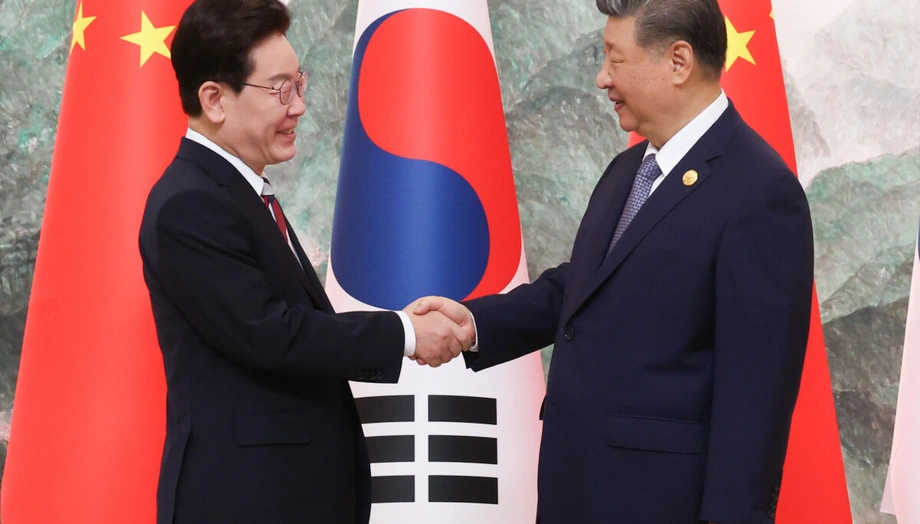
The announcement followed a meeting between South Korean President Lee Jae Myung and Chinese President Xi Jinping in Shenzhen, Guangdong province, on the sidelines of the Asia-Pacific Economic Cooperation summit. The negotiations lasted eight years and eight months, extending a free trade agreement that took effect in December 2015 and focused mainly on goods.
South Korea's Ministry of Trade, Industry and Energy said China would grant Korean film and gaming businesses most-favored-nation treatment and apply nondiscrimination principles when reviewing their content. The commitments give Seoul a trade agreement framework for challenging unfavorable treatment compared with businesses from other countries.
Industry Minister Kim Jung-kwan described the outcome as a firmer foundation for companies seeking business in China.
"The agreement provides a stable institutional basis for Korean companies to expand their presence in China in sectors where they have competitive strengths, including K-content, tourism, finance and distribution," Kim said.
Formal signing, parliamentary ratification and remaining technical work still lie ahead. Signing is anticipated as early as June 2027, with entry into force envisaged for the second half of that year, although a final implementation timetable has yet to be announced. For businesses, the immediate task is preparing for the promised access while governments finish the legal steps.
What changes for Korean films and games?
China's most-favored-nation commitment means Korean films and games should receive treatment at least as favorable as comparable content from third countries. Despite its name, the principle is about equal treatment rather than special preference.
China also agreed to apply nondiscrimination in the screening of Korean films and online games. South Korea's trade ministry described the inclusion of these content provisions in a Chinese trade agreement as a first.
A senior ministry official explained how Seoul could use the commitment if Korean businesses encounter informal barriers.
Even without explicit regulations restricting Korean content, if it receives less favorable treatment than third-country content, the issue can be raised as a violation of the agreement.
Chinese screening procedures remain in place, while film import numbers and game approval numbers are unresolved. Korean producers will continue to need regulatory approval before reaching audiences. For Korean singers, commercial concert access remains dependent on performance approvals and other administrative permissions; the announced agreement contains no explicit provision for resuming their commercial performances.
Those practical issues matter because China's unofficial restrictions on Korean culture followed Seoul's 2016 decision to deploy the United States Terminal High Altitude Area Defense missile defense system, known as THAAD. The restrictions disrupted entertainment distribution and tourism, making administrative decisions a central concern for companies considering a return.
Joint productions gain a broader route to audiences
Korean and Chinese producers will have a wider range of formats available for qualifying joint productions. Cooperation previously centered on films will extend to dramas, animation, variety shows and documentaries.
Productions meeting the agreed requirements can be recognized as domestic content in both countries. In China, that status can provide access to scheduling quotas reserved for domestic programs and other benefits. For a production company, the status assigned to a show can shape where and how it reaches viewers.
National Security Adviser Wi Sung-lac said Lee proposed expanding cultural exchanges in phases, taking account of differences among Chinese regions and sectors. Xi supported gradual cultural cooperation, and the leaders agreed to work together on joint film production.
The approach combines two routes: commitments governing the treatment of Korean content and projects that Korean and Chinese companies create together. Producers will need the final rules to determine which projects qualify and how domestic status will be applied.
Travel agencies gain access in 23 Chinese regions
South Korean travel agencies established in 23 designated Chinese regions will be allowed to arrange overseas trips directly for Chinese citizens and foreign residents. The regions include Beijing, Shanghai, Chongqing and Hainan.
The change addresses a concrete restriction on their business. Korean agencies operating in China have faced limits on organizing overseas travel for local residents, while Chinese agencies in South Korea have been able to sell overseas packages there.
Eligible Korean agencies will be able to recruit customers and sell packages to destinations including South Korea, Japan and Southeast Asia. The opportunity therefore extends beyond bringing Chinese tourists to Korea: it gives these agencies a larger role in China's outbound travel market.
Lee said visits between the two countries were expected to reach 10 million in 2026, the first time in seven years, and called for restoring the 13 million recorded in 2016. Using 10 million as the comparison point, reaching 13 million would require another three million visits, or a 30 percent increase.
The figures count visits rather than individual travelers. They nevertheless show the scale of the recovery sought by hotels, airlines, travel agencies and other businesses that depend on movement between the countries.
Retailers, lawyers and builders receive wider access
Korean distribution companies will be able to operate more than 30 stores in China independently, without forming a joint venture with a Chinese partner. That gives retailers greater scope to control their operations as they expand.
Korean law firms will gain more locations where they can work with Chinese firms, including handling cases jointly and forming business partnerships. Access will extend beyond Shanghai to Tianjin, Qianhai in Shenzhen and Hainan, including Haikou.
Construction provisions will lift restrictions on the types of projects Korean companies can participate in. China's annual construction market is estimated at roughly $4 trillion, giving the change a potentially large commercial setting, although companies will still have to secure individual projects.
Financial services receive a commitment tied to future opening. If China gives firms from third countries additional access to its financial markets, Korean firms will be entitled to the same benefits under the agreed terms.
The financial provision is designed to keep Korean businesses from falling behind later agreements. The retail and legal provisions address more immediate operating questions: whether a company needs a local partner, where it may establish an office and how it can work with local firms.
New investment rules change the starting point
The agreement shifts services and investment opening toward a negative list. Under this approach, governments list the sectors or measures they reserve from opening, while access is permitted in principle elsewhere. A positive list works in the opposite direction, opening only the activities specifically named.
China will retain reservations for some sectors. Companies will therefore need to examine both the general commitments and the exceptions before deciding where they can invest.
A ratchet principle is also included. It is intended to lock in covered regulatory changes that make access easier, preventing governments from simply restoring restrictions after relaxing them.
Investment provisions prohibit requirements that force technology transfers as a condition of investment. Protection through investor-state dispute settlement, or ISDS, will also extend to the stage before an investment is established. ISDS provides a process through which an investor can bring a claim that a government breached its treaty obligations.
These rules address costs that are less visible than tariffs on goods. An investor may spend money preparing an office, negotiating a partnership or planning a distribution network before operations begin. Commitments covering entry and regulatory treatment can help businesses assess those risks earlier.
Why the negotiations took so long
Cultural content was a central obstacle during the negotiations. After responsibility for film and publishing administration moved to the Chinese Communist Party's Central Propaganda Department, Beijing sought to exclude cultural content from the talks. Seoul opposed that demand, arguing it would move backward from the existing agreement.
Official negotiations stopped for more than four years after October 2020. China later withdrew its exclusion demand, allowing talks to resume. A summit in January 2026 gave the negotiations further political momentum.
- December 2015: The original South Korea-China FTA entered into force, concentrating on trade in goods.
- March 2018: Follow-up negotiations on services and investment began.
- After October 2020: Official talks entered a prolonged suspension amid disagreements over cultural content.
- January 2025: Official negotiations resumed after China withdrew its demand to exclude cultural content.
- January 2026: A leaders' summit helped accelerate negotiations.
- November 18, 2026: Seoul and Beijing announced substantive completion in Shenzhen.
- 2027: Signing is anticipated as early as June, followed by possible entry into force in the second half.
The long interruption helps explain why the film and game provisions carry political weight alongside their commercial value. They address an issue that had blocked progress across a much broader services and investment package.
Both countries face new opportunities and competition
South Korea is also pledging wider access for Chinese businesses in legal services, distribution and audiovisual activities, subject to domestic laws and regulations. The agreement creates opportunities in both directions, bringing additional competition as well as new openings for Korean firms.
Services remain much smaller than goods in bilateral trade. Figures cited for 2025 put merchandise trade at $272.9 billion and services trade at $38.8 billion. Services trade was about 14 percent of the goods total, while goods trade was roughly seven times larger.
That comparison explains why the governments are targeting services after years of concentrating on manufactured products. Tourism, entertainment, finance and professional work offer different ways to earn revenue across the border.
The Federation of Korean Industries and the Korea Chamber of Commerce and Industry welcomed the outcome, while urging the government to secure a stable and predictable business environment in China. Retail and food companies also face memories of investment losses during the THAAD dispute.
Kim Se-jin, a lawyer who heads the Trade and Industry Policy Center at Shin & Kim, identified practical access as the central business concern.
"The key question is whether core barriers—such as South Korean online video service (OTT) providers and K-content intellectual property rights—will actually be lifted on the ground," Kim said.
For companies, implementation will be measured through ordinary decisions: a game receiving a review, a travel agency selling a package, a retailer opening stores or a law firm being allowed to work with a local partner.
The summit linked trade with security and technology
Xi and Lee placed the agreement within a broader effort to rebuild cooperation. They discussed stable industrial and supply chains, coordination of economic policies and cooperation in emerging industries such as artificial intelligence.
Xi also supported work toward a Free Trade Area of the Asia-Pacific, a wider regional trade initiative. Lee reaffirmed that South Korea's One-China policy remained unchanged and proposed expanding cooperation in trade, investment and supply chains.
Korean Peninsula security remained part of the meeting. Lee asked China to play a constructive role in easing tensions and supporting peaceful coexistence. According to Wi, Xi expressed support for efforts to reduce tensions, including dialogue between North Korea and the United States.
Lee also raised Yellow Sea issues, protection of Korean nationals in China and preservation of historical sites connected with Korea's independence movement. His proposals for exchanges included bringing a pair of giant pandas to South Korea.
The leaders plan further senior exchanges around the 35th anniversary of diplomatic relations in 2027. That anniversary provides a political milestone alongside the anticipated signing process, as both governments move from negotiated commitments to decisions affecting businesses and travelers.
Key Points
- South Korea and China announced substantive completion of services and investment talks on November 18, 2026, after eight years and eight months.
- China pledged most-favored-nation treatment for Korean films and games and nondiscrimination in content reviews.
- Qualifying joint productions will extend to dramas, animation, variety shows and documentaries.
- Korean travel agencies in 23 Chinese regions will gain access to outbound travel business.
- Wider access covers retail, legal services, construction and finance, alongside new investment protections.
- Chinese businesses will also receive greater access to selected Korean services markets.
- Content reviews remain, and commercial concert access still depends on administrative approvals.
- Formal signing and ratification remain, with signing anticipated as early as June 2027.