A crowded launch with very different missions
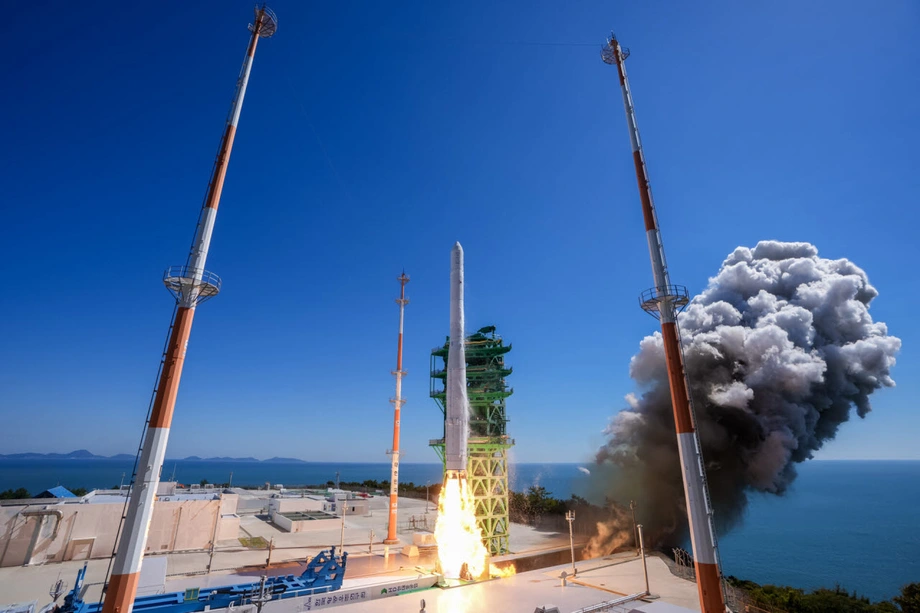
South Korea's Nuri rocket carried 15 satellites into space on October 7, 2026, the largest payload count in the rocket's history. Five small satellites were designed to work together observing the Korean Peninsula. The other 10 were CubeSats, compact satellites built for focused experiments, including research linked to dementia drugs, tests of lunar rover equipment and a student project measuring space radiation.
Contents
- A crowded launch with very different missions
- What did the official review find?
- How will NeonSat watch the peninsula?
- Can a CubeSat help develop dementia medicine?
- Why test a lunar rover near Earth?
- What happened to the student-built radiation satellite?
- Why does releasing a satellite matter?
- How the mission unfolded
- Key Points
The launch also put a new task to the test: releasing satellites in different directions. The Korea AeroSpace Administration and the Korea Aerospace Research Institute later reviewed the flight and confirmed that the rocket launched on time and carried out its main flight steps as planned. Yet one CubeSat, Quaternion's PERSAT-2, did not leave its dispenser. Nine of the 10 CubeSats were released, while all five NeonSat satellites were separated.
That mix of achievements and a technical problem captures what the mission means. Nuri sent a broad set of research projects into orbit, while the investigation showed that even a successful launch depends on small mechanisms that open at exactly the right moment.
What did the official review find?
At a review meeting in Daejeon on November 18, the space agency and research institute examined the launch and the satellite release failure. Their official launch review says the rocket's upper stage sent the release command for PERSAT-2 as intended. However, the electrical current needed to drive the dispenser did not flow, so the motor that opens its cover did not work.
Investigators could not determine whether the break occurred while the command signal was travelling from the rocket to the dispenser or whether the dispenser had a mechanical fault. They said there was not enough measurement data to identify the exact cause. A satellite inside a dispenser cannot simply drift out: the cover must open so the satellite can be pushed clear of the rocket.
The agency and institute plan stronger checks of release equipment and its operating condition, as well as improvements that add a backup to the electrical signal system. They intend to apply the changes to the next launch. The review did not give a date for that launch.
"This fifth launch achieved multiple separation of the small constellation satellites and an on time launch, while also identifying matters to improve regarding the CubeSat that was not released," space agency head Oh Tae-seok said. He added that the agency, the research institute and the rocket system company would share experience and address the improvements to keep increasing reliability.
How will NeonSat watch the peninsula?
NeonSat-2 through NeonSat-6 are each smaller than 100 kilograms. The five satellites form a constellation: a group of spacecraft that work as a team. Their cameras are meant to image the Korean Peninsula and gather information for disaster response and national security. With more satellites passing over a region, it can be observed more often than with a single spacecraft.
Researchers plan to launch five more NeonSat satellites in 2027, then operate the 10 in two groups for morning and afternoon observations. That would extend the coverage schedule across different parts of the day. The project's planning director, Lee Cheol of the KAIST Satellite Technology Research Center, described the first days as tense because this was the first time five of the satellites had been launched together.
About 14 hours and 29 minutes after liftoff, the team succeeded in taking its first image of Earth. The satellite sent back an image of Ohio in the United States the day after launch. The early picture was a first check that the spacecraft and its imaging system could work in orbit; the planned routine mission is to observe the Korean Peninsula.
Can a CubeSat help develop dementia medicine?
BiCheon-12, also called BEE-1012, carries out an experiment on crystallisation, the process in which molecules arrange themselves into an ordered solid. The research is aimed at drug development for dementia treatment. The team wants to grow drug crystals in the near weightlessness of orbit and study which structures best preserve the drug's properties.
On Earth, gravity can affect how crystals grow, making it harder to form a uniform structure. In orbit, gravity's influence is much weaker, which may allow more even growth. A crystal is not simply any hard lump: its molecules are arranged in a regular pattern, and that structure can affect how a substance behaves.
SpaceLynk executive director Kim Byung-ho said the contrast with the earlier BEE-1000 mission was striking for the team. That satellite, launched on Nuri the previous year, went without communication for nine days. BEE-1012 made contact about an hour after launch, and the researchers celebrated the quick connection. Establishing contact is an early milestone because it lets a team check the satellite and begin sending commands.
Why test a lunar rover near Earth?
The Ulysses CubeSat is testing whether cameras, computers, motors and other components intended for a lunar exploration rover can operate in space near Earth. The satellite gives the development team a chance to check equipment in orbit before it is used in a more distant and difficult mission.
On the ground, the team is also practising rover driving on soil made to resemble the Moon's surface. The Moon's gravity is about one sixth of Earth's, so a rover's wheels press down with less force and can spin without gripping the ground. Designers have shaped the wheels and rover so that soil caught in them can escape, and they test how the vehicle moves across the simulated lunar soil.
Lee Jae-ho, head of the Autonomous Exploration Research Institute, said the longer goal is for a rover to reach the Moon before people and help prepare a place for them to live. The team has worked toward that aim for about 20 years. Ulysses's tests are one step in checking the technology that such a rover would need.
What happened to the student-built radiation satellite?
GBSat was built by seven students from Gyeonggi Buk Science High School. Its task is to measure space radiation, which includes energetic particles that can affect spacecraft and their equipment. For the students, it was their first satellite project, and getting it to the launch site became part of the story.
When the team transported satellite parts to the Naro Space Center, they used an instant noodle box. Dust can cause problems if it gets into a satellite or rocket, so staff were startled by the improvised container. The episode showed how strict cleanliness requirements for space hardware can meet the practical challenges of a small student team.
After GBSat reached space, the team sent a command intended to slow its rotation. At the next communication session, they found that the satellite was spinning faster instead. The team plans to work on the issue and collect radiation readings. The available account does not say when the rotation problem will be fixed or how much data the satellite has yet returned.
Why does releasing a satellite matter?
A satellite can be healthy and still fail to begin its mission if it remains inside the rocket. A dispenser is the container and release mechanism that holds a small satellite during launch, then opens so the spacecraft can separate. PERSAT-2's case shows why teams check both the command sent by the rocket and the electrical and mechanical steps that follow it.
The figures from the review put the result in perspective: 14 of the 15 satellites reached separation, including all five members of the NeonSat group and nine CubeSats. The remaining CubeSat was PERSAT-2. The rocket also completed its scheduled major flight stages, including stage separation and engine ignition, before reaching its target orbit.
For the teams whose satellites were released, the next work is different for each mission: imaging, drug crystal experiments, equipment checks or radiation measurements. For launch authorities, the next work includes stronger preflight inspections and a more dependable electrical path for satellite release.
How the mission unfolded
October 7, 2026: Nuri launched with 15 satellites, five NeonSats and 10 CubeSats.
About 14 hours and 29 minutes after launch: NeonSat researchers captured their first image of Earth.
The day after launch: NeonSat sent back an image of Ohio.
November 18: The space agency and research institute held a review meeting and described the PERSAT-2 release failure and planned improvements.
Next launch: Authorities plan to apply stronger equipment checks and electrical signal system improvements. No launch date was announced.
Key Points
Nuri's October 7 flight carried 15 satellites, the most ever loaded onto the rocket.
Five NeonSat spacecraft are intended to observe the Korean Peninsula more often; five more are planned for launch in 2027.
BEE-1012 is testing drug crystal growth in orbit, while Ulysses checks equipment for a future lunar rover.
Seven high school students built GBSat to measure space radiation, but its rotation increased after a slowing command.
Nine of 10 CubeSats were released. PERSAT-2 remained inside its dispenser after the release motor received no current.
Authorities could not pinpoint the failure and plan stronger checks and backup electrical signalling for a future launch.