Three mountain routes clear a major hurdle
Vietnam's National Assembly approved investment policies on November 21, 2026, for three expressways with a combined preliminary cost of VND162.393 trillion. The routes are planned to cover about 430.5 kilometres across the country's northern mountains and central regions, with construction expected to begin in 2027 and the roads to open in 2031.
Contents
The projects are the 119 kilometre Bao Ha–Tan Phong section of the Bao Ha–Lai Chau expressway, the 179.5 kilometre section of the Moc Chau–Son La–Dien Bien route in Son La province, and the 132 kilometre Quang Ngai–Kon Tum expressway. Each is planned with four lanes and will be funded through public investment.
The three preliminary budgets are VND50.990 trillion for Bao Ha–Tan Phong, VND63.120 trillion for the Son La section and VND48.283 trillion for Quang Ngai–Kon Tum. Together, they total VND162.393 trillion. Their approval sets the investment policy and allows preparation to move forward; detailed work on land, contracts and construction remains ahead.
The votes were strongly in favour. Bao Ha–Tan Phong received 476 votes in support from 481 lawmakers who voted. Quang Ngai–Kon Tum received 477 of 480 votes, while the Son La section received 482 of 483.
What the routes are meant to connect
Bao Ha–Tan Phong will link the Hanoi–Lao Cai expressway with Tan Phong ward in Lai Chau province, crossing parts of Lao Cai and Lai Chau. The proposed road is intended to improve access between Lai Chau and Hanoi and neighbouring provinces. The existing mountain roads are more exposed to disruption, including from landslides.
The Moc Chau–Son La–Dien Bien route forms part of a longer planned corridor of more than 300 kilometres. Its approved Son La section is about 179.5 kilometres. Descriptions of the route during planning gave a figure of about 182 kilometres, reflecting a different level of route detail. The road is intended to connect the northwestern provinces more directly with Hanoi and other regional centres.
Quang Ngai–Kon Tum is planned to connect the eastern North–South expressway with the Ho Chi Minh Road. That link would connect the Central Highlands with the central coast and its seaports. Together, the routes are intended to make travel and the movement of goods between remote areas and larger markets easier.
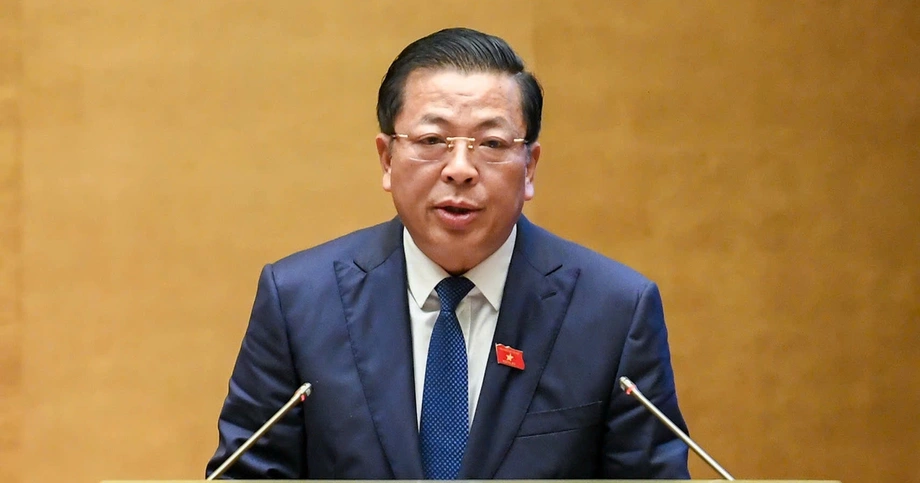
Construction Minister Tran Hong Minh described the three projects as regional links rather than separate roads. Before the vote, the minister said they could ease transport bottlenecks in the Northwest, Central Vietnam and Central Highlands, narrow the gap between mountain and lowland areas, and support national defence and security.
These are not isolated roads, but interregional connection axes.
The minister also said that when the Bao Ha–Lai Chau expressway is completed, all 34 localities in Vietnam will have an expressway. He said planners had compared options for the routes and timing to match transport needs with the available funding, while avoiding roads built in disconnected sections.
How fast will the roads be?
All three projects are planned with four lanes. The general design speeds presented during consideration ranged from 80 to 100 kilometres per hour, depending on the route and terrain. Design speed is the standard used to shape a road's curves and other features; actual driving speeds must also follow traffic rules and conditions.
The Son La route crosses steep terrain with an elevation difference of more than 1,000 metres. Tran said the design speed would be 80 kilometres per hour in difficult mountain sections, while flatter stretches could be designed for 100 to 120 kilometres per hour. The project account for the approved route gives 80 kilometres per hour as its design speed.
Planning estimates for the wider Moc Chau–Son La–Dien Bien corridor suggest travel from Hanoi to Son La could fall from six or seven hours to about two and a half to three hours. The journey to Dien Bien could take less than five hours, compared with more than twice that time on existing roads. These are projected travel times, not guaranteed journey times.
Why the projects will use public investment
The government considered private investment under a public private partnership, including build, operate and transfer contracts. Under that model, a company finances and builds a road, then operates it and collects tolls for a set period. The government said its calculations could not establish a workable payback period, even if the state covered 50 to 70 percent of the investment. The three projects were therefore put forward as public investment.
Funding figures presented during the process require careful attention. An account of the November 7 proposal listed VND158.342 trillion from the central budget and VND4.051 trillion from local budgets. During National Assembly discussion on November 10, Tran said central funding would be VND119.398 trillion, around 75 percent of the combined cost.
The route by route amounts in the approved plans list VND48.986 trillion in central funding for Bao Ha–Tan Phong, VND43.812 trillion for the Son La route, and VND46.236 trillion for Quang Ngai–Kon Tum. Those figures add up to VND139.034 trillion. The local contributions listed for Lai Chau and Quang Ngai are VND2.004 trillion and VND2.047 trillion, respectively.
The different central budget totals presented during the process do not reconcile with one another. The final annual allocations and how the funding plan will meet the full cost remain to be clarified. The projects are expected to draw on the 2026 to 2030 medium term public investment plan and other lawful sources.
Budget pressure on poorer provinces
The planned VND2.004 trillion contribution from Lai Chau became a point of debate because the province has limited funds for other local needs. Lawmaker Nguyen Thi Viet Nga said the amount equalled 38.7 percent of Lai Chau's planned local public investment capital for 2026 to 2030. She cautioned that a large contribution could leave less money for schools, health facilities, clean water, rural roads and poverty reduction.
Nga and lawmaker Nguyen Dang An called for the government to review how much local authorities could afford. A National Assembly review also urged consideration of whether central funding could cover all of Bao Ha–Tan Phong, easing pressure on Lai Chau and leaving the province more room to invest in connecting roads.
Tran said Lai Chau and Quang Ngai had agreed to contribute 50 percent of land clearance costs in their provinces. He said mountainous provinces had committed between 50 and 100 percent of such costs and that maintaining a consistent approach would ensure equal treatment of localities. The approved figures list VND2.004 trillion from Lai Chau and VND2.047 trillion from Quang Ngai.
Land and resettlement will shape delivery
The three roads are expected to use about 4,583 hectares of land, including roughly 1,155 hectares of forest. The preliminary estimate for compensation, support and resettlement across the projects is VND19.056 trillion. These tasks involve paying or providing support to people whose homes or land are affected and arranging new places to live where relocation is needed.
The Son La route is expected to affect about 4,968 households, with around 920 needing to move to planned resettlement areas. In Yen Chau commune, local officials have identified 131 hectares for recovery, more than 400 affected households and 260 graves that must be moved. Those figures show why land preparation is a substantial part of the schedule, alongside building the road itself.
Local residents quoted during planning said they supported the project while seeking to remain near family and familiar work where possible. In Yen Chau's Thin Kha village, seven households were identified as losing homes or land along the route; the village head said they wanted to resettle within the village. The government has said new living conditions for relocated families should be at least equal to those they leave behind.
Route planning has also involved concerns about forest conversion. During review of Quang Ngai–Kon Tum, lawmakers called for further adjustments to reduce effects on natural forest, particularly protected forest in upstream areas. Upstream forests help protect watersheds and reduce soil erosion, so decisions about the route can affect both land acquisition and environmental protection.
Questions raised before the vote
Lawmakers made 65 contributions during consideration of the projects. Their comments covered the need for the roads, route and design standards, total costs, funding capacity, timing, forest conversion, compensation and special procedures. The government revised the draft resolutions in response.
The Economic and Financial Committee called for further review of the cost estimates and the sources of money, including what would be needed after 2030. That timing matters because the stated goal is to complete the main construction work by 2030 and open the routes in 2031, while funding is planned mainly through a public investment period ending in 2030.
The State Audit Office urged caution over direct contracting, a process that selects a contractor without open competitive bidding. It said direct contracting should be limited to exceptional and necessary cases, with transparency and safeguards for public money. The government had proposed special mechanisms that include direct contracting and arrangements for compensation, resettlement and construction waste disposal.
What happens next?
Preparation is expected to begin in 2026, with project implementation and construction starting in 2027. The Quang Ngai–Kon Tum project is expected to begin construction in the fourth quarter of 2027. The stated aim for all three is to complete the main works by 2030 and begin operations in 2031.
The schedule depends on completing route preparation, land clearance, relocation and funding arrangements before construction can advance. Local authorities will also need to coordinate with central agencies on compensation and resettlement. No final annual funding schedule or detailed construction timetable for every project section was given.
The roads are intended to provide more reliable links for residents, farmers and businesses in remote provinces, while helping connect the Northwest and Central Highlands to national transport corridors. Their approval settles the investment policy, while the decisions on financing, land and construction will determine how quickly those promised links become usable roads.
Key Points
- The National Assembly approved three expressway projects on November 21, 2026, with a combined preliminary cost of VND162.393 trillion.
- The routes total about 430.5 kilometres and are planned with four lanes.
- Construction is expected to start in 2027, with opening targeted for 2031.
- Land acquisition is estimated at 4,583 hectares, including 1,155 hectares of forest; about 4,968 households could be affected on the Son La section.
- Funding totals presented during the approval process differ, and the final annual allocations remain to be clarified.