Fewer approvals, closer checks after projects begin
Vietnam's National Assembly has approved changes to the Law on Environmental Protection that the government says will reduce required environmental procedures for more than 90% of projects now subject to environmental impact assessments and environmental permits. The law takes effect on March 1, 2027, and is expected to cut the time needed to complete administrative procedures and the cost of compliance for residents and businesses by more than 52%.
Contents
- Fewer approvals, closer checks after projects begin
- Which projects could avoid assessments and permits?
- What replaces some of the advance paperwork?
- Why do water, homes and resettlement count?
- What changes for air pollution and monitoring data?
- What does the law say about carbon and climate reporting?
- What happens to environmental protection funds?
- Key dates and what remains to be settled
- Key Points
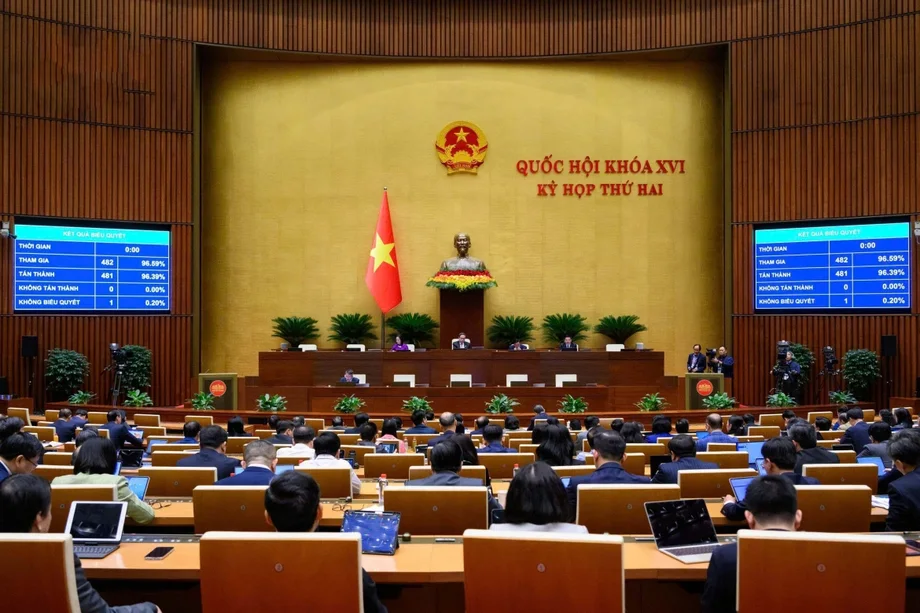
Lawmakers voted on the amendment on the morning of November 21. Of 482 deputies who took part, 481 voted in favour, none voted against and one abstained. The changes aim to move more projects away from advance assessments and permits toward environmental registration, while strengthening inspections and monitoring after projects begin operating.
An environmental impact assessment, often called an EIA, examines how a planned project could affect its surroundings before it goes ahead. An environmental permit sets requirements for projects that release pollutants. Environmental registration is a less demanding procedure for activities with lower environmental risks, though the new law's detailed requirements will determine which projects qualify.
The shift matters to companies planning investment because fewer applications could mean less time spent waiting for approvals. It also puts more weight on authorities' ability to identify problems during operation and act when pollution risks rise.
Which projects could avoid assessments and permits?
The law provides for exemptions from EIAs for secondary projects located inside concentrated production, business and service areas, and industrial clusters, when those locations already meet requirements for technical infrastructure and environmental procedures. A secondary project is an individual business or facility operating within a larger industrial or business area.
For such projects, environmental permits would be required only when they generate large amounts of emissions. The government's stated aim is to avoid making every business repeat procedures that can be handled through shared infrastructure, while retaining permitting for projects with greater pollution potential.
The change builds on earlier adjustments under Government Resolution 66.19/2026 and amendments made by Law 146/2025/QH15, which revised parts of 15 laws in the agriculture and environment fields, including provisions on EIAs and permits. The new amendment puts the direction of those changes into the Environmental Protection Law and continues administrative reform, decentralization and greater use of electronic procedures.
What replaces some of the advance paperwork?
The government plans to rely more heavily on checks after a project starts and to target oversight according to risk. In practical terms, authorities would focus monitoring on activities and locations where the potential for pollution is higher, using data to guide decisions. The law also gives local authorities a larger role in appraising environmental impact assessments and issuing permits.
That shift comes with a clearer assignment of responsibility. The amendment highlights the duties of leaders at each level of government, particularly chairs of People's Committees, to control and address pollution within their areas. It also adds the criterion of a project's operating area to help determine which central or local authority should respond when pollution crosses provincial boundaries.
Local control is intended to make decisions more responsive to conditions on the ground. The accompanying challenge is to ensure that responsibility is clear when pollution moves from one locality to another, and that reduced advance review is matched by effective monitoring during operation.
Why do water, homes and resettlement count?
The law updates the factors used to identify environmental sensitivity. These include population movement and resettlement, wastewater released into water sources used for household supply, and wastewater discharged into densely populated residential areas. These factors can bring direct consequences for people who may have to move or who depend on a water source for daily use.
For surface water, the amendment calls for quality management by river basin and for authorities to assess how much pollution each water body can absorb for different pollutants. A basin is the area of land whose water drains into a river system. Looking at water across that area can help authorities consider pollution coming from more than one locality, rather than examining each discharge in isolation.
The law also revises waste management rules to support recycling and a circular economy, in which materials are reused or recovered instead of simply discarded. Local governments would have more room to organise waste management in ways that match their environmental infrastructure.
What changes for air pollution and monitoring data?
The amendment puts several air quality tools into law: emissions inventories, low emission zones and integrated air quality management plans. An emissions inventory records pollution released by sources in an area, helping officials see where emissions come from and plan controls. Low emission zones restrict or manage activities that produce pollution in designated places.
Environmental monitoring rules are also being strengthened to protect the accuracy, objectivity and completeness of measurements. The government plans to build a unified environmental database that agencies can share and use, alongside wider digitalisation of environmental administration. Better organised data can help officials compare readings, track changing conditions and direct inspections where they are most needed.
Businesses and regulators have already been preparing for changes to environmental administration. On November 13, more than 100 representatives from provincial Industry and Trade departments, industrial park managers and companies attended a training conference in Quang Ninh. The Ministry of Industry and Trade's environmental rules guidance said the conference addressed the need to update rules after Vietnam reorganised local government into a two tier model from July 1, 2025.
At the conference, Do Phuong Dung, deputy head of the ministry's Industrial Safety and Environment Agency, described the meeting as a chance to discuss recent changes and practical problems. She said it would also allow participants to contribute to further work on the law.
The conference is an opportunity for delegates to discuss new changes, clarify issues arising in practice, and contribute ideas to the continued improvement of the law.
The ministry also said Circular 49/2026/TT-BCT, effective from November 2, 2026, updates rules for reporting to and using the Industry and Trade sector's environmental database. It covers access accounts, technical support, digital infrastructure and information security. For companies, the ministry highlighted the need to identify the correct procedure, assess waste thresholds and check which exemptions and transition rules apply to each project or facility.
What does the law say about carbon and climate reporting?
Facilities will continue to report greenhouse gas inventories every two years, the same interval set under the existing law. Greenhouse gases trap heat in the atmosphere, and inventories measure emissions from particular facilities or activities so they can be tracked over time.
The amendment also sets out responsibilities for participants in Vietnam's carbon market, with the government saying the rules should reflect international practice while protecting national interests. A carbon market allows emissions reductions or allowances to be traded under set rules. The law creates a legal framework for companies' roles in that system, alongside wider efforts to reduce emissions and support greener economic growth.
What happens to environmental protection funds?
The amendment gives the government authority to set rules for dissolving the Vietnam Environmental Protection Fund and provincial environmental protection funds. It also provides for transition arrangements if a fund is reorganised or dissolved. The stated purpose is to support a review and restructuring of state financial funds that operate outside the regular state budget, in line with Politburo Resolution 79-NQ/TW of January 6, 2026.
The law calls for a separate budget allocation for environmental protection work, with funding matched to economic growth, the scale of the economy and the tasks required. It does not set a fixed minimum percentage of the state budget. That leaves annual budget planners room to adjust spending, while keeping environmental protection as a distinct budget purpose.
Key dates and what remains to be settled
November 2, 2026: Circular 49/2026/TT-BCT took effect, updating the Industry and Trade sector's environmental database rules.
November 13, 2026: More than 100 officials and business representatives attended an environmental rules conference in Quang Ninh.
November 21, 2026: The National Assembly passed the amendments, with 481 votes in favour, none against and one abstention among 482 participants.
March 1, 2027: The amended Environmental Protection Law is scheduled to take effect.
The law sets the broad direction, but businesses will need to apply the detailed rules to their own projects, including eligibility for an EIA exemption, permit thresholds and transition arrangements. The government is expected to provide further implementation provisions. The main change is a trade: fewer procedures before many projects proceed, paired with stronger data based oversight, clearer local responsibilities and continued controls on activities with higher pollution risks.
Key Points
The National Assembly approved the Environmental Protection Law amendments on November 21, 2026.
The law takes effect on March 1, 2027, with the government projecting procedure and compliance cost reductions of more than 52%.
More than 90% of projects currently subject to EIAs and environmental permits are expected to have procedures reduced.
Projects in qualifying industrial areas may be exempt from EIAs, while permits remain for secondary projects with large emissions.
The law expands local authority and follow up monitoring, and adds rules for water quality, air pollution data, greenhouse gas inventories and carbon market responsibilities.