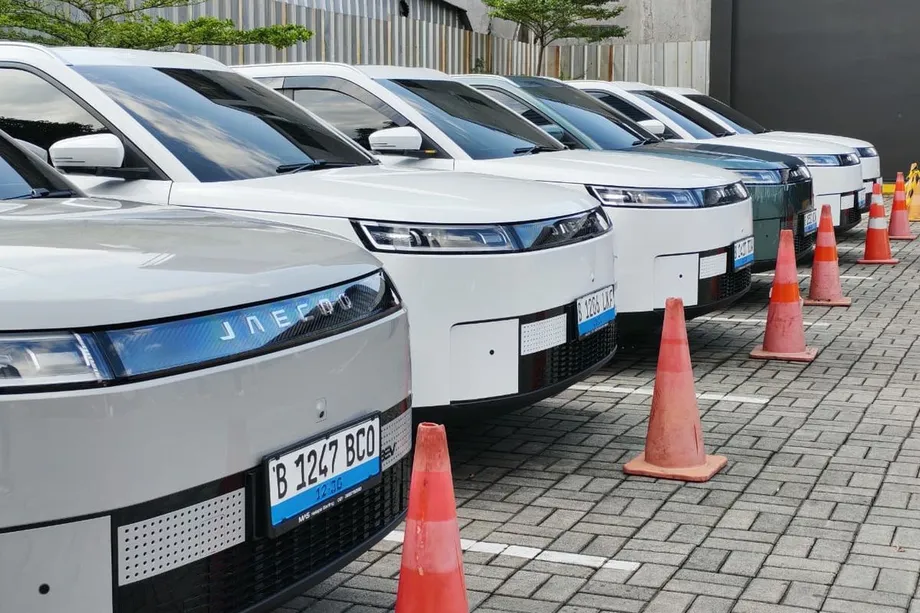
Chinese brands gain ground as Indonesia's car market grows
Chinese automakers sold 17,272 vehicles in Indonesia in October 2026, taking 24.4% of a 70,716 vehicle light duty market, according to Gasgoo data. The share has risen for several consecutive months as electric models and newer brands draw buyers, even while Japanese manufacturers retain the market's biggest positions.
Contents
- Chinese brands gain ground as Indonesia's car market grows
- Why do the market totals differ?
- Japanese brands still set the market's scale
- Small electric cars and SUVs make the push visible
- BYD's fall shows why a popular model is not enough
- PHEVs are growing, but one model leads by a wide margin
- Local production is rising alongside sales
- What the next stage of competition will depend on
- Key Points
Toyota led the October brand table with 23,551 sales, followed by Daihatsu with 10,772. BYD ranked third overall, with 6,639 vehicles, while Suzuki recorded 6,104 and Mitsubishi 3,739. Four Chinese brands made the top 10: BYD, OMODA and JAECOO, Wuling and Geely.
The market's changing shape is clear in the growth figures. OMODA and JAECOO sales reached 3,618, up 1,063.3% from a year earlier, while Geely sold 1,560, up 757.1%. Wuling's 2,101 sales were 48.5% higher. BYD, by contrast, fell 37.3% year on year, a reminder that rapid growth across a group of brands can coexist with a sharp decline for an individual leader.
Electric vehicles are central to the shift. Battery electric vehicles, or BEVs, and plug in hybrid electric vehicles, or PHEVs, together made up 26.2% of the light duty market in October. BEVs accounted for 23.8% and PHEVs 2.4%, while vehicles powered only by internal combustion engines made up 63.3%.
Why do the market totals differ?
Two October tallies describe different sized markets. The Gasgoo series used for the 24.4% Chinese brand share is labeled as light duty vehicles and totals 70,716. A separate Gaikindo based national wholesale tally puts October sales at 81,482, up 10% from 74,051 a year earlier. Wholesale sales mean vehicles sent from factories to dealers, rather than cars bought directly by customers.
The figures should be read within their own series. The published totals do not give a breakdown explaining the 10,766 vehicle gap between them, so the 24.4% share applies to the 70,716 vehicle tally. In another difference between brand counts, Gasgoo lists OMODA and JAECOO at 3,618, while a Gaikindo based tally lists Jaecoo at 3,514. Both record BYD at 6,639.
Gaikindo's data published on Nov. 9 recorded October wholesales of 23,551 Toyota vehicles, 10,772 Daihatsu, 6,284 Suzuki, 6,639 BYD, 3,514 Jaecoo and 2,101 Wuling. A separate reported tally covering 17 Chinese brands put their combined October wholesales at 18,415, or 22.6% of the national total. The brands in that tally were BYD, Jaecoo, Geely, Wuling, Chery, Aion, MG, Danza, Xpeng, Jetour, GWM, iCAR, DFSK, Changan, Baic, Lepas and Maxus. This differs from the 17,714 Chinese brand figure cited below; the available data do not explain the difference in coverage or provide an official reconciliation with Gasgoo's light duty tally.
The Gaikindo based figure for Chinese brand wholesale sales was 17,714 vehicles, a reported 13.67% increase from October 2025. The two Chinese brand totals, 17,272 and 17,714, come from separate tallies and should not be combined. The national market's overall growth also gives automakers a larger pool of potential buyers, but continued gains depend on models that fit household budgets.
Japanese brands still set the market's scale
Toyota and Daihatsu together sold 34,323 vehicles in October, close to half of the 70,716 light duty total. Their lead reflects a strong base of familiar vehicles with combustion engines, while Chinese makers are gaining ground most visibly in electric cars and small sport utility vehicles.
Earlier figures show how far the established leaders stood ahead of newer electric car brands. In its 2025 brand sales table, Gaikindo recorded Toyota wholesales of 202,376 vehicles and Daihatsu sales of 107,090 from January to October 2025. BYD recorded 30,670 in the same period. The figures are not directly comparable with one month of 2026 sales, but they show the very different starting scale of the brands.
The broader 2026 market is also no longer simply a contest between the biggest Japanese groups. Domestic wholesales from January through October reached 760,476, up 19.7% from the same period a year earlier. Astra Group, which includes Toyota and Daihatsu, sold 372,721, or 49% of the market. Non Astra brands together sold 387,755, about 51%.
In October alone, non Astra brands sold 43,748 vehicles, 6,014 more than Astra's 37,734. That group includes long established makers as well as Chinese companies, so the figures do not represent Chinese brands alone. They do show that buyers are spreading purchases across a wider range of manufacturers.
Small electric cars and SUVs make the push visible
Two models illustrate how Chinese brands are pursuing everyday drivers. BYD's Dolphin Surf sold 4,329 units in October and ranked second among all models, although its share is being challenged by other small electric cars. Jaecoo's J5 EV sold 3,366 and led the BEV sport utility vehicle segment.
Those models compete in price conscious parts of the market where compact size and running costs can matter as much as brand history. A BEV uses a battery and electric motor instead of a petrol engine. For a commuter, a smaller electric car can make the switch to battery power feel more accessible; a compact electric SUV offers a higher body and more room while targeting a similar broad audience.
Jaecoo's October total illustrates how concentrated a fast growing brand can be around one vehicle. Of its 3,514 sales in the Gaikindo based tally, 3,366 were J5 models. Across January to October, Jaecoo sold 30,748 vehicles, and 30,001 were J5s. The J5 also gave the brand 22.3% of the country's BEV market over those 10 months, behind BYD's 32.8% and ahead of Geely's 11.9%.
Jaecoo's head of product in Indonesia, Ryan Ferdiean Tirto, said the J5 was still the company's main sales contributor. He also identified a crowded field of new models as a challenge. His comments describe a strength and a risk: a popular model can quickly build a brand's volume, but dependence on one vehicle leaves sales exposed when new rivals arrive.
At present, the Jaecoo J5 remains the main contributor to our sales volume in Indonesia.
BYD's fall shows why a popular model is not enough
BYD remains the largest Chinese brand in October by the Gasgoo count, but its 6,639 sales were down 37.3% year on year. The Dolphin Surf's strong month did not prevent the brand total from falling, showing how sales across a company's full lineup can move differently from the result of one model.
Geely and Wuling are expanding from different points. Geely's 1,560 sales marked a 757.1% rise, though its EX2 has lost ground from its earlier high and faces close competition from the Dolphin Surf and J5 EV in nearby price ranges. Wuling's Air EV and Bingo target the very low cost mini electric car market, where price is a key part of the appeal.
OMODA and JAECOO were October's fastest growing Chinese brand group in the Gasgoo data. Their 3,618 sales were more than 10 times the level a year earlier. MG is relying on its S5 electric SUV, while sales of its ZS hybrid increased. Jetour, which sells both combustion engine and plug in hybrid vehicles, recorded 428 vehicles, more than 300% above the year before.
Gaikindo market development chair Jongkie D. Sugiarto linked Chinese car sales growth to product design and affordability. He said future growth would depend on automakers' ability to keep vehicles within reach of local buyers.
Many cars, including Chinese brands, have been launched with good design and affordable prices.
His point goes to the practical test for manufacturers: a long list of models matters only if buyers can afford them and find a vehicle suited to their needs. The October sales figures show strong interest, but also a race among Chinese brands selling vehicles in similar segments and price bands.
PHEVs are growing, but one model leads by a wide margin
PHEVs combine a battery and electric motor with a combustion engine. They can travel on electricity for some journeys, while the engine provides another source of power. Indonesia's October PHEV wholesale sales rose to 1,725 from 1,294 in September. For January to October, reported sales reached 11,990, up 215.7% from 3,798 in the same period of 2025.
Chinese brands filled all 10 places in one October ranking of the best selling PHEV models. BYD's M6 DM led with 1,142 vehicles, about two thirds of the month's 1,725 total. Jetour's T2 i-DM was second with 148, followed by Jaecoo's J7 SHS with 110 and Chery's Tiggo 8 CSH with 76.
The gap between the leader and the rest is large: the M6 DM sold nearly eight times as many vehicles as the second placed Jetour model. Jaecoo's J7 and J8 PHEVs together accounted for 747 sales from January to October, compared with 30,001 for its BEV J5 over the same period. Chinese brands have established themselves in PHEVs, but those numbers show how much more volume Jaecoo currently gets from a battery only model.
Japanese makers retain a stronger position in hybrid electric vehicles, which use a petrol engine and electric motor but are not usually plugged in to charge. That means the contest in Indonesia's transition is spread across different technologies: Chinese brands have a strong foothold in BEVs and early PHEV growth, while Japanese manufacturers retain broad combustion engine sales and a firm HEV presence.
Local production is rising alongside sales
Chinese automakers are also building a manufacturing presence in Indonesia. Local production of Chinese brand vehicles reached 130,751 from January to October 2026, up 231.6% from 39,430 in the same period of 2025. That amounted to 11.77% of Indonesia's total vehicle production of 1,110,919.
BYD produced 39,774 vehicles locally, the highest figure among Chinese brands and sixth among all manufacturers in Indonesia. Jaecoo produced 30,480 using assembly facilities run by PT Handal Indonesia Motor. Geely produced 18,015, Wuling 17,609 and Chery 13,772.
Local assembly can bring production closer to the customers a company wants to serve and support a wider dealer and service network. It also gives automakers a way to build a lasting presence beyond importing vehicles. For buyers, the practical questions remain the purchase price, access to service and availability of the models they want.
The sales and production figures show two linked changes: Chinese brands are gaining showroom visibility, and their factories are producing more vehicles locally. The 24.4% October share in the light duty tally is a substantial foothold, while the 11.77% production share shows localization still has room to grow.
What the next stage of competition will depend on
Chinese carmakers have found openings with small BEVs and electric SUVs, but competition is tightening in the same price bands. The EX2, Dolphin Surf and J5 EV all face buyers weighing cost, size and equipment. A lineup of near substitutes can divide demand among a company's own models as well as between brands.
Expanding the range could help automakers serve more than one kind of customer. Commuters may want a small electric car, families may need a larger SUV, and businesses may look for commercial vehicles. PHEVs can appeal to buyers who want electric driving for some trips but value a combustion engine for others. Local assembly and broader distribution can support these choices, provided the final vehicles remain affordable.
The market's growth has made room for new entrants, but it has not removed the advantage of established brands. Toyota and Daihatsu still sell far more than any single Chinese maker, and combustion engine vehicles accounted for 63.3% of the October light duty mix. Chinese automakers' task is to turn electric vehicle interest and rapid production growth into repeat sales across a broader range of customers.
Key Points
- Chinese brands sold 17,272 vehicles and held 24.4% of the 70,716 vehicle light duty market in October, according to Gasgoo data.
- Toyota and Daihatsu remained the top two brands. BYD ranked third, while four Chinese brands entered the top 10.
- BEVs and PHEVs together represented 26.2% of the October light duty market; combustion engine vehicles accounted for 63.3%.
- BYD's M6 DM led October PHEV sales with 1,142 vehicles, while Chinese brands took all 10 places in a top model ranking.
- Chinese brand vehicle production in Indonesia rose 231.6% year on year to 130,751 in January to October 2026.