Government borrowing drives a $3.5 billion increase
Indonesia's external debt reached $458.9 billion in the third quarter of 2026, up $3.5 billion from the previous quarter, according to Bank Indonesia (BI). Government borrowing drove the increase while private companies reduced their external debt slightly. With 59.07% of the total denominated in US dollars, pressure on the rupiah is also drawing attention to repayment costs.
Contents
- Government borrowing drives a $3.5 billion increase
- What changed between the second and third quarters?
- Where government external borrowing is directed
- Private debt falls slightly, with four sectors dominating
- Singapore leads the country creditor figures
- Why dollar debt matters when the rupiah weakens
- Long maturities provide breathing room
- Why an economist wants closer attention to cash flow
- What the market snapshot means for debt management
- Key Points
The total rose 7.2% from a year earlier, compared with an increase of about 0.77% from the second quarter's $455.4 billion. At an exchange rate of Rp18,200 per dollar, the latest debt stock was worth approximately Rp8,352 trillion.
BI said the debt structure remained healthy, pointing to an external debt ratio of 30.9% of gross domestic product (GDP) and the predominance of borrowing with long maturities. GDP measures the value of goods and services produced in an economy.
Ramdan Denny Prakoso, head of BI's communications department, described the central bank's assessment in a statement:
Indonesia's external debt structure remains healthy, supported by the implementation of prudent debt management principles.
Economist Rahma Gafmi, a professor of monetary economics at Airlangga University, offered a more cautious assessment. She said Indonesia was in an "amber zone," with attention needed on available foreign currency, repayment schedules and companies that earn rupiah but owe dollars.
In remarks published on November 17, 2026, Rahma said Indonesia had not entered a solvency crisis, but foreign currency liquidity and external vulnerabilities warranted close monitoring. She put the conventional prudential threshold for emerging markets at around 40% to 50% of GDP, while warning that remaining below that range did not by itself establish repayment resilience.
The two assessments focus on different parts of the same balance sheet: BI highlighted the size and maturity of debt, while Rahma focused on the cash needed to repay it.
What changed between the second and third quarters?
Government external debt increased by $3.9 billion, from $216.3 billion in the second quarter to $220.2 billion in the third. That was an increase of approximately 1.8%, larger than the percentage rise in total external debt.
Private external debt moved in the opposite direction, falling by $400 million to $196.3 billion from $196.7 billion. BI attributed the decline to lower debt positions among both financial institutions and companies outside the financial sector.
Foreign investment in government securities, known in Indonesia as Surat Berharga Negara (SBN), and loan disbursements supported the increase in government borrowing. BI said those inflows reflected continued investor confidence in Indonesia's economic outlook.
External debt covers obligations owed by Indonesian residents to creditors outside the country. It includes borrowing in foreign currencies and rupiah, as well as domestic securities held by investors who are not Indonesian residents. A bond can therefore enter the external debt figures even when it is issued within Indonesia.
The figures place the latest increase in this timeline:
- Third quarter of 2025: external debt stood at approximately $428.25 billion.
- Second quarter of 2026: external debt reached $455.4 billion, including government debt of $216.3 billion and private debt of $196.7 billion.
- Third quarter of 2026: total external debt rose to $458.9 billion, with government debt increasing and private debt declining.
- November 16 and 17, 2026: BI's assessment and the latest debt figures were made public, alongside renewed attention to rupiah weakness.
Where government external borrowing is directed
Health and social services accounted for the largest identified share of government external debt, at 22%. Public administration, defence and compulsory social security followed at 20.8%, while education represented 16.2%.
Construction accounted for 11.4%, and transportation and warehousing for 8.5%. Together, those five categories represented 78.9% of the $220.2 billion government external debt stock.
Health and education alone accounted for 38.2%, equivalent to approximately $84.1 billion when their combined share is applied to the government total. These allocations connect debt management to services people use, including healthcare, schooling and transport.
BI described external borrowing as an instrument for financing the state budget, known as the APBN, with funding directed toward productive sectors while keeping debt sustainable. The government also committed to paying principal and interest on schedule and managing borrowing prudently, measurably and flexibly.
Rahma argued that the quality of spending deserves close scrutiny. She recommended concentrating borrowing on strategic infrastructure and investment in people's skills and health, with loan maturities suited to the useful life of the projects being financed.
In remarks published on November 16, 2026, she said projects should have an efficient Incremental Capital-Output Ratio (ICOR) and strong multiplier effects on the real economy. She opposed using external debt for consumptive operating expenditure that generates no cash flow to repay principal and interest, and recommended long-term concessional loans rather than short-term commercial financing for long-lived infrastructure.
Private debt falls slightly, with four sectors dominating
Manufacturing, financial and insurance services, electricity and gas supply, and mining and quarrying together accounted for 80.5% of private external debt. Applied to the $196.3 billion total, that concentration represents approximately $158 billion.
The quarterly decline was modest, at about 0.2%. The longer history shows a broader reduction followed by a partial recovery: private external debt fell from $202.8 billion in 2021 to $199.09 billion in 2022, $196.6 billion in 2023 and $194.3 billion in 2024. It then increased to $195.13 billion in 2025.
The third quarter of 2026 therefore left private external debt $6.5 billion below its 2021 level, but $1.17 billion above the 2025 figure. Companies have reduced their debt from the earlier peak, although the movement has varied across periods.
Rahma warned that businesses serving mainly domestic customers can be especially exposed when they earn rupiah and borrow in foreign currencies. Property, domestic infrastructure and utilities were among the activities she identified.
A company in that position needs more rupiah to purchase the dollars required for an unchanged dollar repayment when the local currency weakens. Currency protection arrangements, known as hedging, can help manage that exposure. Rahma warned that unprotected losses could weaken companies and increase the risk of bad loans in domestic banks.
Singapore leads the country creditor figures
Singapore was the largest country creditor location in the debt breakdown, accounting for $52.30 billion, up from $51.89 billion in the second quarter. The United States followed at $29.73 billion, compared with $29.55 billion previously.
China accounted for $26.03 billion, down from $26.09 billion. Japan's figure declined to $20.89 billion from $21.38 billion, while Hong Kong's increased to $20.70 billion from $20.22 billion.
Singapore's total was about 11.4% of Indonesia's external debt and approximately 1.76 times the US figure. The creditor geography includes the locations of lenders and investors across the external debt portfolio.
Among international institutions, the International Bank for Reconstruction and Development, part of the World Bank, accounted for $22.29 billion. The Asian Development Bank accounted for $12.16 billion, followed by the International Monetary Fund at $8.74 billion.
The Islamic Development Bank accounted for $1.34 billion, while other international institutions together represented $2.82 billion. Those institutional amounts totalled $47.35 billion, illustrating how Indonesia's external financing comes from several types of creditors rather than a single lender.
Why dollar debt matters when the rupiah weakens
Debt denominated in US dollars reached $271.08 billion, or 59.07% of Indonesia's external debt. Rupiah debt held by external creditors was equivalent to $94.62 billion, followed by euro debt worth $42.51 billion, yuan debt worth $20.23 billion and yen debt worth $18.46 billion.
The rupiah component represented approximately 20.6% of the total. The currency breakdown matters because a borrower owing rupiah has a different repayment exposure from one that must obtain dollars, euros or another foreign currency.
At Rp18,256 per dollar, the dollar denomination component was equivalent to approximately Rp4,948.9 trillion. On November 17, the rupiah weakened to around Rp18,260 per dollar, close to the Rp18,200 to Rp18,300 range Rahma cited when discussing repayment pressures.
Rahma explained the effect on borrowers:
"With the rupiah still under pressure at around Rp 18,200 to Rp 18,300 per US dollar, the cost of converting rupiah into foreign currency to repay external debt principal and interest has become significantly heavier," Rahma said on Monday.
The practical exposure depends on how much foreign currency a borrower earns and how much protection it has arranged. An exporter receiving dollars has a source of dollars for repayments. A business receiving mainly rupiah must obtain foreign currency elsewhere or use a hedging arrangement.
Long maturities provide breathing room
Borrowing with long maturities accounted for 84.3% of Indonesia's external debt, equivalent to approximately $386.9 billion. The remaining 15.7% represented about $72 billion.
All government external debt was classified as long term. Among private borrowers, the share was 76.6%, equivalent to approximately $150.4 billion of the $196.3 billion private total.
Longer maturities spread repayment obligations over more time and reduce reliance on repeatedly replacing short loans. Refinancing means obtaining new borrowing to repay debt that is reaching its payment date.
Rahma warned that tighter global financing conditions and higher borrowing costs could make refinancing more expensive. Borrowers eventually have to repay or replace obligations with long maturities as well, so the timing and cost of future payments remain central to debt management.
BI's published assessment gave the maturity shares and debt ratio, but no detailed repayment calendar or current debt service ratio was stated in the announcements described here. Those measures would help show how much foreign currency is needed at particular payment dates.
Why an economist wants closer attention to cash flow
Rahma described a possible "denominator illusion" in relying too heavily on debt as a share of GDP. GDP captures the size of the economy, while foreign debt payments require funds in the currency due to creditors.
She recommended closer attention to the debt service ratio, which compares principal and interest payments with export earnings. That measure connects the repayment bill with an important source of incoming foreign currency.
Commodity prices are relevant to that calculation. During trading on November 17, crude oil fell toward $90 a barrel while coal rose toward $145 a tonne. Changes in export prices can affect the foreign currency exporters bring into Indonesia.
Rahma also proposed monitoring government interest payments against tax revenue. A growing interest bill can leave less budget room for infrastructure, education, healthcare and social protection unless revenue rises sufficiently.
In a direct interview on October 19, 2026, Rahma identified fiscal rigidity and mandatory spending as constraints on budget flexibility. She recommended keeping the projected deficit near 2.85% of GDP and below the 3% limit, alongside tax reform, a broader compliance database, more efficient management of state assets and postponement of secondary projects.
Her recommendations included stronger hedging, greater use of local currencies in suitable transactions, and regular stress tests for sharp rupiah depreciation, higher global interest rates and weaker export commodity prices. She also called for export proceeds to enter the domestic financial system in line with foreign exchange regulations.
Her November 16 remarks specifically called for government and state-owned enterprises with substantial external debt exposure to strengthen hedging and make greater use of Local Currency Settlement (LCS) and Local Currency Transaction (LCT). She recommended aligning natural-resource export proceeds with foreign currency debt maturities and strengthening tax revenue through downstreaming and a wider domestic tax base. In her November 17 assessment, she also emphasised compliance with natural-resource export proceeds rules, known as DHE SDA, and fiscal deficit discipline to avoid adding to Indonesia's market risk premium.
For projects financed with external borrowing, she recommended periodic audits by the Supreme Audit Agency (BPK) and the Financial and Development Supervisory Agency (BPKP), an end to further funding for failed projects, and fuller disclosure of financing costs, risks and results. These were her proposals for stronger oversight.
Her November 16 recommendations specified real-time, comprehensive disclosure of each externally financed project's risk profile, funding costs and outputs. She expected external debt expansion to continue in a measured manner, but called for stricter selectivity and risk oversight.
What the market snapshot means for debt management
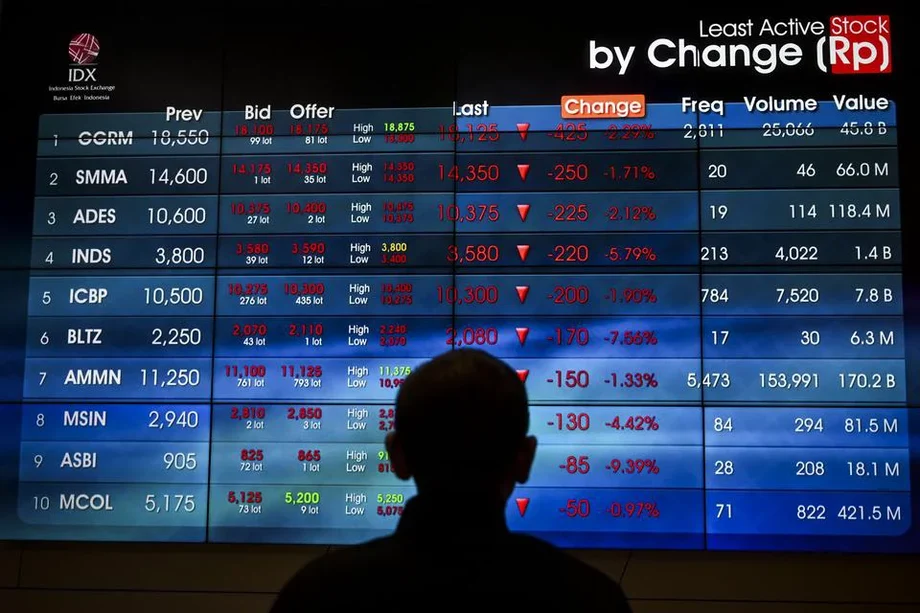
Indonesia's stock market and currency moved in different directions on November 17. At 10:03 a.m. Western Indonesia Time, the Jakarta Composite Index was up 0.82% at 5,364 while the rupiah was weakening to approximately Rp18,260 per dollar.
For borrowers, the exchange rate directly affects the rupiah cost of obtaining foreign currency. For the government, foreign purchases of securities can support budget financing while also increasing obligations to investors outside Indonesia.
BI and the government said they would continue strengthening coordination to monitor and manage external debt so that it supports development financing and sustainable economic growth. The immediate management task is to keep financing useful projects while maintaining enough cash and foreign currency to meet scheduled payments.
The third quarter figures show the balance Indonesia is managing: a larger government debt stock, a small decline in private borrowing, predominantly long maturities and substantial dollar exposure. Borrowing costs, export receipts and the rupiah will shape how comfortably those obligations can be serviced.
Key Points
- Indonesia's external debt reached $458.9 billion in the third quarter of 2026, up $3.5 billion from the previous quarter and 7.2% from a year earlier.
- Government external debt rose to $220.2 billion, while private external debt fell slightly to $196.3 billion.
- US dollar debt accounted for 59.07% of the total, increasing sensitivity to rupiah weakness.
- Singapore led the country creditor breakdown at $52.30 billion.
- BI assessed the structure as healthy, citing a debt to GDP ratio of 30.9% and an 84.3% share of borrowing with long maturities.
- Economist Rahma Gafmi urged closer monitoring of repayment cash flow, export earnings, currency exposure and project performance.