A title won from the brink
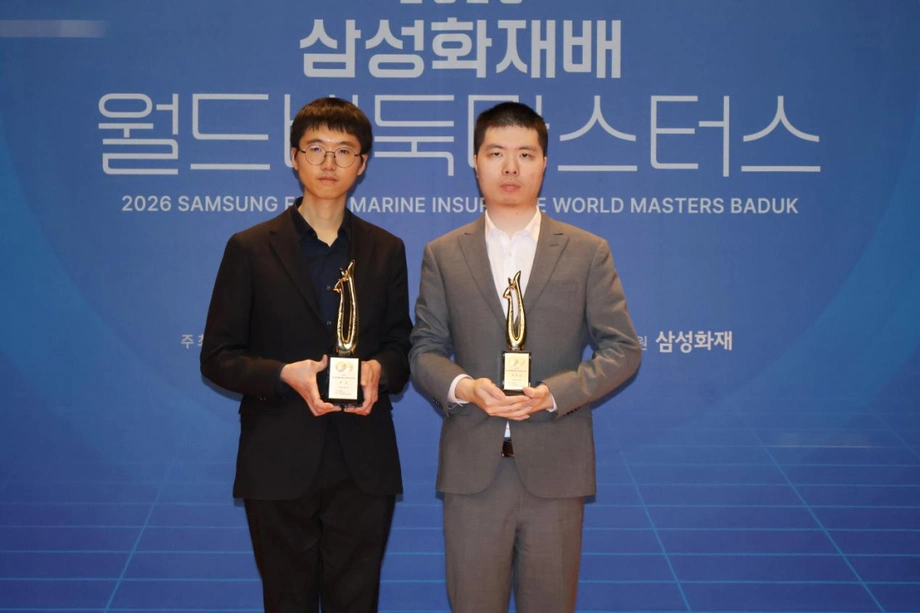
Goyang, South Korea, Nov. 20, 2026: Byun Sang-il turned a game that an artificial intelligence program rated at just a 1% chance of winning into a 271 move victory, defeating China's Li Qincheng in the final game of the Samsung Fire & Marine Cup.
Contents
Byun, playing black, won by resignation at the Samsung Fire & Marine Global Campus in Goyang. His victory gave him the best of three final by 2-1 and his first title at the tournament, after losing the opening game and winning the next two. Li resigned with about an hour left on his two hour clock, according to most accounts. One detailed account said he had used less than 40 minutes.
The win brought Byun his third major international title, following the Chunlan Cup in 2023 and the LG Cup in 2025. The 29 year old South Korean earned 300 million won, while Li received 100 million won as runner up. The prizes were presented at a ceremony attended by Samsung Fire & Marine vice president Kim Sun-moon and Korea Baduk Association chairman Chung Tae-soon.
For Byun, it was also the end of a long wait. He first entered the Samsung Cup in 2012 and won it on his 15th attempt. He became the event's 20th champion since it began in 1996.
How the final unfolded
The final was played over three games on Nov. 18, 19 and 20. Byun lost the first game, then won the second to force a decider. The last game began with Li in control, and Byun's position soon looked close to hopeless.
- Nov. 18: Li won the first game.
- Nov. 19: Byun won the second game to level the match.
- Nov. 20: Byun won the deciding game in 271 moves and took the final 2-1.
Byun had made several loose moves on the right side of the board. At one point, he was estimated to be almost 30 points behind, and the AI win estimate for him fell to 1%. In Go, players place black and white stones on a grid to claim territory and surround the other player's stones. A large group that loses all its liberties, or open spaces next to it, can be captured.
Byun's large black group on the right appeared to be in danger. He kept fighting, however, and steered the game into a ko fight. A ko is a repeating capture pattern that players can use to create threats elsewhere on the board. The fight gave Byun a chance to save his group, and he captured a large white group in the upper right corner instead.
The turning point on the board
Saving the black stones brought the game closer, but Byun was still behind. The next major shift came in the center, where Li misjudged an exchange involving stones and territory. Byun gave up two black stones to gain the initiative, meaning he could make the next move that demanded a response.
That exchange changed the balance. Byun's estimated win chance climbed above 90%, and he also managed to bring another large black group in the lower center to safety. With the danger to his groups reduced, he could focus on keeping his lead rather than trying to rescue stones.
The players each had two hours, followed by five one minute countdown periods. Byun used nearly all his main time and had to make his final decisions under those short countdowns. He kept control through the closing moves and Li resigned before the board was filled.
Li is known for playing quickly. Byun later said that Li's speed could sometimes lead to careless mistakes. Li's fast pace was especially striking in the final, where he left a large amount of his allotted time unused even as the game's advantage shifted.
Byun's account of the comeback
After the ceremony, Byun described how the game felt from his side. He said that after the position became tangled, he thought he had almost lost, but that the ko fight helped him find a way back into the game.
I thought I had almost lost, but things gradually opened up after we reached a compromise. After that, things went a little better, and I was able to win.
Byun also spoke about the pressure of the final and his preparation. He said he went for a walk to clear his head after losing the first game, and that he studies with AI at the Korea Baduk Association. He said the win could give him more confidence.
I did not think I would win like this today. I think luck was on my side.
Byun thanked the tournament organizers for the playing conditions and food, and expressed gratitude to the cooks who encouraged him, as well as his coaches, teammates and fans. He said winning the Samsung Cup fulfilled a goal he had held since before becoming a professional player.
A milestone for South Korean Go
Byun's result also changed the tournament's national tally. South Korean players have now won the Samsung Cup 15 times, one more than players from China, who have 14 titles. The two countries have met in the final 15 times, with South Korea winning nine of those matches and China six.
Byun also moved ahead in his personal record against Li. He now leads their head to head results 7-6. Li, who was runner up at the Beihai Xinyi Cup last year, has now finished second in two major international tournaments.
Before reaching the final, Byun defeated South Korea's Shin Jinseo in the semifinal. Shin is widely regarded as one of the country's leading players, and Byun had been heavily behind in their previous record. The semifinal win and the final comeback made for a demanding path to the title.
How this win fits into Byun's career
Byun's earlier major titles came at the Chunlan Cup in 2023 and the LG Cup in 2025. The LG Cup final ended amid a dispute over rules for managing captured stones. China's Ke Jie forfeited after officials penalized him over the issue, and he did not attend the award ceremony. Byun said at the time that the result left him feeling uncomfortable.
The Samsung Cup final was decided over three completed games on the board. Byun lost the first game, answered with a win in the second, then survived a position that looked nearly lost in the third. It was his first Samsung Cup title after years of competing at the event.
Byun has described his progress as the result of steady work rather than a special formula. At 29, he now has three major international titles. He said he had not decided how to use the prize money and wanted to rest after the tournament.
What the numbers say
The decisive game showed how quickly a Go match can change. The AI estimate fell to 1% for Byun before his rescue of the black group and Li's later mistakes swung the advantage sharply the other way. Those percentages are estimates of who is more likely to win from a board position, not a score of points already won.
The final's time limit was two hours per player, followed by five one minute countdown periods. Byun used almost all his main time; Li resigned with roughly an hour remaining in most accounts. The result was a 271 move win by resignation, rather than a game decided by counting the territory at the end.
Key Points
- Byun Sang-il beat Li Qincheng in 271 moves on Nov. 20 to win the Samsung Fire & Marine Cup final 2-1.
- Byun's AI win estimate fell to 1% before he saved a large black group and turned the game around.
- The title was Byun's third major international win and his first Samsung Cup victory, on his 15th attempt.
- South Korea now has 15 Samsung Cup titles, compared with China's 14.
- Byun won 300 million won; runner up Li received 100 million won.