Two swings restore Japan's control at Tokyo Dome
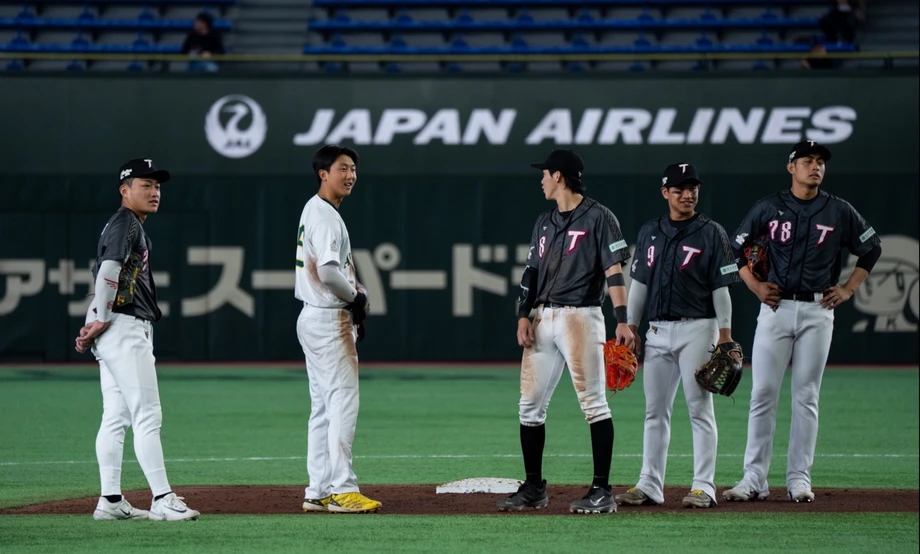
Rui Muneyama hit home runs in consecutive innings, including the decisive three-run drive in the eighth, as Japan defeated South Korea 9-5 at Tokyo Dome on November 13 to take sole possession of first place in the 2026 Asia Professional Baseball Championship.
Contents
- Two swings restore Japan's control at Tokyo Dome
- Masaki answers South Korea's early breakthrough
- Kojima and Muneyama stretch the lead
- South Korea erases four runs in the eighth
- An intentional walk brings Muneyama back to the plate
- The pitchers behind the changing score
- Chinese Taipei's rally reshapes the standings
- What South Korea needs from the final group games
- The schedule from opening day to the final
- Key Points
Japan's four home runs produced eight of its nine runs. Muneyama drove in five, first extending the lead to 5-1 in the seventh and then breaking a 5-5 tie after South Korea's dramatic comeback in the eighth. Koki Yamaguchi added a run with a double before Hibiki Shinohara finished the ninth.
The victory lifted Tadahito Iguchi's team to two wins from two games, following its 5-0 opening victory over Chinese Taipei. Australia and Chinese Taipei stood at one win and one loss, while South Korea remained without a victory after two games.
The World Baseball Softball Confederation's official tournament account said Japan was "within one win of a place in the final." The account also confirmed Japan's 2-0 record, Australia and Chinese Taipei at 1-1, and South Korea still seeking its first win. Japan was scheduled to face Australia on November 14, with South Korea playing Chinese Taipei later that day.
Masaki answers South Korea's early breakthrough
South Korea scored first through Han Dong-hui, who drove a solo home run into the right-field stands with two outs in the third inning. He connected against a fastball travelling at 150 kilometres per hour from Japan starter Kazuyuki Takemaru, giving South Korea a 1-0 lead and Japan its first run allowed in the tournament.
Japan answered in the bottom half. Yudai Shoji opened with a triple, putting himself one base from home. Tomoya Masaki then homered against South Korea starter Kim Jin-wook, turning the deficit into a 2-1 advantage with one swing.
Masaki had already hit two home runs against Chinese Taipei the previous day. His third of the tournament gave South Korea another reason to be cautious when he returned to the plate in the decisive eighth inning.
Japan threatened to add more in the third but left the bases loaded. Kim limited the damage and completed five innings, allowing two runs on four hits and four walks while striking out four. South Korea remained within one run when its starter left the game.
Kojima and Muneyama stretch the lead
Taiga Kojima broke the scoring pause in the sixth with a solo home run off South Korean reliever Jhun Jun-pyo. The catcher drove a fastball travelling at 153 kilometres per hour out of the park, moving Japan ahead 3-1.
Muneyama followed in the seventh. After Masaki drew a walk against Park Si-won, the Rakuten shortstop hit a two-run homer to make it 5-1. With six outs left for South Korea to bat, Japan held a four-run cushion.
Three different Japanese hitters had now homered, and each drive had changed the score. Masaki supplied the first lead, Kojima widened it, and Muneyama appeared to give the relief pitchers room to finish the game.
Muneyama's performance also continued his strong start to the competition. He had homered in the opening game, meaning his two against South Korea brought his total to three in two appearances. Together, Masaki and Muneyama had hit six home runs across Japan's first two games.
South Korea erases four runs in the eighth
South Korea began its comeback against Shunsuke Nakamori, Japan's fourth pitcher. Kim Do-yeong drew a walk, and Ahn Hyun-min reached on a fielder's choice, a play in which the defence tries to retire another runner rather than the batter.
Han then drove in a run with a single, cutting Japan's advantage to 5-2 and prompting another pitching change. Han had supplied both of South Korea's runs to that point, first with his third-inning homer and then with the eighth-inning hit.
Shunya Morita entered with the rally still alive. With two runners aboard, Kim Hwi-jip hit a three-run home run to tie the game at 5-5. South Korea had erased the entire four-run deficit in a single inning.
The comeback gave Choi Won-ho's team a chance to recover from its 8-7 opening defeat to Australia. Instead, South Korea's pitchers immediately faced another test against the same Japanese hitters who had built the earlier lead.
An intentional walk brings Muneyama back to the plate
Japan's winning rally began when Kim Young-woo hit Shinya Hasegawa with a pitch. Kojima advanced Hasegawa with a sacrifice bunt, deliberately giving up his own chance to reach base so the runner could move closer to scoring.
Shoji then flew out to centre field. With first base open, South Korea intentionally walked Masaki, allowing him to reach without having to swing. Masaki's three home runs in the tournament made him a dangerous opponent, but the decision brought up another hitter who had already homered that night.
Muneyama sent the ball into the stands in right field for his second home run in consecutive plate appearances. The three-run shot restored Japan's lead at 8-5. Yamaguchi's subsequent double brought home another run, completing a four-run response to South Korea's four-run comeback.
Iguchi, Japan's manager, praised his players' concentration after the game, singling out the shortstop who had delivered the winning hit.
It was a very tough game. I thought the players showed tremendous focus as it came down to a tense finish. I think Muneyama's focus was outstanding.
Shinohara closed the ninth with consecutive strikeouts. Japan had survived the late challenge, while South Korea finished with another defeat despite scoring four runs in the eighth.
The pitchers behind the changing score
Takemaru entered his first international tournament after an impressive rookie season with the Yomiuri Giants. The left-hander led the club with 11 wins, finishing with an 11-9 record and a 3.27 earned run average across 22 appearances. Earned run average measures the runs charged to a pitcher over the equivalent of nine innings.
His season included a milestone on September 4 against Hiroshima, when he became the first Giants rookie left-hander in 87 years to reach 10 wins. Against South Korea, however, he needed 27 pitches to get through the first inning and had thrown 44 after two.
Yutaro Ishida provided Japan with two scoreless innings in relief, allowing one hit. His work helped preserve the narrow lead before Kojima and Muneyama supplied more runs. Japan's later difficulties came when South Korea attacked Nakamori and Morita in the eighth.
South Korea's larger pitching problem came after Kim Jin-wook departed. Its relievers allowed seven runs over Japan's final three innings at bat. Across the game, South Korea conceded four home runs, a triple and a double, six hits that each allowed the batter to travel beyond first base.
Chinese Taipei's rally reshapes the standings
Chinese Taipei's 6-4 victory over Australia earlier on November 13 kept the competition for second place open. Australia had beaten South Korea on the first day, while Chinese Taipei had lost to Japan.
Chinese Taipei scored twice in the first inning, but Australia answered with four runs in the bottom half to lead 4-2. Walks and defensive mistakes contributed to the Australian rally. Chinese Taipei also lost catcher Sung Jia-Xiang to an injury following a wild pitch.
Chang Jen-Wei began the recovery with a solo home run in the third. Wang Nian-Hao's double tied the game in the fifth, and Ma Chieh-Sen's sacrifice fly put Chinese Taipei ahead in the seventh after Kuo Tien-Hsin walked and advanced to third on a wild pitch.
Chinese Taipei's pitchers held Australia scoreless after the first inning and recorded 12 strikeouts. Starter Chen Ko-Yi accounted for eight, although he also issued six walks. Australia left the bases loaded in the fifth and finished with one hit in five chances with runners in scoring position.
Kao Chih-Kang, Chinese Taipei's manager, said the victory gave his players confidence before their final preliminary game.
It is a huge boost to the team's morale. It gives us greater motivation and confidence heading into tomorrow's game.
The six runs equalled Chinese Taipei's highest total in an APBC game. More immediately, the result left both teams at 1-1 and ensured that South Korea retained a route to the final despite its two defeats.
What South Korea needs from the final group games
South Korea must beat Chinese Taipei and have Japan defeat Australia to keep its final hopes alive. Those results would leave Japan at 3-0 and the other three teams tied at 1-2, requiring a tiebreaker to choose Japan's opponent.
The qualification calculations centre on Team Quality Balance, or TQB. This compares runs scored per inning at bat with runs allowed per inning in the field. A team improves its figure by scoring more frequently and conceding less frequently. Because innings enter the calculation, the precise qualifying margin depends on the final scores and how the games finish.
A victory over Chinese Taipei by at least four runs would guarantee South Korea a place in the final, provided Australia loses to Japan. Assuming all games are completed in nine innings, a one-run South Korean win would require Japan to beat Australia by at least four runs; a two-run win would require a Japanese victory by at least three runs; and a three-run win would require Japan to win by at least two runs. Extra innings or walk-off victories could produce additional scenarios.
Japan and South Korea have contested both previous APBC finals. Japan won the inaugural tournament in 2017 and retained the title in 2023. This victory extended Japan's APBC record against South Korea to five wins in five games.
Across the wider set of international matchups involving professional players, South Korea's last win over Japan came in the 2015 WBSC Premier12 semifinal. Its subsequent record was 11 defeats and one draw in 12 games. Asian Games meetings, in which Japan has fielded amateur players, are counted separately.
The APBC focuses on developing professional talent. Players qualify if they are aged 24 or younger or have no more than three years of professional experience. Each team may also select up to three players aged 24 to 29.
The schedule from opening day to the final
The four teams each play the other three in the preliminary round. The top two then contest the championship, while the bottom two meet for third place. After two days, the schedule and results were:
- November 12: Japan beat Chinese Taipei 5-0, and Australia defeated South Korea 8-7.
- November 13: Chinese Taipei beat Australia 6-4, and Japan defeated South Korea 9-5.
- November 14: Japan was scheduled to play Australia at noon, followed by South Korea against Chinese Taipei at 7 p.m.
- November 15: The third-place game was scheduled for 11 a.m., with the final at 7 p.m. All times are Japan local time.
Japan therefore had the first opportunity to shape the final standings on November 14. South Korea would begin its evening game knowing the Japan-Australia result and whether a place in the championship remained within reach.
Key Points
- Japan beat South Korea 9-5 at Tokyo Dome on November 13 to lead the APBC standings at 2-0.
- Rui Muneyama hit two home runs and drove in five runs, including the decisive three-run homer in the eighth.
- South Korea tied the game at 5-5 with four runs in the eighth, but Japan immediately scored four of its own.
- Chinese Taipei beat Australia 6-4, leaving both teams at 1-1 and South Korea at 0-2.
- South Korea needed a win over Chinese Taipei and a Japanese victory over Australia to reach a possible qualification tiebreaker.
- A South Korean win by at least four runs would guarantee a place in the final if Australia lost to Japan; smaller winning margins would depend on Japan's margin of victory and the innings played.
- The championship final was scheduled for November 15 at 7 p.m. in Japan.