Ten months of trade nearly match a full year
China exported $224.14 billion in goods to Africa in the first ten months of 2026, up 24% from a year earlier, while its purchases from the continent reached $122.72 billion. The resulting African trade deficit of about $101.4 billion was already close to the $102 billion recorded for all of 2025.
Contents
- Ten months of trade nearly match a full year
- What the trillion dollar surplus measures
- Why Africa's deficit remains so large
- What changed when tariffs fell to zero?
- Nigeria's export surge still leaves a wide gap
- Ghana's challenge is getting products ready
- South Africa seeks sales and protection for industry
- Processing minerals could change what Africa sells
- From solar fans to competition for factories
- Africa sits within a wider trade shift
- Key Points
Total China–Africa goods trade reached $346.8 billion from January through October, an increase of 22.7%, according to figures attributed to China's General Administration of Customs. That puts ten months of trade within about $1.2 billion of the $348 billion exchanged during the whole of last year.
African exports to China are growing faster than they did in 2025. China's imports from the continent rose 20.3% in the latest period, compared with 5.4% last year. Yet Chinese exports are rising from a much larger starting point, so the gap continues to widen in dollar terms.
The figures arrive ahead of a planned meeting between US President Donald Trump and Chinese President Xi Jinping during the Asia-Pacific Economic Cooperation summit in Shenzhen on November 18–19. Tariffs, technology and supply chains remain central issues between the two governments.
For African businesses, the immediate question is more practical: can wider access to China turn into enough orders, production and export earnings to narrow the imbalance? A Chinese tariff concession introduced on May 1 has opened opportunities across 53 African countries, while examples from Nigeria, Ghana and South Africa show how much depends on what producers can supply.
What the trillion dollar surplus measures
China's Ministry of Commerce publishes a monthly goods trade table using customs data. Its cumulative figures show exports of $3.782761 trillion and imports of $2.740167 trillion through October 2026. Subtracting imports from exports gives a goods trade surplus of about $1.043 trillion.
A trade surplus means a country sells more goods abroad than it buys from other countries. A deficit is the reverse. These figures cover physical goods, such as vehicles, oil and machinery, rather than services such as tourism or banking.
The ministry's October figures show exports of $412.333 billion and imports of $307.053 billion, with a monthly surplus of about $105.3 billion. That was smaller than September's surplus of about $133.5 billion, but large enough to push the cumulative balance beyond $1 trillion.
The ministry table lists October export growth at 5.2%; another customs attributed account gives 35.2% for the same month and export value. Both give import growth of 41.6%. The central finding is consistent: China continued to sell substantially more goods abroad than it purchased.
Africa accounted for about 5.9% of China's worldwide exports through October, calculated from $224.14 billion out of $3.783 trillion. Its purchases matter to Chinese manufacturers, although larger export markets still lie elsewhere.
Why Africa's deficit remains so large
China sold Africa about $1.83 in goods for every $1 it bought from the continent during January–October. The difference between those flows, roughly $101.4 billion, was only about $600 million below Africa's deficit for the whole of 2025.
Last year, Chinese exports to Africa reached about $225 billion, while imports from Africa were about $123 billion. Chinese exports grew 25.8%, far faster than the 5.4% increase in purchases from the continent. Africa's deficit rose 64.5% to $102.01 billion.
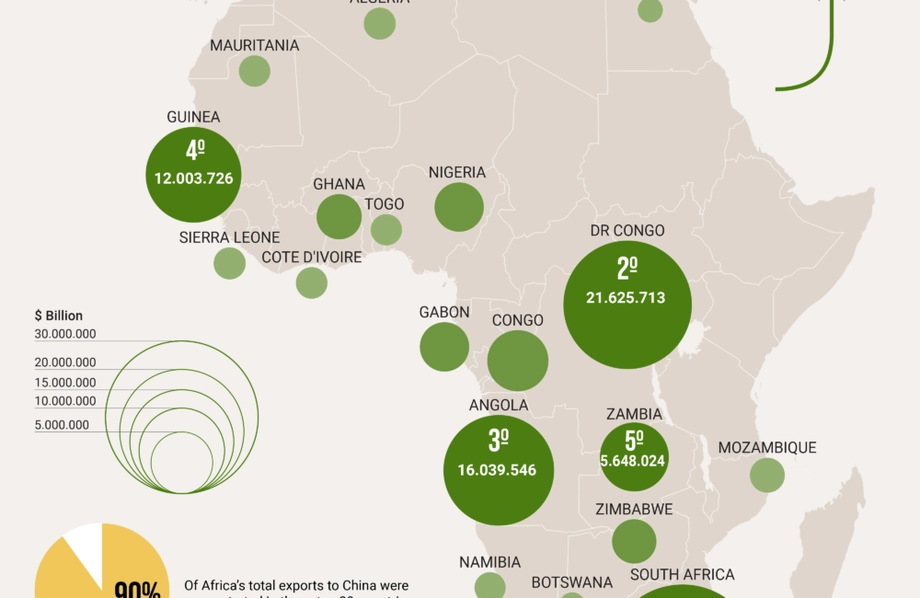
Trade is also concentrated in a few countries. South Africa, the Democratic Republic of the Congo and Angola supplied 55.4% of Africa's exports to China in 2025. Nigeria, South Africa and Egypt together received 30% of China's exports to Africa.
Those concentrations help explain why a continental total can hide very different national experiences. An oil exporter, a copper producer and a country importing machinery can all face different changes in demand, prices and industrial competition.
Jeremy Smith, a Rhodium Group analyst writing for the Atlantic Council, links weaker Chinese property and construction activity to pressure on demand for Angolan crude and South African iron ore. Demand for copper and cobalt used in clean energy industries, meanwhile, supports exports from the Democratic Republic of the Congo.
What changed when tariffs fell to zero?
China's tariff concession took effect on May 1, 2026, covering all tariff lines for 53 African countries with diplomatic relations with Beijing. The arrangement is scheduled to run until April 30, 2028, while longer trade agreements are negotiated.
A tariff is a tax charged when a product enters a country. Removing it can make an African product less expensive for a Chinese buyer. Exporters still need to meet product standards, document where goods were made and arrange delivery.
Cong Song, China's ambassador to Ghana, told a trade forum in Accra that the concession did not require African countries to offer matching access to their markets. He also described the arrangement as having no export volume limit.
The zero-tariff policy is offered unilaterally, with no requirement for African countries to open their markets reciprocally. There is no ceiling on the volume of African exports to China.
The trade calendar now includes several dates that matter to exporters and governments:
- May 1, 2026: China's tariff concession began for 53 African countries.
- October 19–21, 2026: South Africa and China held their first negotiating round in Beijing.
- November 18–19, 2026: The Shenzhen summit provides the setting for the planned Trump–Xi meeting.
- December 31, 2026: The renewed US African Growth and Opportunity Act preferences are scheduled to expire.
- 2027: Another South Africa–China negotiating round is planned, with no exact date announced.
- April 30, 2028: China's current African tariff arrangement is scheduled to end.
Nigeria's export surge still leaves a wide gap
Nigeria's exports to China reached $2.25 billion in the first half of 2026, up 81%, according to figures released by the Chinese Embassy in Nigeria. Bilateral trade rose 35% to $17.4 billion.
Yang Jiaxing, the embassy's cultural counsellor and director of the China Cultural Centre in Nigeria, presented the figures in connection with the China–Nigeria Bridge Programme. He said Chinese imports from Nigeria grew by more than 40% in both May and June.
"In the first half of this year, bilateral trade between China and Nigeria reached $17.4 billion, up 35 per cent year-on-year. China's imports from Nigeria amounted to $2.25 billion, representing a remarkable increase of 81 per cent," Yang said.
Nigeria's sales accounted for about 13% of the total bilateral trade value. The figures imply imports from China of roughly $15.15 billion and a Nigerian deficit of about $12.9 billion during those six months. Rapid export growth therefore coexists with a large imbalance.
Nigerian producers face constraints including high production costs, inadequate infrastructure, limited processing capacity and transport difficulties. Businesses also need reliable distribution channels and sufficient quantities of goods that meet Chinese certification requirements.
The relationship is expanding beyond merchandise. The Bridge Programme, launched on September 2, combines Mandarin lessons with news and information about cooperation. It followed agreements signed by Voice of Nigeria with Xinhua on April 24 and the Chinese Embassy on May 18.
Ghana's challenge is getting products ready
Ghana exported $290 million in goods to China in June 2026 under the tariff concession, according to Ambassador Cong Song. Ghana–China trade had reached $14.12 billion in 2025, including $2.67 billion in Ghanaian exports, up 33.9%.
The June figure gives exporters an early measure of sales under the new arrangement. For Ghana's government, the broader objective is to connect market access with local factories, domestic suppliers, workforce skills and lasting jobs, priorities outlined by Foreign Affairs Minister Samuel Okudzeto Ablakwa.
Leonard Edem Cosmos, president of the MOFCOM Scholars Alumni Association of Ghana, identified the practical work needed to turn tariff relief into shipments at the Accra forum.
"Knowing that duties have been removed is only the first step; knowing how to navigate sanitary and phytosanitary standards, packaging regulations, rules of origin, logistics, and Chinese buyer expectations is where real trade happens," he said.
Sanitary and phytosanitary standards are rules intended to protect people, animals and plants from unsafe food, pests and disease. Rules of origin establish where a product was made so customs officials can decide whether it qualifies for preferential treatment. For a small food processor, meeting those requirements can be as important as finding a buyer.
South Africa seeks sales and protection for industry
South Africa's exports to China rose 24% between May and August 2026 compared with the same period a year earlier, according to its Department of Trade, Industry and Competition. Imports from China increased 23% during the same period.
Several export categories grew beyond minerals. Vehicle exports rose 104%, although from a low starting point. Chemicals increased 63%, mechanical and electrical power products 36%, agricultural exports more than 35%, and nonmineral exports 21%.
Xolelwa Mlumbi-Peter, the department's deputy director-general for trade, said South Africa was negotiating an early harvest agreement. Such an agreement allows countries to settle selected trade measures before completing a broader deal.
The zero-duty tariff access is for two years to allow for the negotiation of arrangements and a trade agreement with China. We are negotiating an early harvest agreement with China that will fundamentally ensure we do not open up sectors that are sensitive to South Africa. We are looking at an arrangement that will work in the best interests of South Africa.
South Africa's position captures the balance facing several African governments: increase exports while preserving room for domestic manufacturers to compete. The department is working with industry following the October talks in Beijing, with another round planned for 2027.
Processing minerals could change what Africa sells
China's purchases from individual African countries show pockets of rapid growth. The institutional China Trade Data dataset, attributed to customs statistics and verified on November 18, lists imports from Mali at $660 million in January–September, up 503.3%. Purchases from Chad reached $1.5 billion, up 358.4%, and those from Rwanda reached $543 million, up 246.3%.
The same dataset shows Chinese exports to the Democratic Republic of the Congo reaching $5.6 billion, up 61.7%. These changes show trade expanding in both directions across countries with very different economic sizes.
African governments are also seeking more income from minerals before they leave the continent. Processing ore into a refined material, or using it to manufacture a component, can create additional stages of production locally. The Democratic Republic of the Congo, Guinea and Zimbabwe have introduced mineral export bans or restrictions to encourage that shift.
An investment tally through June 2026 identified $41.2 billion across 32 mining and exploration developments in 15 African countries. Of those, 19 projects involving mineral processing, refining or manufacturing represented $16.3 billion, about 40% of the total value.
These investments address a central issue in the trade relationship: many African exports remain raw materials, while China supplies machinery, electronics, vehicles and other manufactured products. More local processing would give African businesses additional products to sell and more production work to undertake at home.
From solar fans to competition for factories
Yiwu, the Chinese trading city, exported 141.4 billion yuan, or about $19.9 billion, in goods to Africa in 2025, up 28.4%. That represented almost 9% of China's exports to the continent.
Its wholesale markets supply household appliances, clothing, electronics, solar equipment and hardware. A foldable fan with a lamp and a small solar panel illustrates the practical appeal: it can provide cooling and light where electricity supplies are unreliable.
Trade also moves in the other direction through Yiwu. African products sold in China include Senegalese raffia hats, Malagasy handicrafts, Kenyan carvings, South African pecans and Ethiopian coffee.
Tseganeh, an Ethiopian merchant displaying coffee at a China–Africa commodities exhibition, described plans to broaden his business.
This is just the beginning," he said. "I think I will expand my network and grow my business from coffee into other products.
For African consumers and companies, Chinese imports can expand access to useful equipment and goods. Local producers face stronger competition at the same time. Smith's analysis identifies that pressure alongside the continued concentration of African exports in raw materials.
Africa sits within a wider trade shift
China's expansion into African markets is part of a broader effort to sell across more destinations as Western trade barriers tighten. Chinese exports to the Association of Southeast Asian Nations reached $705.9 billion in January–October, up 30.5%, with a surplus of $293.1 billion.
China's surplus with the European Union reached $310.7 billion over the same period, compared with $266.5 billion with the United States. Exports to the United States also rebounded in October, rising 32.9% to $46.4 billion.
African exporters face a shorter policy timetable in the United States. The African Growth and Opportunity Act, which provides preferential access for eligible African products, was renewed retroactively after expiring on September 30, 2025. Its current extension runs only through December 31, 2026.
China has also formalized the suspension of a 24% tariff on goods originating in the United States through January 10, 2027. The planned Trump–Xi talks therefore take place amid temporary trade arrangements on several fronts.
For Africa, the clearest change is already visible in the figures: sales to China are accelerating, but imports remain much larger. Nigeria's export surge, Ghana's focus on standards and South Africa's negotiations show that closing the gap requires both customers abroad and stronger production at home.
Key Points
- China–Africa goods trade reached $346.8 billion in January–October 2026, up 22.7%.
- China exported $224.14 billion to Africa and imported $122.72 billion, leaving Africa with a deficit of about $101.4 billion.
- China's worldwide goods trade surplus passed $1 trillion through October.
- China's tariff concession covers 53 African countries and is scheduled to run until April 30, 2028.
- Nigeria, Ghana and South Africa recorded export gains, while production capacity, standards and industrial competition remain central concerns.
- South Africa plans further trade negotiations with China in 2027; US AGOA preferences currently expire on December 31, 2026.