A robot girl group moves toward the global stage
South Korea's Galaxy Corporation plans to unveil a humanoid robot K-pop girl group globally in January 2027, following a small concert in Macau in December 2026. Chinese manufacturer Unitree Robotics will supply the robots, while the Korean side develops the music, choreography and idol characters and manages the group.
Contents
- A robot girl group moves toward the global stage
- Three partners divide the work
- What audiences have already seen
- The Seoul park is the permanent testing ground
- How the robots learn to dance
- A rollout with several different milestones
- Why Galaxy wants income beyond human stars
- From concert venues to toys and cafes
- The difficult part is making repeat shows pay
- Key Points
Galaxy founder and chief executive Choi Yong-ho is proposing something more lasting than dancing machines at a technology exhibition. The company wants to apply the K-pop business model to robots: give them recognizable personalities, build fan communities, sell merchandise and send them on tour. Virtual AI and human girl groups are planned to follow the robot act.
The project brings together Galaxy, whose artists include G-Dragon, Taemin and Kim Jong-kook, Unitree, and Hong Kong listed entertainment company Star Plus Legend. Galaxy and Star Plus Legend signed a strategic memorandum of understanding in Hong Kong on November 16, 2026, expanding their partnership into robot parks, international performances, AI toys and companion robots.
The commercial ambition is concrete. Galaxy wants performances that can run without waiting for a human star's next available date, including permanent shows at its Seoul robot park and concerts staged in several countries simultaneously. Dubai and Tokyo are among the cities targeted for expansion.
The next scheduled steps are the December Macau performance and January group debut. A humanoid idol world tour has also been announced for the second half of 2027, although Galaxy's official timetable includes an earlier launch for a broader robot concert format.
Three partners divide the work
Unitree's role is to build the physical performers. Galaxy supplies the entertainment elements, including songs, movement routines, characters and experience managing artists. Star Plus Legend brings experience commercializing celebrity intellectual property and access to business networks in Hong Kong and China.
Intellectual property, often shortened to IP, means creative assets that a business can control and license, such as a character, brand or performance concept. Galaxy's plan is to turn a robot from a piece of equipment into a recognizable entertainer whose identity can appear in concerts, clothing and consumer products.
Star Plus Legend already has experience in that process. Founded in 2017 with support from members of Jay Chou's team, including his mother, Ye Huimei, it listed in Hong Kong in July 2023. It has commercialized an animated character associated with Chou and operates businesses in IP and health related consumer products.
The relationship also involves investment. On November 3, 2025, Star Plus Legend subscribed through an industry fund for up to 7% of Galaxy's issued shares. Plans discussed in January 2026 included deeper cooperation in AI and robotics and a proposed venture called Galaxy China. The November agreement extends the relationship into products and venues; Star Plus Legend chief financial officer Lai Kwok Fai Franki said there were no current plans to buy additional equity.
What audiences have already seen
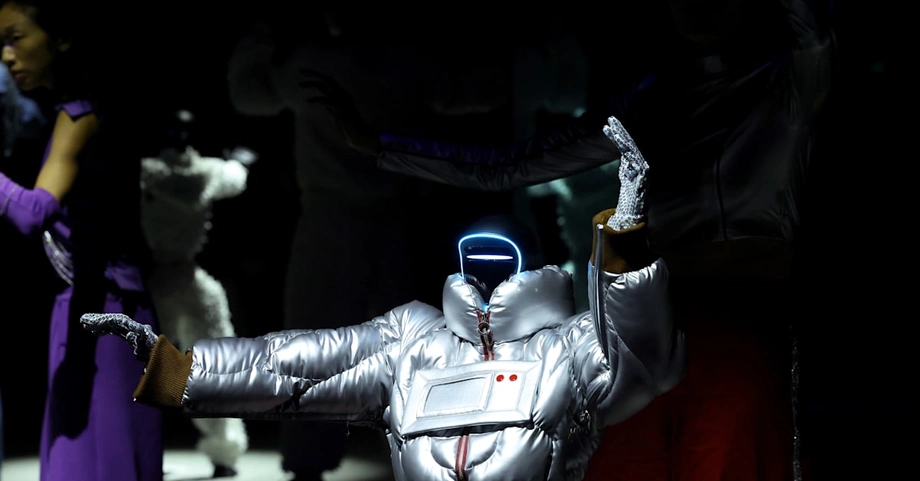
Galaxy's November 16 fashion show at HEXA, at Hong Kong's Harbour City Ocean Terminal, gave the partnership a public stage. Humanoid robots reproduced BIGBANG music and choreography, while human models and machines shared the runway. The event coincided with BIGBANG concerts in Hong Kong.
The show also included robot fashions inspired by traditional Korean masks. A humanoid presenter named Schofield Stein appeared with a face modeled on Choi's, making the company's founder part of its experiment in giving machines individual identities.
Galaxy's MACH33 robot fashion brand had already appeared at its Seoul park in May and at the VivaTech exhibition in Paris in June. The Paris presentation included designs by the late André Kim restored using AI. In September, Galaxy staged a K-pop performance with 17 humanoid robots in New York's Times Square, followed by an appearance at Dubai Mall's Robot Arena in October.
Clothing, faces and stage names are central to the commercial plan. A synchronized dance routine gives an audience something to watch. A distinct character gives fans something to recognize when the performer returns, appears on merchandise or moves into another venue.
The Seoul park is the permanent testing ground
Galaxy Robot Park occupies roughly 16,500 square meters in Godeok, in Seoul's Gangdong District. Galaxy's official company FAQ describes a permanent K-pop robot show and a target of at least four performances a day, or more than 1,000 a year.
The company gives July 2026 as the start of its soft opening and August 21 as its grand opening. A May announcement had set May 5, Children's Day, as the public opening date, and subsequent descriptions have referred to the park being introduced in May. Galaxy's official opening chronology is later.
Galaxy says 20,000 people visited before the grand opening and every soft opening session sold out. A later figure puts paid attendance at about 33,000 in its first six months, with construction costing approximately $20 million.
Three Unitree robots have performed to G-Dragon's "POWER" and Taemin's "Advice." Other attractions include portrait drawing, robot dogs, boxing and interactive experiences. The Children's Day program was designed to welcome about 100 children, including 70 from families with one parent and children with borderline intellectual functioning.
The venue gives Galaxy a place to repeat performances, change routines and observe whether visitors return. Ticket income, food outlets and merchandise can also support a different business rhythm from an occasional concert tour.
How the robots learn to dance
Galaxy says its robots learn choreography using motion capture. In simple terms, a dancer's movements are recorded as data, which is then used to teach a robot how to reproduce a routine within the limits of its body.
The company says those routines can be transmitted over a network to robots in different locations. Its proposed international concert format would therefore allow machines in several countries to perform the same show at the same time, rather than move one cast from city to city over several months.
Galaxy calls this Physical AI: artificial intelligence operating through a machine that moves in the real world. Its business also includes virtual characters that appear on screens, but the planned girl group's performers will have physical robot bodies sharing a venue with their audience.
Choi has described human performers, virtual idols and robots as parts of the same entertainment market. In a previous television appearance, the Galaxy founder and chief executive outlined his expectation for their coexistence:
Robots are next. The three coexist, and I think the coexistence will happen in the next five years. Galaxy Corp. is preparing a lot for that day.
A rollout with several different milestones
Galaxy's plans span park performances, short showcases, a group debut and international touring. Its official FAQ says it is preparing to launch a robot concert world tour by the end of 2026, using networked robots to stage simultaneous performances. An announcement at the park's opening placed a humanoid idol world tour in the second half of 2027.
The timetable leaves the precise relationship between those touring projects and the January girl group debut unresolved. Galaxy has not announced the group's name, number of members, full concert schedule or ticket prices.
- November 2025: Star Plus Legend becomes a strategic investor in Galaxy.
- May to August 2026: Galaxy introduces the Seoul park, followed by its official soft opening and grand opening.
- September and October 2026: Robot performances reach Times Square and Dubai Mall.
- November 16, 2026: Galaxy and Star Plus Legend sign their expanded agreement in Hong Kong and present a robot fashion show.
- December 2026: Galaxy plans a small Macau robot concert.
- January 2027: The robot girl group is scheduled for its global unveiling.
- Second half of 2027: Galaxy targets a humanoid idol world tour.
Why Galaxy wants income beyond human stars
Galaxy reported revenue of 298.8 billion won for fiscal 2025, an increase of 619% from the previous year, and operating profit of 12.5 billion won, returning it to profitability. Those figures put its operating profit margin at about 4.2%, calculated by dividing operating profit by revenue.
G-Dragon remains the company's main commercial engine. Galaxy's official FAQ says Choi has put the artist's share of revenue at 75% to 80%. That concentration helps explain the push into a broader artist roster, permanent attractions, robotics and AI products.
The company was founded in August 2019 and reached a valuation of roughly 1 trillion won in a December 2025 funding round before a planned stock market listing. Cumulative funding exceeds 180 billion won, with investors including Shinhan Bank, Shinhan Capital, SK Telecom, Taiwan's ADATA and Star Plus Legend.
Galaxy formally announced its intention to pursue a US listing at an August 25, 2026 shareholder briefing. The exchange and timing have not been decided. Its robotics expansion sits alongside established businesses in artist management, licensing and television production, including the team behind the competition franchise Physical: 100.
From concert venues to toys and cafes
The November agreement extends beyond stages. Galaxy and Star Plus Legend plan to jointly develop AI art toys and companion robots for markets including South Korea and China. Those products would bring artist characters into homes and everyday settings.
Star Plus Legend opened its Pandabot Cafe in Hong Kong's Tsim Sha Tsui district in November 2026, combining physical robots, AI generated content and IP. Its chief financial officer, Lai, described a direction in which entertainment characters can respond to people in person rather than remain images on a screen.
Galaxy established its Dubai subsidiary, Galaxy ME, in April 2026 and has presented Galaxy Robot Arena Dubai. The company identifies Dubai as a base for the Middle East and a hub for its proposed robot concert network. Its ambitions for Tokyo and other Japanese cities would extend that network further.
Human celebrity businesses continue alongside these plans. Lai said G-Dragon pop-up exhibitions were planned for four or five Chinese cities in December. The partners are using established fan interest to support new experiences while developing robot characters that could eventually attract audiences of their own.
The difficult part is making repeat shows pay
Unitree has demonstrated dancing robots on major stages, including China's Spring Festival Gala. Its founder, Wang Xingxing, has described strong prospects for the sector while pointing to practical deployment problems, including adapting machines to unfamiliar settings without retraining them each time.
Wang also warned that increasing annual production from tens of thousands of robots to millions or tens of millions would test manufacturing capacity, reliability and service after a sale. Galaxy faces a concentrated version of those demands: machines must perform precise movements, stay coordinated and remain dependable across repeated shows.
Robots do not need the same rest schedules as human artists, but motors, joints and batteries require maintenance. Expensive hardware, stage preparation, wear and repair create substantial costs. A permanent venue can spread those costs across many performances, while international shows require dependable local equipment and technical support.
Audience interest is another practical test. Galaxy will need fresh music, recognizable characters and reasons for fans to return after the novelty of a dancing machine fades. The industry also needs workable arrangements for choreography, likenesses, music rights and the relationship between human and robot performers.
The December Macau show and January debut will move Galaxy closer to testing that proposition in public: whether the production methods that turn people into K-pop idols can also turn robots into entertainers with a lasting audience.
Key Points
- Galaxy plans a Macau robot concert in December 2026 and a global robot girl group debut in January 2027.
- Unitree supplies the hardware, while Galaxy develops music, choreography and idol characters.
- A November 16 agreement with Star Plus Legend covers robot parks, tours, AI toys and companion robots.
- Galaxy's Seoul park targets at least four robot shows daily and more than 1,000 annually.
- The company reported 298.8 billion won in 2025 revenue, with G-Dragon accounting for 75% to 80% of revenue according to its chief executive.
- Maintenance costs, performance reliability, rights arrangements and repeat fan demand are central commercial challenges.