October growth puts QRIS ahead of its adoption targets
Indonesia's QRIS payment system reached 71.91 million users and 51.31 million merchants in October 2026, exceeding Bank Indonesia's targets for the end of the year as the central bank prepared to test payments by Hong Kong users in Indonesia in December.
Contents
- October growth puts QRIS ahead of its adoption targets
- More users and merchants, but a slower growth rate
- What the first half reveals about payment activity
- Foreign visitors account for most international payments
- Hong Kong is next, with Timor Leste targeted for 2027
- Why a common code matters to small businesses
- Tap payments and merchant tools extend the system
- December and January bring other payment changes
- Cash demand is growing alongside digital payments
- Key Points
QRIS transactions increased 70.95% from October 2025, Bank Indonesia Governor Destry Damayanti said when presenting the results of the central bank's Board of Governors meeting on November 18, 2026. Total digital payment volume reached 6.18 billion transactions in October, up 31.47% from a year earlier.
The figures show two changes happening together: more people and businesses are joining Indonesia's common QR payment network, while the network is extending its reach abroad. The next scheduled step is a Hong Kong trial in the second week of December 2026, initially allowing participating users from Hong Kong to pay merchants in Indonesia.
QRIS, short for Quick Response Code Indonesian Standard, lets participating banking applications and digital wallets use a common payment code. For a small shop, that can mean accepting payments from several providers through one displayed QR code rather than keeping a separate code for each service.
More users and merchants, but a slower growth rate
Bank Indonesia had set targets of 70 million users and 47 million merchants for the end of 2026. October's figures were already 1.91 million users and 4.31 million merchants above those goals, equivalent to about 2.7% and 9.2%, respectively.
The expansion since June was substantial. At the end of the first half of 2026, QRIS had 66 million users and 44.86 million merchants. By October, it had added 5.91 million users and 6.45 million merchants, increases of approximately 9% and 14.4% in four months.
Transaction growth nevertheless slowed. The annual increase of 70.95% in October 2026 compares with 139.45% in October 2025, a decline of 68.5 percentage points. Payments were still increasing quickly, but their pace of expansion was lower than a year earlier.
QRIS also grew faster than digital payments as a whole: its reported growth rate was more than twice the 31.47% increase across the broader digital payment system. The 6.18 billion October transactions cover that broader system, while the QRIS figures describe one part of it.
What the first half reveals about payment activity
Bank Indonesia recorded 12.55 billion QRIS transactions in the first six months of 2026, twice the number in the same period of 2025. Their value reached Rp600.69 trillion, an increase of 89.52%.
Those figures describe different things. Transaction volume counts how many payments people make. Transaction value adds up the money spent. When the count rises faster than the value, the average payment becomes smaller.
Using the first half figures, the average QRIS payment was approximately Rp47,864. Because the number of payments doubled while their combined value rose 89.52%, the average payment amount fell about 5.2% from a year earlier. This pattern is consistent with QRIS being used more frequently for smaller purchases.
The central bank's annual goal was 17 billion QRIS transactions. By June, the system had reached about 73.8% of that target. The October announcement gives a monthly growth rate rather than a cumulative QRIS transaction count for the year, so progress toward that particular target cannot yet be calculated through October.
Speaking at the Prima Executive Gathering 2026 in Bali, Bank Indonesia Deputy Governor Filianingsih Hendarta described the system's role in these terms:
QRIS has become a gateway to the digital economy and a game changer for Indonesia's digital economy and financial system.
Foreign visitors account for most international payments
International QRIS activity through October 2026 was heavily weighted toward purchases in Indonesia. Filianingsih gave figures of 29.9 million inbound transactions, meaning payments by foreign users in Indonesia, and 5.75 million outbound transactions, meaning payments by Indonesian users abroad.
Together, those figures amount to 35.65 million transactions. Inbound payments accounted for approximately 84% of the total and outnumbered outbound payments by about 5.2 to one.
The balance matters for Indonesian merchants because incoming visitors can bring spending directly into local shops, restaurants and other businesses through familiar payment applications. For Indonesian travelers, the outward connection offers a similar convenience at participating merchants overseas.
The monetary balance needs clarification. Filianingsih was cited as putting net inbound value through October at Rp61 trillion, while another account of her remarks gave a surplus of Rp6.1 trillion for the same period. The latter account attributed the figures to her November 18 press conference in Jakarta and put inbound transaction value at Rp8.27 trillion and outbound value at Rp2.16 trillion, a difference of Rp6.11 trillion, consistent with a rounded net inbound figure of Rp6.1 trillion. Bank Indonesia's transaction counts provide a clearer measure of the direction of activity while the tenfold difference in the stated monetary figure awaits clarification.
Earlier figures show how much smaller inbound activity had been: from January through April 2025, Bank Indonesia recorded 24,121 incoming QRIS payments worth Rp7.1 billion, led by visitors from Malaysia, Singapore and Thailand. Those figures cover a shorter period and an earlier stage of the network's expansion.
Hong Kong is next, with Timor Leste targeted for 2027
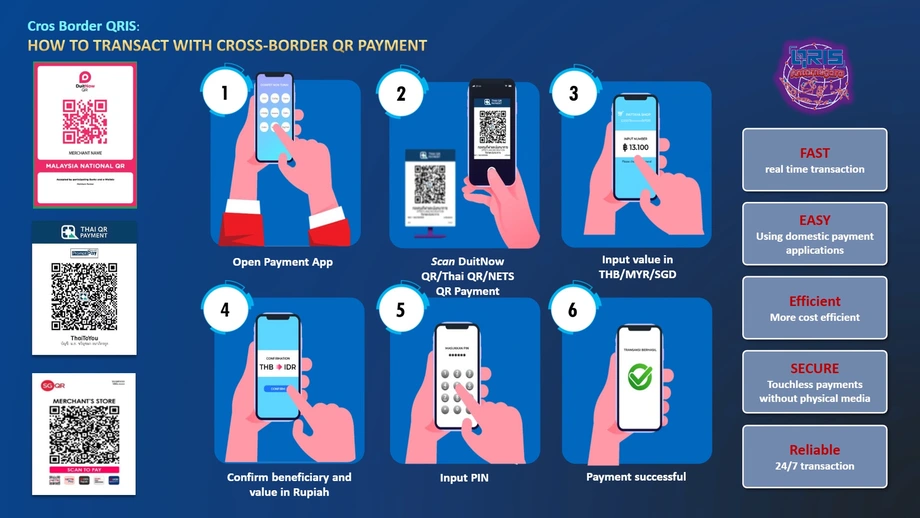
By July 28, 2026, international QRIS connections had been implemented in Thailand, Malaysia, Singapore, Japan, South Korea and China. Bank Indonesia is now preparing the Hong Kong corridor as another step in connecting payment systems across Asia.
The Hong Kong pilot is scheduled for the second week of December 2026. Its initial scope is inbound payments to Indonesia. In practical terms, participating users from Hong Kong would be able to use compatible applications to pay at Indonesian merchants through connected QR systems.
The technology behind that connection is interoperability: different payment systems are made able to communicate, so a merchant's QR code can work with a visitor's supported application. The December timetable covers the inbound pilot; a date for Indonesian users to make corresponding payments in Hong Kong has not been given.
Timor Leste is targeted for a connection in 2027. Bank Indonesia is also discussing expansion with Saudi Arabia and India. Earlier expansion plans included agreements with South Korea and the United Arab Emirates, while Japan and India were identified as prospective connections. By July 2026, Japan and South Korea were among the markets already implemented.
Why a common code matters to small businesses
Small businesses make up much of the QRIS network. In the first quarter of 2025, 92.5% of its 38.1 million merchants were micro, small or medium enterprises. At that time, the system had 56.3 million users, compared with 71.91 million by October 2026.
QRIS was introduced in 2019 to replace a fragmented arrangement in which shops could need several codes for different payment providers. A common standard makes it easier for a merchant to accept electronic payments without managing a separate display for each participating application.
Bank Indonesia Assistant Director and Senior Economist Willy Togi, from the Payment System Policy Department, has described international QRIS as a way for small businesses to accept digital payments from foreign visitors using a printed QR code.
The network also depends on financial institutions and payment companies connecting customers with merchants. In the first half of 2026, the QRIS ecosystem included 96 banks, 60 financial institutions outside banking and four payment switching operators. Switching operators help route payment instructions between participating institutions.
For a business owner, the practical benefit is broader acceptance: more customers can pay through a system the merchant already uses. The international connections extend that principle to participating visitors from abroad.
Tap payments and merchant tools extend the system
QRIS is developing beyond the familiar process of opening an application and scanning a printed code. Willy identified QRIS Tap, which uses near field communication, or NFC, as a newer development. NFC allows compatible devices to exchange information over a very short distance, enabling a tap payment.
Payment company PT Finnet Indonesia supports the ecosystem through services as an issuer, acquirer and payment gateway. An issuer serves the paying customer, an acquirer connects the merchant to payment acceptance, and a gateway helps pass payment information between systems.
Finnet's Director of Technology, Product and Operation and Acting Director of Finance and Risk Management, Anton Daryono, said the company was developing services around industry needs and Bank Indonesia requirements. Its merchant tools include transaction notifications and a Soundbox, which provides an audible payment notification.
Such tools address a basic need at a busy counter: helping the seller recognize when a payment has arrived. Digital records also give merchants a transaction history and reduce the amount of cash they need to handle.
December and January bring other payment changes
Bank Indonesia's next steps extend beyond international QR payments. Destry outlined plans for rules covering supporting payment service providers and the first phase of the Payment System Data Infrastructure, both scheduled to take effect in the second week of December 2026.
The central bank placed those measures within its work to strengthen payment risk management. As more purchases pass through digital channels, the institutions supporting payments and the data behind those transactions become a larger part of keeping the system operating reliably.
Bank Indonesia also plans to develop an online payment feature for Kartu Kredit Indonesia, known as KKI, starting in January 2027. That initiative is intended to broaden acceptance of the Indonesian credit card system alongside the continued expansion of QRIS.
The announced timetable is:
- July 28, 2026: QRIS international connections were implemented in Thailand, Malaysia, Singapore, Japan, South Korea and China.
- November 18, 2026: Bank Indonesia presented October payment figures and its next policy steps.
- Second week of December 2026: Hong Kong inbound pilot, supporting provider rules and the first phase of payment data infrastructure are scheduled.
- January 2027: Development of KKI online payments is scheduled to begin.
- 2027: Bank Indonesia targets a QRIS connection with Timor Leste.
Cash demand is growing alongside digital payments
Indonesia's growing use of QRIS is taking place alongside rising demand for physical money. Currency in circulation increased 11.48% from a year earlier to Rp1,353 trillion, according to Bank Indonesia's October figures.
Currency in circulation measures the stock of physical rupiah outside the central bank. Digital transaction volume counts payments made during a period. The two figures describe different parts of everyday financial activity, and both increased in October.
Destry said Bank Indonesia would continue ensuring sufficient supplies of rupiah in usable condition across the country, including frontier, outermost and remote areas. For households and businesses, that means the central bank is expanding digital payment connections while continuing to provide access to cash.
Key Points
- QRIS transactions grew 70.95% annually in October 2026, slower than the 139.45% growth recorded a year earlier.
- The network reached 71.91 million users and 51.31 million merchants, exceeding its targets for the end of 2026.
- Total digital payment volume reached 6.18 billion transactions in October, up 31.47%.
- International QRIS activity included 29.9 million inbound and 5.75 million outbound transactions through October.
- A Hong Kong inbound pilot is scheduled for the second week of December 2026, with Timor Leste targeted for 2027.
- Currency in circulation also increased, rising 11.48% to Rp1,353 trillion.