Digital money moves beyond banking hours
Hong Kong has opened its EnsembleTX pilot to settlement around the clock using tokenized central bank money, expanding a system that now brings together 12 banks and 20 industry participants. The Hong Kong Monetary Authority announced the upgrade on November 2, 2026, alongside plans to bring regulated stablecoins into trials involving tokenized Exchange Fund Bills.
Contents
- Digital money moves beyond banking hours
- What changes when settlement stays open?
- From a sandbox to transactions with real money
- Government bills could supply cash when banks need it
- Banks put the infrastructure to work
- RedCoin brings stablecoins into everyday payments
- What backs the new stablecoin?
- Digital bonds give the system assets to settle
- Security and AI controls accompany the expansion
- A separate payment link targets the end of 2026
- Key Points
The changes connect three parts of the city's digital finance push: money held at commercial banks, settlement money provided by the monetary authority, and financial assets recorded as digital tokens. Banks and their clients can use the upgraded infrastructure to move funds and settle tokenized transactions outside conventional operating hours.
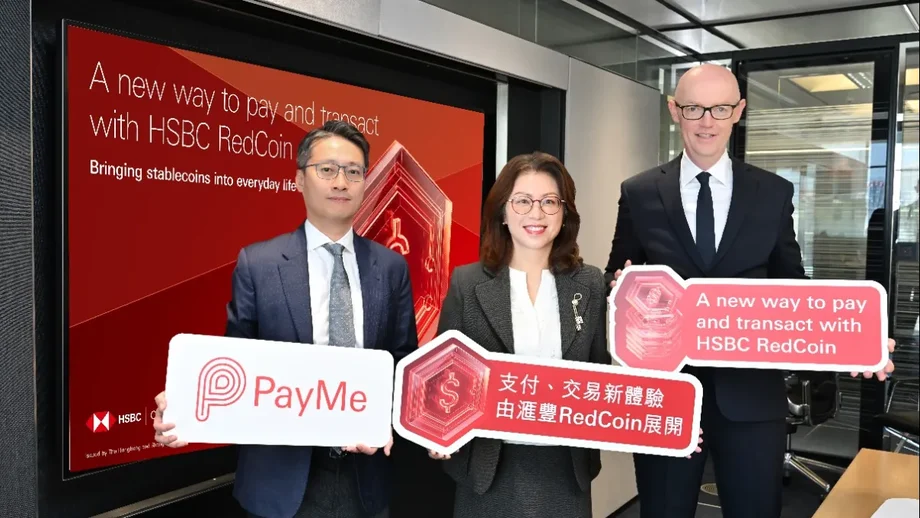
HSBC is pursuing the consumer side at the same time. Group Chief Executive Georges Elhedery said its Hong Kong dollar stablecoin, RedCoin, had attracted 50,000 users about 10 days after launching through PayMe on October 23. The bank disclosed HK$87.75 million in circulation against HK$88.75 million in cash reserves as of November 2.
The HKMA's EnsembleTX settlement announcement sets out the institutional change precisely: participating banks can now settle tokenized deposit transactions between themselves in tokenized central bank money, 24 hours a day, seven days a week. Corporate treasury management and tokenized money market fund transactions are already among the pilot's uses.
What changes when settlement stays open?
Settlement is the step that completes a payment or trade by transferring the money owed. A financial asset might be recorded and traded digitally, yet its payment can still depend on a banking system that operates only during certain hours.
EnsembleTX initially used Hong Kong's dollar Real Time Gross Settlement system, known as RTGS, for settlement between banks. That arrangement allowed actual money to move within a controlled pilot, but tied those transfers to the system's operating hours. Tokenized central bank money now supplies the settlement asset outside that schedule.
A tokenized deposit is a commercial bank deposit represented on a digital ledger. Tokenized central bank money serves a different role: it allows participating banks to settle what they owe each other using money provided by the monetary authority. A stablecoin is issued separately and is designed to maintain a stable value against a currency, supported by reserves and redemption arrangements.
For a company managing funds across time zones, continuous settlement gives its treasury team more flexibility over when to move cash. For an investment platform, it creates the payment infrastructure needed to support transactions in tokenized funds outside ordinary banking hours. Access remains within the participating institutions and the pilot's arrangements.
From a sandbox to transactions with real money
Project Ensemble began in March 2024 as an investigation into how banks could settle tokenized transactions using wholesale central bank digital money. Its progress has followed a series of controlled steps rather than a single public launch.
- March 2024: The HKMA launched Project Ensemble.
- August 2024: A sandbox opened so banks could connect tokenized deposit platforms and test transactions.
- November 2025: EnsembleTX began real value trials, initially using Hong Kong dollar RTGS for settlement between banks.
- November 2, 2026: The HKMA announced settlement around the clock in tokenized central bank money.
The number of banks providing tokenized deposits has risen from seven to 12, while industry participants have increased from 13 to 20. Together, that brings participation to 32 organisations, compared with 20 previously. Cumulative transaction value since the November 2025 launch has exceeded HK$1 billion.
Participants include HSBC, Standard Chartered, Bank of China (Hong Kong), Ant International, BlackRock and China Asset Management (Hong Kong). Banks joining during 2026 include Bank of Communications (Hong Kong), China CITIC Bank International and Nanyang Commercial Bank.
HKMA Chief Executive Eddie Yue said the project was moving toward commercial applications. The authority also plans to work with the Securities and Futures Commission on the supporting market infrastructure. SFC Chief Executive Julia Leung identified secondary trading of tokenized funds on licensed platforms as one application of continuous settlement.
Government bills could supply cash when banks need it
Recognized dealers have completed trial trades in tokenized Exchange Fund Bills in the secondary market, where securities change hands after their initial sale. The HKMA plans to extend the trials to regulated stablecoins, although it has announced no starting date.
Exchange Fund Bills are short term debt instruments issued by the monetary authority. Making them available as tokens could also support repurchase agreements, usually called repos. In a repo, an institution exchanges securities for cash and agrees to reverse the transaction later under agreed terms.
HKMA Deputy Chief Executive Howard Lee said tokenized bills could give banks another tool for obtaining liquidity when Hong Kong dollar RTGS is closed. Liquidity here means having money available when a payment falls due. A bank holding eligible securities could use a repo to obtain that money rather than wait for the conventional settlement system to reopen.
Lee said future issuance of tokenized bills would not be very large. The priority is to help participating banks establish operating arrangements and complete the transaction process. That makes the trials a practical exercise in trading, funding and settlement, with stablecoins intended to become another payment instrument within that testing.
Banks put the infrastructure to work
HSBC has completed two EnsembleTX transactions that show how tokenized deposits can serve different needs. One involved a prepaid transfer between banks during subscriptions to the Hong Kong government's fourth digital green bond issuance. The other moved HK$40 million between banks for Ant International's internal treasury and funding management.
Standard Chartered also announced its Hong Kong tokenized deposit service for corporate clients on November 2, making the city the first market in its global network to receive the product. Its tokenized deposit announcement says China AMC, Finloop and PantherTrade have already executed live deposit transactions and settled tokenized money market funds through EnsembleTX.
Standard Chartered is partnering with Fireblocks to connect banking services with its digital asset platform, while HashKey has joined the ecosystem. The bank says the service supports transfers across participating banks and settlement in central bank money, including wholesale central bank digital currency.
Ole Matthiessen, Standard Chartered's Global Head of Transaction Services & Digital Assets, explained the service's purpose:
The value of tokenised deposits lies in their ability to help clients move and manage liquidity more efficiently across institutions and markets. This launch brings digital money into practical treasury and investment workflows, supported by the trust and controls of the banking system.
HSBC's Redefining Treasury report found that more than seven in 10 Hong Kong treasury executives believed digital currencies could lower transaction costs. The completed transfers and fund settlements put that expectation into concrete business workflows.
RedCoin brings stablecoins into everyday payments
RedCoin, whose ticker is RCHKD, takes a different route to adoption: an existing consumer payment application. More than 3.3 million PayMe customers can activate a wallet without opening another bank account or maintaining a minimum balance. The token supports transfers and purchases at more than 100,000 merchants.
Elhedery's reported 50,000 users amount to roughly 1.5% of PayMe's customer base of more than 3.3 million. HSBC is aiming for millions of users and plans to add RedCoin to its main mobile banking application.
HSBC Hong Kong Chief Executive Maggie Ng said merchant payments and wallet top ups were already operating. The bank also plans to support subscriptions to tokenized investments, including a Hong Kong dollar share class of a money market fund. Such funds generally invest in short term debt and other liquid instruments.
RedCoin runs on a private blockchain built with Hyperledger Besu technology. Participation and transfers are controlled through approved channels. HSBC has not disclosed recurring usage or total payment value, or set a timetable for extending access to all HSBC and Hang Seng Bank customers.
Elhedery said HSBC also provides tokenized deposits to wholesale clients in Hong Kong and about half a dozen other jurisdictions, allowing funds to move at any hour. Consumer stablecoin payments and corporate deposit transfers therefore sit alongside each other, serving different customers.
What backs the new stablecoin?
HSBC's November 2 figures put RedCoin cash reserves at HK$88.75 million against circulation of HK$87.75 million. The difference was HK$1 million, equivalent to about 1.14% of outstanding tokens. Circulating supply had increased by HK$6.75 million over the preceding seven days.
The bank publishes daily circulation and reserve figures and weekly unaudited statements. Its first independent reserve attestation, an outside assessment of the reserve information, is expected after the fourth quarter of 2026.
Hong Kong's stablecoin licensing regime took effect in August 2025, setting requirements for reserves, redemption and risk management. HSBC and Anchorpoint Financial received the first two issuer licences on April 10, 2026.
Anchorpoint is backed by Standard Chartered, Animoca Brands and HKT. Its HKDAP token began a limited institutional rollout in August, with retail distribution planned but no launch date fixed. HSBC's approach places a licensed token directly within an established payment application, giving it immediate access to a large potential customer base.
Digital bonds give the system assets to settle
Hong Kong's government digital green bond programme has supplied a growing pool of assets for the settlement infrastructure. Issuance rose from HK$800 million in 2023 to about HK$6 billion in 2024, HK$10 billion in 2025 and HK$20 billion in September 2026. The latest amount is 25 times the first issuance.
Green bonds raise money for environmental projects. Tokenization changes how ownership and transactions are recorded and processed. The fourth issuance added settlement using tokenized deposits and tokenized central bank money alongside RTGS. HSBC's Orion platform supports issuance, settlement, interest payments and redemption.
Yue said about 70% of tokenized bonds issued globally during 2026 had come from Hong Kong. At the same conference, Bank for International Settlements Innovation Hub head Tommaso Mancini-Griffoli said BIS research found tokenized bonds had about 40% higher liquidity than traditional bonds. Liquidity describes how readily an asset can be bought or sold.
Mancini-Griffoli also pointed to the US market for tokenized government debt, which had grown from roughly US$9 billion about a year earlier to about US$14 billion. He identified institutional coordination and risk management as necessary work in connecting financial infrastructure across borders.
Security and AI controls accompany the expansion
The HKMA's November 2 measures also address the security of increasingly automated financial services. Project SAGE focuses on governance for AI agents, systems that can make decisions and carry out tasks with greater independence than a conventional chatbot.
A panel of 22 members from finance, technology, professional services and academia will support the work. A discussion paper uses the ART framework, covering accountability, resilience and trust. Officials expect initial results within nine to 12 months, including work on applications and good industry practices.
The authority will examine whether existing laws adequately address risks such as unauthorized actions and cybersecurity failures, then consider whether new legislation is needed. Mancini-Griffoli separately warned that investment portfolios managed using the same AI model could react in similar ways during a shock, even when their holdings appear varied.
The HKMA and the Hong Kong University of Science and Technology have also introduced a post quantum cryptography toolkit. It helps banks prepare to replace encryption that future quantum computers could potentially break. Hong Kong's first Quantum Preparedness Index, published in July 2026, scored the banking industry at 2.3 out of 10. The targets are five to six by 2028 and 10 before 2030, with an interim survey planned for the second quarter of 2028.
HSBC plans a Global AI and Emerging Technology Institute in Hong Kong, with HKUST as its principal academic partner, beginning operations in early 2027. Research will cover AI security, fraud detection, post quantum cryptography and blockchain. The bank also intends to double its Hong Kong AI specialist workforce to about 300.
A separate payment link targets the end of 2026
The HKMA and Cyberport launched tConnect Launchpad to bring together financial institutions, technology companies and digital asset businesses developing tokenization applications. Alongside that work, Hong Kong is preparing a separate expansion of ordinary payments through the Faster Payment System, or FPS.
The authority aims to connect FPS with UnionPay International by the end of 2026 and begin service in selected markets. The wider network covers more than 100 million merchants across Hong Kong, mainland China and over 40 overseas markets, with access intended to expand gradually.
Users would pay by scanning supported merchant QR codes through their existing payment tools. Transaction limits and fraud prevention measures will be announced when the connection launches. For consumers, that project concerns where they can pay; for banks and investment businesses, EnsembleTX concerns when tokenized transactions can settle.
Key Points
- EnsembleTX now supports settlement between participating banks around the clock in tokenized central bank money.
- Participation has grown to 12 banks and 20 industry organisations, with cumulative transactions exceeding HK$1 billion.
- Tokenized Exchange Fund Bill trading trials will expand to regulated stablecoins, with no starting date announced.
- HSBC reported 50,000 RedCoin users and HK$87.75 million in circulation by November 2.
- Hong Kong is pairing payment and tokenization projects with new work on AI governance and quantum security.
- The FPS connection with UnionPay International is targeted for the end of 2026, initially in selected markets.