A 456 MW project remains outside India's electricity market
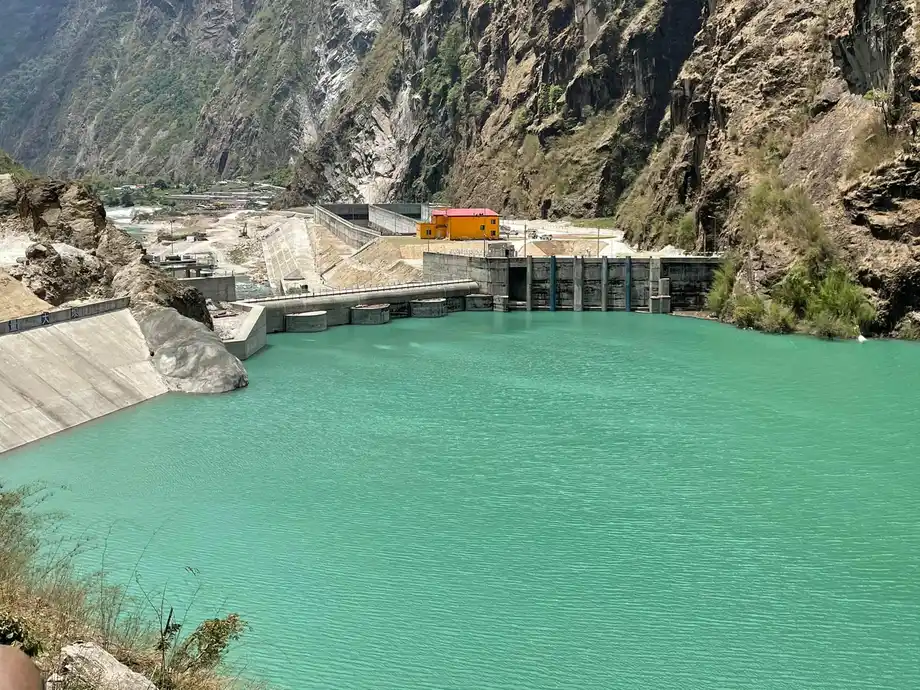
Nepal plans to seek permission to sell electricity from the 456 megawatt Upper Tamakoshi hydropower project to India during Prime Minister Balendra Shah's proposed November 22–23 visit, reviving a request first submitted in April 2021. The project was financed in Nepal, but Nepali energy officials believe the involvement of a Chinese construction contractor has held up access to the Indian market.
Contents
- A 456 MW project remains outside India's electricity market
- Who paid for Upper Tamakoshi?
- What India's approval rules require
- A request stretching back to 2021
- Existing exporters also face renewal deadlines
- Bangladesh trade depends on India's grid
- Transmission plans need several approvals
- Nepal also needs electricity for the dry season
- A short visit with a wider negotiating agenda
- Key Points
The Nepal Electricity Authority (NEA) wants the talks to address a broader problem: how India assesses electricity from projects built by Chinese contractors when the investment and ownership are Nepali. Upper Tamakoshi is the largest example, with Chinese company Sinohydro having carried out its civil construction work.
The proposed discussions reach beyond export approvals. Nepal also wants permission to send another 20 MW to Bangladesh through India's grid, renew arrangements for electricity imports, accelerate transmission construction and secure assistance for power stations damaged by floods.
Shah's visit is expected to last about 25 hours in New Delhi. The proposed itinerary has him departing Kathmandu on November 22 and returning the following afternoon. The visit and detailed programme had not been formally approved and announced when the arrangements were described, while the electricity agenda still required coordination with Nepal's energy and foreign ministries.
The central issue is practical for Nepal: a power station can be generating electricity, with a customer across the border, yet still need permission for that particular project's output to enter the market. Upper Tamakoshi has been waiting for that permission since before it began producing electricity in July 2021.
Who paid for Upper Tamakoshi?
Nepali institutions hold the main investment in Upper Tamakoshi. The NEA, Nepal Telecom, the Citizen Investment Trust and the Rastriya Jeevan Beema Company together own 51 percent. The remaining shares belong to members of the public, residents of Dolakha, Employees Provident Fund contributors and employees associated with the project.
Domestic institutions also supplied the loans used to build it. Nepal's argument therefore rests on a straightforward difference between an owner and a builder: an investor supplies capital and holds a financial interest, while a contractor is paid to carry out agreed construction work.
Sinohydro won the contract for civil works, including the dam and tunnels, through international competition. Indian and Austrian companies also participated in other construction packages. Nepal wants India to assess the project's Nepali financing and ownership separately from the nationality of one contractor.
The financial consequences fall close to home. Export earnings would support a project backed by Nepali public institutions, savers and shareholders. Without access to the Indian market, Nepal has fewer options for selling its surplus generation.
What India's approval rules require
India's Central Electricity Authority issued procedures governing electricity imports and exports in 2021. They require approval for individual projects seeking access to the Indian market, meaning a broad agreement between governments still leaves individual power stations subject to scrutiny.
Section 6.3 addresses direct or indirect investment, ownership or control involving an entity from a third country that shares a land border with India but lacks an electricity cooperation agreement with it. This is relevant to Chinese investment because India and China have no such agreement.
Nepal's position is that hiring a Chinese builder is different from having Chinese investment or control. Nepali energy officials attribute Upper Tamakoshi's continued lack of approval to Sinohydro's involvement. An Indian explanation specific to the pending application has not been made public in the account of the negotiations.
Govinda Raj Pokharel, a former vice chairman of Nepal's National Planning Commission, has urged Shah to press for easier access for electricity produced in Nepal. His argument is that applying restrictions to projects merely because they employed Chinese contractors places the burden on Nepal.
A request stretching back to 2021
Upper Tamakoshi's application has already passed through several rounds of diplomacy. Nepal previously sought approvals for electricity from projects including Upper Bhotekoshi, Marsyangdi, Kali Gandaki A and Middle Marsyangdi, alongside Upper Tamakoshi.
The main dates show how long the largest unresolved request has been under discussion:
- April 2021: The NEA requested Indian export approval for Upper Tamakoshi and other projects.
- July 2021: Upper Tamakoshi began producing electricity.
- June 2023: Then prime minister Pushpa Kamal Dahal asked Indian Prime Minister Narendra Modi to expedite approval for another 1,200 MW, including Upper Tamakoshi.
- January 4, 2024: Nepal and India signed a power trade agreement lasting 25 years, with a target of importing up to 10,000 MW from Nepal over the following decade.
- November 22–23: Shah's proposed visit offers another opportunity to raise the application.
India has authorised imports of about 1,200 MW from Nepal, according to the account of the current electricity agenda. Upper Tamakoshi's 456 MW is equivalent to roughly 38 percent of that figure, showing the scale of the project awaiting market access.
The 10,000 MW target gives Nepal a much larger potential market, but reaching it requires both approvals and physical connections. Indian companies have also been assigned seven projects in Nepal with a combined capacity of about 4,700 MW, making the treatment of projects with different ownership and construction arrangements a substantial issue for future trade.
Existing exporters also face renewal deadlines
Nepal's concern extends to power stations already permitted to export. Approvals have expiry dates, and changes in sales arrangements can require further authorisation.
Three projects with a combined 56 MW received permission to sell through the Indian Energy Exchange until July 31, 2027. Permissions for roughly 98 MW from Upper Chameliya, Seti River, Upper Tadi Khola and Upper Dordi A were renewed only in early October after delays.
Contracts covering 609 MW sold to Haryana, Uttar Pradesh and Bihar expired at the end of October. The NEA had submitted a proposal in August to sell that electricity through the Indian Energy Exchange, but approval was still pending. The exchange is a marketplace where electricity can be bought and sold for specified delivery periods.
These deadlines affect income as well as administration. A power station needs a valid route to market when surplus electricity is available. A gap between an expiring contract and a new permission can interrupt that route even when generation and transmission equipment are ready.
Bangladesh trade depends on India's grid
Nepal already exports 40 MW to Bangladesh using Indian transmission infrastructure. The NEA wants permission to add 20 MW, taking the total to 60 MW, a 50 percent increase.
India's role is essential because the electricity must travel through its network. Nepal and Bangladesh can agree on a sale, but moving the power also requires authorisation and arrangements with India.
The proposed increase remains held up by the necessary Indian approval. Nepal therefore plans to raise Bangladesh exports alongside access to India's own electricity market, treating both as parts of the same regional trading agenda.
Electricity trade is already producing meaningful revenue. In Nepal's fiscal year 2082/83, exports to India and Bangladesh were valued at 29.32 billion Nepali rupees, against electricity imports from India worth 10.55 billion rupees. The difference was 18.77 billion rupees.
Those earnings sit beside a much larger goods trade imbalance with India. Nepal imported about 1.211 trillion rupees in goods and exported about 259 billion rupees during the same fiscal year, leaving a deficit of roughly 952 billion rupees. More dependable electricity sales would provide another source of export income. The NEA recorded profit before tax of about 5.04 billion rupees that year.
Transmission plans need several approvals
The NEA also wants work accelerated at India's Gorakhpur substation. It has agreed to cover the entire 37 million Indian rupee cost of an interim arrangement intended to support electricity trade between the two countries.
Nepal plans to ask India to instruct Power Grid Corporation of India to complete the work in line with an agreed November 2026 deadline. The proposal also calls for prompt consent from Uttar Pradesh Power Transmission Corporation.
An associated foreign investment application submitted through India's National Single Window System on June 26 is another item Nepal wants processed quickly. Together, these requests show that expanding trade involves construction contracts, investment permissions and coordination between several electricity bodies.
At Sitamarhi, Nepal wants Indian company SJVN to finish substation work so additional trade can begin through the Dhalkebar–Sitamarhi connection. It also wants construction procedures advanced for the Nijgadh–Motihari and Lamahi–Lucknow transmission lines, both rated at 400 kilovolts, whose detailed project reports have been approved.
Megawatts measure power output or transfer capacity, while kilovolts describe electrical voltage. The proposed 400 kV lines are intended to carry large amounts of electricity between the two national networks. Nepal and India have also agreed to increase export capacity from 1,100 MW to 1,650 MW, a rise of 50 percent.
Nepal also needs electricity for the dry season
Nepal's agenda combines requests to sell more electricity with requests to buy it. River flows affect hydropower production, so the country's supply needs change across the year. Flood damage has added pressure ahead of the coming dry season.
The NEA wants to renew arrangements for importing 270 MW from Bihar and Uttar Pradesh through Power Trading Corporation. It also seeks easier access to electricity bought through the Indian Energy Exchange using the Dhalkebar–Muzaffarpur 400 kV transmission line, particularly during periods of peak winter demand.
Nepal is proposing agreement on a further 150 MW of imports after floods damaged generation facilities in the Trishuli and Devighat areas. The additional supply would help manage the expected shortage while damaged facilities are restored.
Repair assistance is another proposed topic. Nepal wants Indian technical and other support to reconstruct the Trishuli and Devighat hydropower stations damaged by flooding in the Bhotekoshi–Trishuli river system.
The NEA also plans to update India on the 40 MW Rahughat hydropower project, which is being developed with Indian assistance. According to the authority, physical progress has reached 99 percent, commissioning of both units is complete and final trial operation is under way before commercial production begins.
A short visit with a wider negotiating agenda
Shah's electricity requests are part of a much broader proposed package. Nepal has sought 200 billion Nepali rupees in Indian assistance, divided equally between concessional loans and grants. A Foreign Ministry source described India's initial response as positive, with discussions still at the proposal stage.
The proposed grant allocation includes 50 billion rupees for reconstruction following floods in Rasuwa and another 50 billion rupees for the Butwal–Pokhara Expressway. Concessional loans are borrowing offered on more favourable terms than ordinary commercial lending.
Other possible subjects include additional air routes, the Raxaul–Kathmandu railway, an Ayodhya–Janakpur train service and petroleum pipelines crossing the border. Nepal also wants progress on the Pancheshwar Multipurpose Project and the release of 10 cubic metres of water per second for the Mahakali Third Irrigation Project. India has maintained that Pancheshwar needs broader political consensus.
For electricity, the immediate priorities are specific: a decision on Upper Tamakoshi, timely renewals for existing exports, permission for another 20 MW to Bangladesh, progress on transmission works and dependable winter imports. Resolving those items would turn the countries' larger power trade ambitions into more predictable arrangements for Nepal's generators and consumers.
Key Points
- Nepal plans to seek Indian export approval for the 456 MW Upper Tamakoshi project during Shah's proposed November 22–23 visit.
- The project was financed in Nepal. Nepali officials attribute the approval delay to Chinese contractor Sinohydro's construction role.
- India requires approval for individual projects, while existing exporters also face renewal deadlines.
- Nepal wants Bangladesh exports increased from 40 MW to 60 MW using India's grid.
- The agenda includes transmission construction, renewal of 270 MW in imports and a request for another 150 MW.
- Flood repairs and preparations for winter electricity demand are central to Nepal's requests.