Thirty years of disasters put India among the hardest hit
India recorded 436 extreme weather events, more than 78,000 deaths and over $170 billion in direct economic losses between 1996 and 2025, placing it 10th among the countries most affected in Germanwatch's Climate Risk Index 2027. The disasters affected more than 1.2 billion people across the period, according to the analysis.
Contents
- Thirty years of disasters put India among the hardest hit
- What does India's ranking measure?
- India's toll stretches from coastal cyclones to inland floods
- Heat accounts for the largest share of deaths
- Storms bring the largest financial losses
- Small countries carry a heavy share of the burden
- What changed in the 2025 assessment?
- Climate attribution and the call for financial support
- Key Points
The report, released on November 17, 2026, on the sidelines of the UN climate conference COP31 in Antalya, Türkiye, puts India's experience within a much larger global toll. Nearly 10,000 extreme weather events worldwide killed more than 916,000 people, affected more than 5.5 billion and caused direct economic losses exceeding $4.7 trillion over those three decades.
Germanwatch, an environment and development organisation based in Bonn, adjusted the economic losses for inflation. This allows damage recorded in different years to be compared on a more consistent basis, rather than treating a dollar lost in 1996 as equal in purchasing power to a dollar lost in 2025.
India's figures amount to an average of about 2,600 deaths and more than $5.7 billion in direct damage each year. Actual losses were uneven, with major cyclones, floods and heatwaves producing particularly destructive years.
The findings also show why death tolls and financial damage need separate attention. Heatwaves caused the largest share of recorded deaths worldwide, while storms generated the largest share of economic losses. Countries therefore face several kinds of danger at once: extreme heat threatens health, while powerful storms can destroy homes, roads and other expensive infrastructure.
What does India's ranking measure?
The Climate Risk Index measures the consequences of extreme weather using deaths, the number of people affected and economic damage. It considers both absolute totals and losses relative to population size and gross domestic product, the value of goods and services produced by an economy.
This approach brings together two different experiences. A large country can suffer a very high number of deaths, while a small country can lose a much greater share of its population or economy in a single disaster. Both influence the ranking, in which first place means the most affected country.
Germanwatch draws on extreme weather records from the International Disaster Database and socioeconomic information from the International Monetary Fund and the World Bank. Its index looks back at recorded impacts, giving readers a measure of damage already experienced.
India ranked ninth in the previous assessment covering 1995–2024 and 10th in the latest period, 1996–2025. China ranked 11th in both periods. Because the assessment window moves forward by a year, the latest comparison drops 1995 and adds 2025, changing the collection of disasters being measured.
The affected population figures also cover events across 30 years. A person can experience several disasters during that time, so the cumulative human burden includes the possibility of repeated disruption to the same communities.
India's toll stretches from coastal cyclones to inland floods
India's position reflects repeated disasters across different regions rather than a single exceptional event. Germanwatch identifies major cyclones along the coast, devastating floods inland and episodes of extreme heat among the events contributing to its losses.
The report highlights the following disasters and periods of severe heat:
- 1998: The Gujarat cyclone and a severe heatwave contributed to the toll.
- 1999: The Odisha cyclone was among the major disasters identified.
- 2002 and 2003: Intense heatwaves caused deaths.
- 2013: Floods devastated Uttarakhand.
- 2014: Cyclone Hudhud caused major damage.
- 2015: Another severe heatwave claimed many lives.
- 2019: Severe flooding affected 13 states.
- 2020: Cyclone Amphan added to the country's cyclone losses.
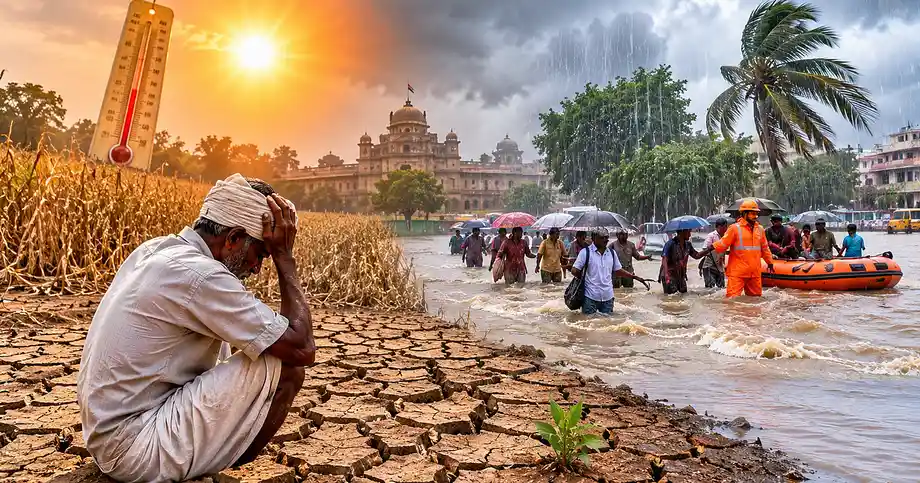
Temperatures during the heatwaves highlighted in the report reached around 50°C. Such conditions place heavy strain on the body, especially when people cannot find shade, cooling or enough water.
The range of disasters matters for households and public services. A coastal community rebuilding after a cyclone faces different immediate needs from a family enduring dangerous heat or a mountain settlement cut off by flooding. India's accumulated losses combine all of these experiences.
Heat accounts for the largest share of deaths
Heatwaves killed about 364,000 people worldwide over the 30 years studied, accounting for roughly 40% of recorded fatalities. Storms killed about 276,000, floods about 200,000 and droughts 25,373.
In 2025, the role of extreme heat was even greater. Heatwaves caused more than 24,000 deaths, close to 70% of the nearly 35,000 deaths recorded from extreme weather that year.
The comparison shows a different balance between the latest year and the longer period: heat accounted for about four in every 10 recorded deaths across three decades, but nearly seven in every 10 during 2025.
Germanwatch also notes that heatwaves can interact with droughts. High temperatures can increase water stress at the same time that limited rainfall leaves farms and communities short of water. These overlapping conditions can put agriculture and food supplies under pressure while also threatening health.
The report says the influence of climate change is easier to establish for heatwaves than for some other extreme events because rising global temperatures are a dominant driver of extreme heat.
Storms bring the largest financial losses
Storms accounted for 58% of global direct economic losses between 1996 and 2025, making them the costliest hazard in the index. In 2025, they caused nearly $65 billion in damage, or about 41% of the year's total.
The financial ranking differs from the death toll ranking because the measures capture different consequences. A storm can damage large amounts of property and infrastructure, while extreme heat can cause many deaths without leaving the same visible trail of destroyed buildings.
India's losses of more than $170 billion sit within the worldwide total exceeding $4.7 trillion. These figures describe direct economic damage. Families can also face disruption to work, schooling and daily life as communities recover.
Repeated storms create a further problem for countries with limited resources: money and labour may have to return to rebuilding places that were repaired after an earlier disaster. Recovery can become a recurring demand rather than a single period of reconstruction.
Small countries carry a heavy share of the burden
Dominica ranked as the most affected country over 1996–2025, followed by Myanmar and Honduras. Libya, Haiti and Grenada came next, with the Philippines, Nicaragua, the Bahamas and India completing the top 10.
Nine of those 10 countries were in the lower and upper middle income groups. The Bahamas was the only country classified as having a high income. Germanwatch describes a pattern in which countries with fewer resources, and which have contributed least to climate change, carry particularly heavy burdens.
Laura Schäfer, a coauthor of the report, described how repeated tropical cyclones have damaged countries near the top of the ranking:
Among the ten countries most affected in the past 30 years, the Bahamas is the only one that is per definition a high income country. At the top of the list are nine countries that have been particularly hard-hit by devastating tropical cyclones—often repeatedly, with subsequent storms destroying structures that had already been rebuilt,
The index's use of losses relative to population and economic output helps explain why small countries feature so prominently. Damage that represents a limited fraction of a large economy can consume a much larger share of a small country's resources.
What changed in the 2025 assessment?
Germanwatch recorded 367 extreme weather events worldwide in 2025, roughly one for every day of the year. Those events affected more than 100 million people, killed nearly 35,000 and caused direct economic losses exceeding $158 billion.
Jamaica, Sri Lanka and Spain were the three most affected countries in the annual ranking. Thailand, the Philippines, Pakistan, Indonesia, Bolivia, Mozambique and Vietnam completed the top 10.
India placed 12th for 2025, compared with 15th for 2024. Its annual position therefore moved closer to the most affected end of the ranking, even as its position in the assessment covering 30 years moved from ninth to 10th.
The two rankings cover different time spans. The annual list captures the concentration of damage in one year, while the longer assessment combines repeated disasters and exceptional catastrophes across three decades. India's placement near the top of both lists reflects the scale of the impacts recorded in each period.
Climate attribution and the call for financial support
Germanwatch says climate change increased the likelihood or intensity, or both, of 77% of the extreme events assessed in the attribution research it discusses. Attribution science examines how human influence on the climate changes the chances or strength of a particular weather event.
The Climate Risk Index 2027 lists the following 2025 events covered by attribution science:
- Heat: March in Kazakhstan, Kyrgyzstan, Uzbekistan, Tajikistan and Turkmenistan; and July in Norway, Sweden and Finland.
- Floods: February in Botswana and South Africa; March in Argentina; April in the central Mississippi River valley in the US; May in Australia; June in Colombia and Venezuela; June in Pakistan; and October in Mexico.
- Drought: Iran, in the Euphrates and Tigris basin.
- Storms: October and November in Jamaica and Cuba; and November in Sri Lanka.
- Wildfires: January in the Los Angeles area of the US; March in South Korea; July in Türkiye, Cyprus and Greece; and September in Spain and Portugal.
That work helps connect a warming climate with specific hazards. Researchers can compare the likelihood of an event under today's conditions with its likelihood in a climate without the same human influence.
Vera Künzel, a coauthor of the index, described once exceptional catastrophes becoming "continuous threats" as climate change increases risk. She said countries with fewer resources face particular difficulty responding:
This increases the challenge to deal with these events, especially for those countries with less means to adapt and rebuild,
Lisa Schulthei, also identified as a coauthor, called on countries and companies responsible for large emissions to move rapidly away from fossil fuels and increase financial support for people least able to cope with the damage.
The findings put two concrete needs side by side: reducing the emissions that drive warming and helping communities withstand and recover from disasters. The report's appeal does not specify a new funding amount or a deadline for delivering that support.
Key Points
- India ranked 10th for extreme weather impacts during 1996–2025, with 436 events, more than 78,000 deaths and over $170 billion in direct losses.
- Worldwide, nearly 10,000 events killed more than 916,000 people and caused losses exceeding $4.7 trillion over the same period.
- Heatwaves accounted for about 40% of recorded deaths across 30 years and nearly 70% in 2025.
- Storms caused 58% of direct economic losses over the longer period.
- India ranked 12th in the annual assessment for 2025, when Jamaica, Sri Lanka and Spain were most affected.
- Nine of the 10 countries most affected over three decades were in the lower and upper middle income groups.