Two teeth reveal a giant from 34 million years ago
A molar measuring just 11.56 millimeters long has helped identify an unusually large ancient rodent in southern Thailand. Together with a broken front tooth, it represents Yakamys sirindhornae, an animal estimated to have weighed about 30 kilograms, or 66 pounds, roughly 34 million years ago.
Contents
- Two teeth reveal a giant from 34 million years ago
- A discovery that waited more than two decades
- What makes the teeth exceptional?
- Microscopic enamel helps identify the family
- How did two teeth become a 66-pound estimate?
- Why its age matters more than a size record
- A lake landscape, with its inhabitants still taking shape
- A Thai name and an international research effort
- An older tooth in Myanmar offers another lead
- Key Points
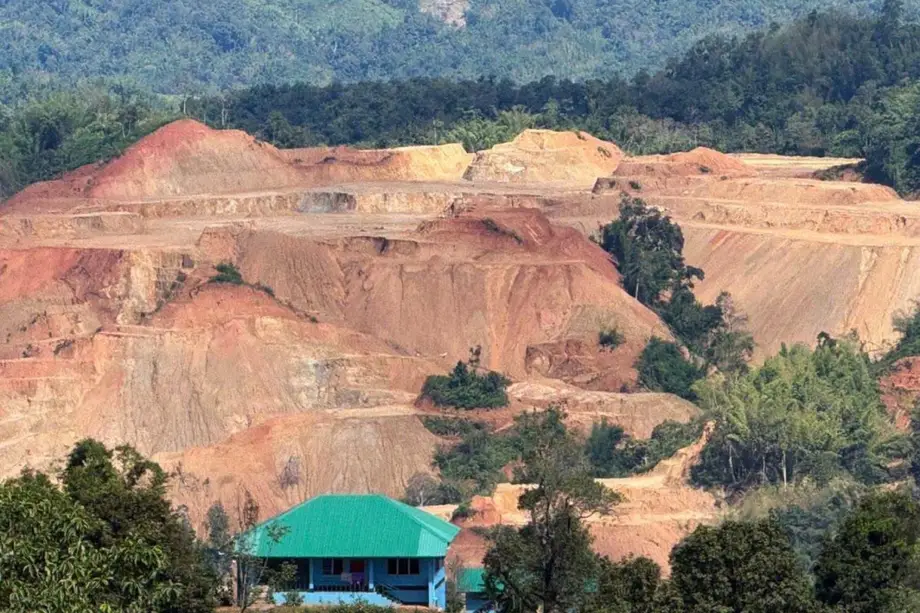
The fossils came from a clay layer inside the main coal seam at Bang Mark Pit in the Krabi lignite mine, about 500 miles south of Bangkok. Their description in Scientific Reports places a rodent of exceptional size in Southeast Asia long before the best known giants appeared in South America.
The Scientific Reports study, published on November 4, 2026, identifies the animal as a member of Ischyromyidae, one of the earliest major families of rodents. Its importance lies in the combination of its age, location and unusually large teeth, which extend the known history of large rodents in Asia.
Virginie Millien, a McGill University biology professor and study coauthor, described the broader finding in a McGill University release:
Giant rodents evolved repeatedly during the later history of the group, mostly in South America. This discovery suggests that Southeast Asia also played an important role in the early evolutionary history of large-bodied rodents.
The headline weight is an estimate assembled from seven calculations. The study offers a detailed explanation of how the researchers reached it, while leaving the animal's appearance and much of its way of life open for future discoveries.
A discovery that waited more than two decades
The teeth were recovered in 2004 during a Thai and French expedition investigating fossil mammals in the Krabi Basin. Pannipa Tian, a geologist with Thailand's Department of Mineral Resources, found the incisor. Another expedition member found the molar the same day.
Pannipa said the incisor's exceptional size initially led her to mistake it for a piece of bone. She recalled the moment:
At first, I thought it was a bone. I showed it to my supervisor, who told me it was a giant rat's tooth.
The cream colored incisor stood out against the dark coal, while the molar was dark. Detailed comparisons and examination of the enamel eventually helped researchers identify a new genus and species more than two decades after collection.
The main dates trace a long journey from discovery to formal recognition:
- 2004: The molar and incisor were recovered at the Krabi mine.
- November 4, 2026: The scientific description was published, and Natural Resources and Environment Minister Suchart Chomklin announced the finding.
- November 5, 2026: The Krabi fossil identification brought attention to the newly named animal and its estimated weight.
The specimens are now held by the Department of Mineral Resources in Bangkok. The research project was designed by Yaowalak Chaimanee, a specialist in fossil mammals working in France, and brought together researchers from Thailand, France and Canada.
What makes the teeth exceptional?
The complete fossil is a right lower second molar, a tooth used for grinding food near the back of the jaw. It measures 11.56 by 11.27 millimeters, making it almost square. Its highest surviving crown reaches 7.85 millimeters.
Hulgana, previously regarded as the largest Asian member of this ancient rodent family, had molars less than half as long and less than half as wide. That makes the Thai tooth more than twice its dimensions in both directions.
Manitsha tanka, a large relative described from South Dakota in 1941, offers a closer comparison. Its lower second molar measures about 8.2 by 8.9 millimeters. Using those measurements, the Yakamys molar is about 41 percent longer and 27 percent wider.
The tooth's arrangement of cusps and ridges also matters. Cusps are the raised parts of a tooth that help process food. Yakamys has a distinctive combination of these structures, including an isolated front cusp and a branching ridge toward the back, which helped the researchers distinguish it from previously named animals.
Microscopic enamel helps identify the family
The second specimen is a fragment of a left lower incisor, the long front tooth a rodent uses for gnawing. Its measured dimensions are 11.23 by 9.22 millimeters. Despite that size, its enamel coating is only about 235 micrometers thick, less than a quarter of a millimeter.
The team cut the incisor lengthwise and examined its enamel under an electron microscope. Inside, they found bands formed by the arrangement of tiny enamel structures. The pattern is consistent with that described in other members of Ischyromyidae, supporting the family identification.
The molar and incisor were found close together in the same fossil layer. Researchers provisionally assigned them to the same species because both are exceptionally large and share that geological setting. Their association remains tentative, and the animal's closest relatives within the family are unresolved.
A formal analysis of those relationships will require more anatomical information. The two teeth nevertheless preserve enough distinctive features for the authors to name a new genus as well as a new species. A three dimensional model of the molar is available through MorphoMuseuM, an open collection that allows other researchers to examine digital specimens.
How did two teeth become a 66-pound estimate?
Millien applied seven published equations that connect tooth dimensions with body mass. Scientists develop these relationships using animals whose teeth and weights can both be measured, then apply them to fossils when skeletons are missing.
The seven calculations produced estimates ranging from 21.4 to 47.3 kilograms. Their mean, found by adding the results and dividing by seven, was 31.6 kilograms. Their median, the middle result when the estimates are ordered, was 28.6 kilograms.
The researchers took the midpoint of the mean and median, 30.1 kilograms, then rounded it to about 30 kilograms. That is the origin of the widely cited 66 pounds.
Millien explained the uncertainty surrounding the calculation:
This is only a ballpark figure, as there is substantial uncertainty associated with fossil body-mass estimation.
Tooth size and body weight vary in their relationship among living rodents. When the prediction errors for the individual equations are included, their uncertainty ranges collectively extend from about 10.8 to 69 kilograms, or roughly 24 to 152 pounds. Each equation carries its own range of error, making the rounded central estimate the simplest way to describe the animal's likely scale.
Why its age matters more than a size record
The fossil layer dates to approximately 35.1 million to 33.7 million years ago, during the late Eocene. Researchers established that age using other mammals found at the site and the direction of ancient magnetism preserved in the rocks.
Rodents have more living species than any other mammalian order, but exceptional body size has appeared in relatively few branches of their family tree. Their earliest fossils come from North America. Ischyromyids later spread through Europe, Asia and Africa, while the Asian fossil record remained dominated by smaller animals from China and India.
Yakamys extends the family's known distribution into Southeast Asia and adds a large animal to that early record. Manitsha, its closest comparison in tooth size, lived later, during the Oligocene. Their estimated weights are similar, but their molars differ in structure, showing that large members of the family had different tooth designs.
Minister Suchart described Yakamys as the largest rodent discovered from the Paleogene, the period spanning roughly 66 million to 23 million years ago. The study focuses more specifically on its exceptional size among early ischyromyids and the evidence that this lineage had already grown large by the late Eocene.
Much bigger rodents evolved later in South America. Josephoartigasia monesi was initially estimated to weigh more than 1,000 kilograms, while later studies, including work by Millien, placed it at about 350 kilograms. At that later estimate, it was nearly 12 times the central estimated mass of Yakamys. The Thai animal's contribution is an earlier chapter in the story, rather than the greatest size.
A lake landscape, with its inhabitants still taking shape
The clay containing the teeth formed in a lake. Coal deposits around it have yielded a varied collection of mammals, including ancient primates, carnivores and hoofed animals. Together, the rocks and fossils place Yakamys in a landscape that included lakes and abundant animal life.
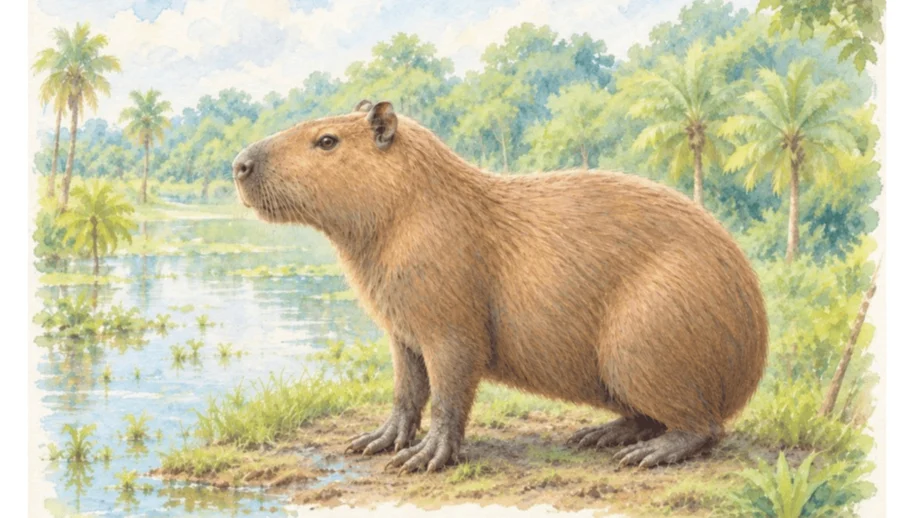
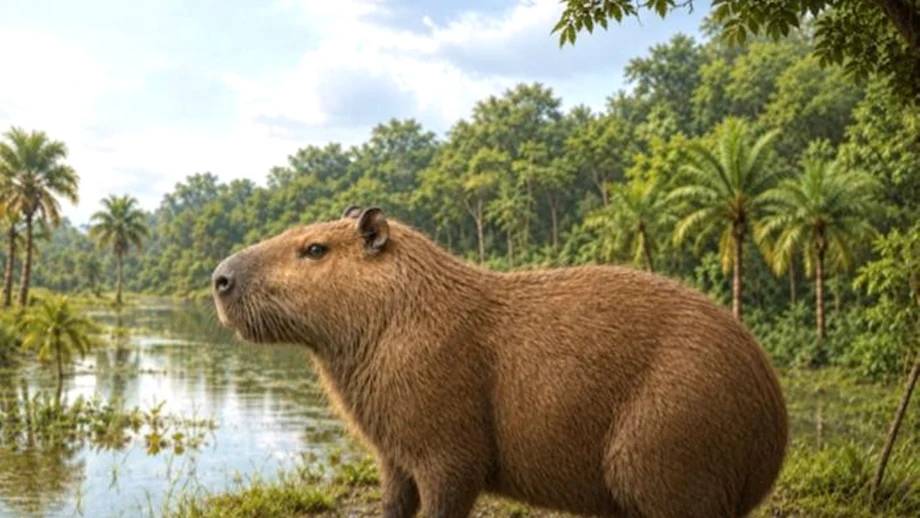
The researchers suggested that the rodent may have lived along lake edges, where food could have been plentiful, drawing a possible comparison with capybaras living near water today. Whether Yakamys regularly entered the water, what it ate and what its body looked like remain unknown. Skull and limb fossils, alongside further study of the surrounding rocks and animals, could help answer those questions.
Ancient geography offers another useful clue. Giant rodents are often discussed in connection with islands, where isolation can affect animal size. The authors found that the reconstructed geography of Krabi and its associated mammals instead point toward a setting connected to a larger land area.
The molar's relatively tall crown may have helped it withstand wear. Its exact function, and any connection between crown height and the animal's size, will also require more complete fossils.
A Thai name and an international research effort
Yakamys combines yak, the Thai word for giant, with mys, Greek for mouse or rat. The species name, sirindhornae, honors Princess Maha Chakri Sirindhorn for her longstanding support of science and fossil research in Thailand.
Suchart said the princess had granted permission for her name to be used and that Yakamys was the fifth fossil species to receive a royally granted name. Although sometimes called Sirindhorn's giant rat, the animal belongs to the extinct Ischyromyidae family.
The study's authors are Yaowalak Chaimanee, Laurent Marivaux, Virginie Millien, Chotima Yamee, Pannipa Tian and Jean-Jacques Jaeger. Support came from CNRS, Université de Poitiers, Université de Montpellier, McGill University and Thailand's Department of Mineral Resources.
An older tooth in Myanmar offers another lead
The team also holds an unusually large rodent incisor from Myanmar's Pondaung Formation, which dates to the late middle Eocene and is older than the Thai deposits. The specimen is considerably larger than incisors of other rodents described from the region.
The Myanmar tooth has yet to be formally described or identified. Detailed comparison and additional fossils could reveal whether it belongs to the same ancient family as Yakamys or to another rodent lineage that independently grew large.
Krabi has already supplied a securely identified example of an exceptionally large early rodent in Southeast Asia. Further discoveries in Myanmar, Thailand and neighboring areas could show whether such animals were a local occurrence or a more widespread feature of the region's ancient ecosystems.
Key Points
- Two teeth from Bang Mark Pit in Krabi identify Yakamys sirindhornae, a rodent that lived about 34 million years ago.
- Seven calculations produced weight estimates of 21.4 to 47.3 kilograms, summarized by the researchers as about 30 kilograms, or 66 pounds.
- The fossils were collected in 2004 and formally described in November 2026.
- The discovery documents exceptional size in an early rodent family in Southeast Asia, long before the best known South American giants.
- More fossils are needed to reconstruct its appearance, diet, habits and closest evolutionary relationships.