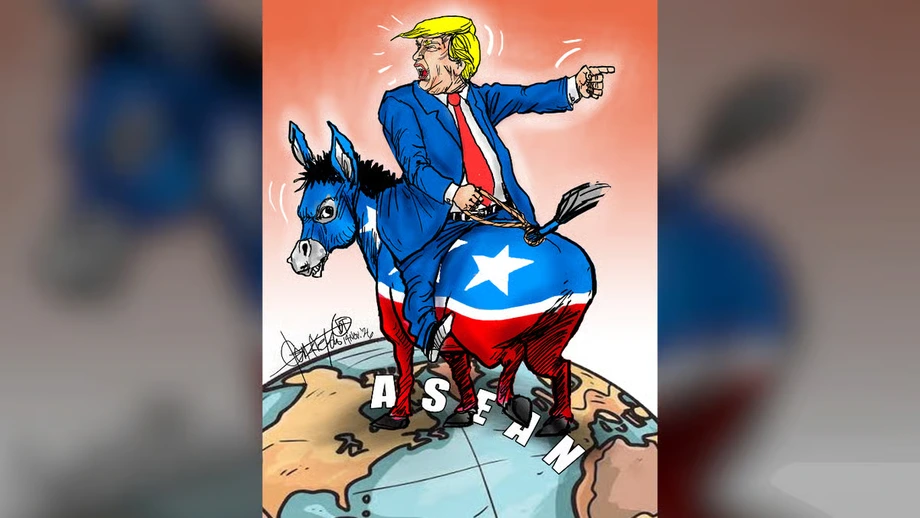
Manila seeks relief for $6.25 billion in exports
The Philippines is seeking a reduction in the 12.5% US tariff affecting about $6.25 billion of its exports as President Ferdinand Marcos Jr. prepares to meet President Donald Trump in Manila on November 18, 2026. Trade Secretary Ma. Cristina Roque has confirmed that she wants a lower rate, while withholding Manila's negotiating target.
Contents
- Manila seeks relief for $6.25 billion in exports
- What will the presidents discuss?
- How the tariff reached 12.5%
- Manila's response centers on forced labor imports
- Exemptions protect most exports, but exposure is uneven
- Clothing, footwear and travel goods face the pressure
- Strong export growth meets a larger trade deficit
- Exporters seek faster refunds and more markets
- Security and technology share the agenda
- Key Points
The Department of Trade and Industry (DTI) estimates that 34.28% of Philippine exports to the United States face the duty. Another $11.98 billion, including major electronics and agricultural exports, is exempt. The immediate stakes are concentrated in industries such as clothing, footwear, leather goods, travel goods and toys.
Roque, speaking to reporters ahead of the meeting alongside the 49th Association of Southeast Asian Nations Summit, explained the government's objective:
Of course, my wish is to bring down the tariffs because we want to be able to expand exports to the US and to all other markets globally.
Philippine officials have submitted proposals and an administrative order addressing imports made with forced labor to Washington. Whether those steps will secure a tariff cut, and when any reduction might take effect, has not been announced. Roque said the government would disclose the discussions and outcomes after the meeting.
What will the presidents discuss?
Roque has said the tariff and Manila's response to US concerns are expected to be discussed on November 18. Philippine Ambassador to the United States Jose Manuel Romualdez, however, said detailed tariff negotiations would remain with trade officials rather than form part of the leaders' bilateral discussions.
Romualdez said the presidents would focus on the alliance, defense and security, economic relations, artificial intelligence, digital infrastructure and cybersecurity. His account points to a meeting that could give political direction to negotiations while leaving the precise tariff terms to officials.
Trump's arrival in Manila was scheduled for November 17, ahead of the bilateral meeting. The Philippine government has also been negotiating a proposed reciprocal trade agreement with Washington, but Romualdez said those talks could continue beyond December. US officials have asked Manila to clarify the commitments and requirements each country would accept before signing.
How the tariff reached 12.5%
The current duty took effect on July 24 under Section 301 of the US Trade Act of 1974. That law allows Washington to investigate foreign trade practices and respond with measures such as tariffs, which are taxes collected on imported goods.
The US action followed a finding that the Philippines had failed to prohibit and effectively enforce a ban on imports made with forced labor. The concern is about whether such goods can enter the Philippine market, including goods manufactured abroad.
The tariff sequence matters because Manila is seeking relief from a rate that replaced an earlier levy:
- February 2026: The US Supreme Court ruled that Trump exceeded his authority by imposing reciprocal tariffs under the International Emergency Economic Powers Act. Washington subsequently introduced a replacement global tariff of 10%.
- July 24: The 10% baseline expired, and the 12.5% Section 301 tariff took effect, subject to product exemptions.
- November 17: Trump was scheduled to arrive in Manila.
- November 18: Marcos and Trump were scheduled to hold bilateral talks, with Philippine officials also preparing discussions on forced labor measures.
A reduction from 12.5% to 10% would remove 2.5 percentage points from the rate. On a covered shipment with a customs value of $100, that would mean $10 in this tariff instead of $12.50. The US importer pays the duty, but the added cost can influence the price buyers will accept from Philippine suppliers.
Manila's response centers on forced labor imports
The Philippine joint administrative order creates an interagency committee to receive, evaluate and investigate complaints about imported goods produced with forced labor, and to prevent their entry. DTI chairs the committee, with the Department of Labor and Employment as vice chair.
The Department of Finance, Bureau of Customs, Board of Investments and Philippine Economic Zone Authority are also members. Their involvement connects labor investigations with the agencies responsible for imports, investment and export manufacturing.
Roque said Washington had received an order issued in October addressing forced labor and child labor. Earlier DTI descriptions dated an order establishing the committee to July, a day before the tariff announcement. Officials have not explained whether the October document revised the July measure or was a separate submission.
Trade Undersecretary Ceferino Rodolfo said the Office of the US Trade Representative was reviewing the Philippine order. He said tariff changes could be made "at any time" as that assessment proceeds. DTI has also secured offers of grants and technical assistance from development partners to help put the import controls into practice.
Exemptions protect most exports, but exposure is uneven
DTI's estimate leaves about 65.72% of Philippine exports to the US outside the additional tariff. Semiconductors, other electronics, certain agricultural products, automotive parts, minerals and aircraft parts are among the exempt categories.
The department's regional comparison shows why the coverage matters alongside the headline rate. DTI estimates that about 83% of Indonesia's exports to the United States and roughly 40% of Malaysia's shipments are exposed to the additional tariff, compared with 34.28% for the Philippines.
Rodolfo described the Philippine position as manageable and said 12.5% appeared to be its ceiling under the forced labor investigation. The Philippines was also outside a separate US investigation into structural excess capacity covering several regional competitors, including Indonesia, Malaysia, Thailand and Vietnam.
Exporters nevertheless want the existing exemptions protected. Philippine Exporters Confederation President Sergio R. Ortiz-Luis Jr. urged the government to preserve the treatment of electronics and agricultural goods. For those businesses, keeping access on current terms is a central objective alongside securing relief for products already covered.
Clothing, footwear and travel goods face the pressure
Leather goods, apparel, footwear and toys account for much of the exposure because they fall outside the major exemptions. These industries often employ many workers and operate with limited room between their production costs and selling prices.
Francisco Cid L. Terosa, a former dean of the University of Asia and the Pacific School of Economics, warned that the affected industries could lose orders and jobs:
It is worrisome that these exports are produced by industries that have low margins and greater labor demand, as the tariff can make them lose competitive advantage and force them to lay off workers.
Foreign Buyers Association of the Philippines President Robert M. Young favors bringing the rate back to 10%, which he described as comparable to the rate imposed on imports from Malaysia and Indonesia. Roque has declined to confirm whether that is the government's target.
Young also wants duty exemptions restored under the US Generalized System of Preferences, known as GSP. The program covers some 3,500 tariff lines for eligible developing countries. Philippine access expired on December 31, 2020, and Young estimates that its absence costs the country $400 million in exports annually. Restoring GSP would be a separate objective from lowering the current Section 301 duty.
Strong export growth meets a larger trade deficit
Philippine Statistics Authority figures show exports to the United States rose 27.7% to $8.44 billion in January through June 2026, from $6.61 billion a year earlier. The United States received 18.1% of Philippine exports during that period.
Former Tariff Commissioner George N. Manzano said the continued exemption of semiconductors and other electronics should help keep the effect on bilateral trade manageable. Much of the first half's export growth occurred while the previous 10% tariff was already in place.
The two countries' 2025 trade figures use different statistical accounts. The Office of the US Trade Representative puts US imports from the Philippines at $17.8 billion, up 25.4%, while Philippine figures put exports to the United States at $13.46 billion, or 16% of total exports. Those totals differ, and the exposure estimates should be read with their stated agency attribution.
USTR estimates total bilateral goods trade at $26.9 billion in 2025, including $9.1 billion in US exports to the Philippines. It puts the US goods trade deficit with the Philippines at $8.6 billion, an increase of 75.3%.
The Philippines, meanwhile, recorded a worldwide goods deficit of $30.81 billion in the first half of 2026. Exports reached $46.72 billion, but imports were higher at $77.53 billion. Ortiz-Luis has projected Philippine exports could reach $108 billion for the full year, making stable access to major markets a pressing business concern.
Exporters seek faster refunds and more markets
Leonardo A. Lanzona, an economics professor at Ateneo de Manila University, has called for faster tax refunds, working capital loans and help reaching other markets. Faster refunds would return money owed to exporters sooner, helping them pay workers and suppliers while waiting for customer payments.
Roque has said the Philippines aims to conclude five free trade agreements during 2026. The country signed agreements with the United Arab Emirates in January and Chile in July, its first such deals with a Middle Eastern and a Latin American country, respectively.
Negotiations with Canada and the European Union, along with an updated Japan-Philippines Economic Partnership Agreement, form the rest of that push. These agreements can reduce trade barriers and widen the range of buyers available to Philippine manufacturers.
Peter Mumford, Eurasia Group's head for Southeast Asia, cautioned at the ASEAN Business and Investment Summit that Trump's regional meetings and the Democrats' takeover of Congress would not necessarily reverse US tariff policy. He said progress on agreements might reduce uncertainty without eliminating it. Businesses therefore face decisions about orders, pricing and investment while talks continue.
Security and technology share the agenda
The Manila visit also comes with concrete security commitments already in place. The United States transferred two T38 unmanned surface vessels worth more than $8 million to the Philippines in early November. These are boats designed to operate without crews aboard.
The Philippines Enhanced Resilience Act, included in the US National Defense Authorization Act for fiscal year 2026, authorizes up to $500 million annually in foreign military financing through 2030. That authorization provides a framework for assistance, while actual delivery depends on funding and implementation decisions.
Technology cooperation includes the proposed Pax Silica manufacturing park in New Clark City. Philippine officials envision a site of about 1,620 hectares that could attract $40 billion to $70 billion in investment and create more than 130,000 jobs. Those figures are projections for the proposed development.
The Philippines joined the US led Pax Silica initiative as its 13th signatory in April. A framework agreement is targeted for the end of 2026. Although political support for the initiative had been anticipated around the visit, Romualdez said it would stay outside the leaders' meeting because its scope and conditions were still under technical negotiation.
For exporters awaiting tariff relief, the next concrete checkpoint is the government's promised disclosure after the November 18 talks. A lower rate, continued exemptions and a timetable for further negotiations would each affect a different part of the country's export business.
Key Points
- Marcos and Trump are scheduled to meet in Manila on November 18, 2026.
- Manila wants a lower US tariff but has not disclosed its negotiating target.
- DTI estimates the 12.5% duty covers $6.25 billion in exports, while $11.98 billion is exempt.
- Washington is reviewing Philippine measures against imports produced with forced labor.
- Detailed tariff negotiations remain with trade officials, according to Ambassador Romualdez.
- Exporters want relief for exposed industries and continued exemptions for major electronics and agricultural products.
- Trade agreement negotiations could extend beyond December.