Chip shipments put a historic trade milestone within reach
South Korea's exports reached $963.7 billion by November 10, 2026, leaving $36.3 billion to reach the country's first $1 trillion export year. Strong demand for semiconductors used in artificial intelligence is expected to carry shipments across that threshold around November 19 or 20.
Contents
- Chip shipments put a historic trade milestone within reach
- How close is South Korea to $1 trillion?
- Why AI demand is driving semiconductor sales
- The investment boom reaches beyond chips
- China and the United States both buy more
- Cars, cosmetics and food broaden the gains
- Higher oil prices lift export receipts and import bills
- Incheon visit puts logistics workers in the picture
- From $100 billion to the trillion dollar threshold
- Key Points
The milestone would make South Korea the fourth country to record annual exports above $1 trillion, joining China, the United States and Germany. It would come 31 years after South Korea first passed $100 billion in annual exports in 1995.
The Ministry of Trade, Industry and Resources had already forecast a November crossing in its 2026년 10월 수출입 동향 (October 2026 Export-Import Trends), released on November 1, 2026, and described in a government article published on November 2. The report put exports for January through October at $930 billion, leaving $70 billion to reach $1 trillion, and Industry Minister Kim Jung-kwan said a November crossing was virtually certain. October exports reached $115.28 billion, up 93.7% from a year earlier, with 18 of the country's 20 main export categories recording growth.
Semiconductors supplied almost half of October's export value. The wider gains included computers, cars, electrical equipment, cosmetics and food, showing how the surge reaches beyond chip factories into other industries and the ports that move their goods.
How close is South Korea to $1 trillion?
Preliminary Korea Customs Service statistics released on November 11 put exports during November 1 to 10 at $33.5 billion, up 111.9% from the same period a year earlier. Imports rose 45% to $24.7 billion, leaving a trade surplus of $8.8 billion.
The cumulative figure of $963.7 billion through November 10 leaves about 3.6% of the trillion dollar target still to be earned. A reported daily export average of $4.46 billion during November underpins the expectation that the threshold will be crossed on November 19 or 20.
The ministry's October release put exports for January through October at $930 billion. The $1.8 billion mismatch arose from using $35.5 billion for preliminary November shipments rather than the reported $33.5 billion. Adding the reported November figure produces $963.5 billion, which is $200 million below the reported cumulative total through November 10. The available figures do not explain that remaining difference, and the precise crossing date remains a forecast pending updated customs totals.
The scale of the advance is already substantial. The ministry recorded $709.3 billion in exports for all of 2025. Reaching $1 trillion would mean an increase of $290.7 billion, or about 41%, above that annual record.
Why AI demand is driving semiconductor sales
Semiconductor exports reached $56.44 billion in October, up 259.4% from a year earlier. September's total was even higher at $60.30 billion. The two months each exceeded $50 billion as technology companies continued investing in the equipment needed to develop and run AI services.
AI systems depend on large collections of computers in data centers. Those computers need chips to process information and memory to hold it while calculations take place. South Korea's export surge reflects both more shipments and higher prices for memory products.
The October ministry report showed the contract price of one listed DDR5 memory product rising from $40 in June to $50 in October, an increase of 25%. DDR5 is a type of memory used to give processors quick access to information. The listed NAND memory price rose from $28.8 to $30.6 over the same period. NAND stores information in devices such as solid state drives.
Chip exports totaled $340.3 billion during the first nine months. Against total exports of $814.5 billion over that period, semiconductors represented about 41.8%. Their share rose to approximately 49% in October, using the ministry's monthly figures.
November's early figures showed the momentum continuing: semiconductor exports increased 331.2% to $16.6 billion during the first 10 days, a record for that period. This growing concentration makes demand for chips central to South Korea's export performance.
The investment boom reaches beyond chips
Computer exports rose 496.6% to $5.85 billion in October. The ministry linked that growth to spending on server infrastructure and rising demand for solid state drives used in servers as AI services spread.
Electrical equipment exports reached a monthly record of $1.99 billion, up 74%. Demand from AI data centers supported sales of transformers, wires and cables. A transformer changes electricity to the voltage equipment needs, making it part of the physical infrastructure behind digital services.
Wireless communication equipment exports increased 6.7% to $1.95 billion in October, marking 12 consecutive months of growth. New Apple products and strong Samsung smartphone sales supported that category.
The ministry's September trade statement also recorded growing demand for steel used in AI data centers, particularly in the United States. Together, the figures show several routes through which spending on AI reaches Korean manufacturers, from memory chips to power equipment and construction materials.
China and the United States both buy more
China bought $26.98 billion of South Korean exports in October, up 133.6% from a year earlier. Shipments to the United States reached $24.90 billion, an increase of 185.8%. Together, the two destinations accounted for about 45% of South Korea's October exports.
Chinese imports from South Korea totaled $236.2 billion during January through September, up 75.1%. South Korea was China's largest import supplier in each month from April through September and held a 9.8% share of Chinese imports across the first nine months. It regained that leading position for the first time since 2019.
Korean semiconductor exports to China rose 221.5% to $105.4 billion over the first nine months. American imports of South Korean goods reached $129.2 billion during the same period, up 35.2%, making South Korea the sixth largest supplier to the United States.
Other Asian markets also contributed. Exports to the Association of Southeast Asian Nations reached $21.33 billion in October, up 128%, supported by semiconductors, displays and petroleum products. Exports to the European Union rose 56.4% to $8.10 billion, extending growth to an eleventh consecutive month.
The early November customs figures recorded further increases in exports to China, the United States, Vietnam, Taiwan and the EU. China, the United States and Taiwan together accounted for 57.3% of shipments during November 1 to 10.
Cars, cosmetics and food broaden the gains
Automobile exports rose 18.1% to $6.55 billion in October, their highest level for that month. Strong hybrid vehicle shipments helped, alongside more working days because the Chuseok holiday fell in September in 2026 rather than October as it had in 2025.
The holiday shift helps explain why monthly comparisons can move sharply. Car exports had fallen 5.5% in September, while their daily average rose 5.5%. October then benefited from the extra working days compared with a year earlier.
Cosmetics exports climbed 57.5% to $1.44 billion in October, with growth across the United States, China and the EU. Agricultural and fisheries exports rose 11.6% to $1.11 billion, helped by noodles, drinks and sauces. Both categories set records for October.
Biohealth exports also reached an October record, increasing 30.2% to $1.53 billion. The ministry cited sales across more destinations and higher volumes associated with contracts lasting several years for manufacturing products on behalf of other companies.
Shipbuilding moved in the opposite direction. Ship exports fell 43.6% to $2.64 billion in October, partly because a large offshore plant shipment had lifted the comparison figure a year earlier. September ship exports had risen 29.9%, illustrating how delivery schedules can produce large monthly swings.
Higher oil prices lift export receipts and import bills
Petroleum product exports rose 80% to $6.92 billion in October, while petrochemical exports increased 27.5% to $4 billion. Higher prices drove those gains: shipment volumes fell 7.5% for petroleum products and 6.8% for petrochemicals.
Middle East supply uncertainty kept international oil prices high. The ministry listed Dubai crude at $110.7 a barrel in October, up 70.4% from a year earlier. September's statement also identified reduced vessel traffic through the Strait of Hormuz and shipping risks in the Red Sea.
South Korea simultaneously faced a larger energy import bill. October energy imports increased 63.1% to $16.49 billion. Crude oil imports cost $10.7 billion, up 51.9%, even though the volume purchased fell 6.3%.
The trade surplus, the value of exports minus imports, nevertheless reached $42.50 billion in October. The ministry put the cumulative surplus for January through October at $294.9 billion. Energy costs remained a pressure on importers even as exporters brought in record receipts.
Incheon visit puts logistics workers in the picture
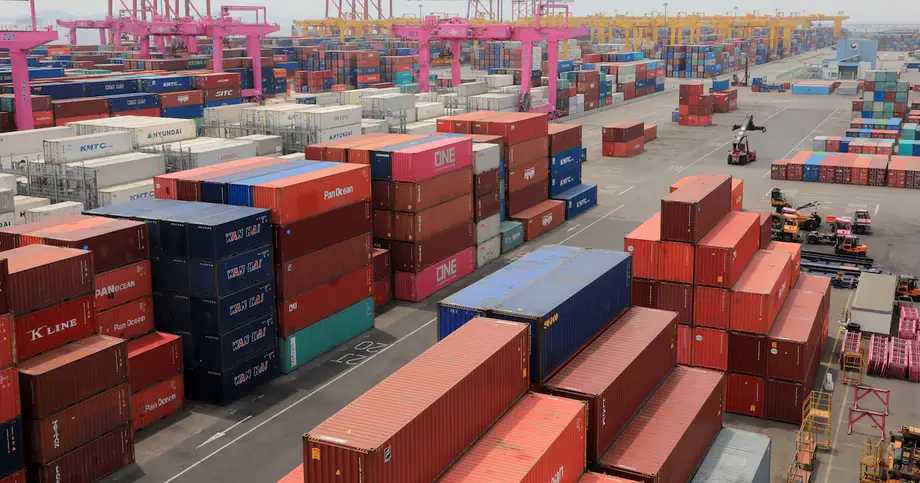
Industry Minister Kim Jung-kwan visited a port in Incheon on November 17 to thank workers in port management and logistics. The western coastal city is one of South Korea's major maritime gateways.
Kim credited the people whose work keeps goods moving through the export system:
Reaching $1 trillion in exports is not an achievement that happened overnight," Kim said. "Our exports have been able to make history thanks to the countless people who have quietly fulfilled their roles behind the scenes.
The minister's visit connected the headline export figure with the work of handling cargo, managing ports and arranging transport. Factories need those services to turn overseas orders into delivered goods.
Kim also warned in the October policy statement that many small and medium sized companies still faced difficulties from stronger protectionism, changes in global supply chains and instability in the Middle East. The ministry pledged closer trade cooperation with major economies and action to address problems facing exporters so that smaller businesses could share more widely in the growth.
From $100 billion to the trillion dollar threshold
South Korea's latest surge follows several decades of expanding overseas sales. The main milestones show how quickly the country has advanced beyond its previous annual record:
- 1995: Annual exports first exceeded $100 billion.
- 2015: Annual exports passed $500 billion.
- 2025: Exports reached a record $709.3 billion.
- September 2026: Cumulative exports reached $814.5 billion, already above the full year record for 2025.
- October 2026: The ministry recorded cumulative exports of $930 billion.
- November 10, 2026: Reported cumulative exports reached $963.7 billion.
- November 19 or 20, 2026: Exports are projected to cross $1 trillion.
The immediate achievement is the speed and scale of the increase. Sustaining it will depend heavily on continued semiconductor demand, while trade restrictions, shipping disruption and expensive energy remain concrete pressures on businesses.
Key Points
- South Korea's reported exports reached $963.7 billion by November 10, leaving $36.3 billion to its first $1 trillion year.
- Preliminary November 1 to 10 exports were $33.5 billion, not $35.5 billion; adding them to the October year-to-date figure leaves an unexplained $200 million difference from the reported cumulative total.
- The threshold is expected around November 19 or 20, which would make South Korea the fourth country to reach it.
- October semiconductor exports rose 259.4% to $56.44 billion, supplying about 49% of total exports.
- China, the United States and Southeast Asia recorded strong demand, while cars, cosmetics and food also contributed.
- Higher oil prices increased both export receipts and energy import costs.
- Minister Kim Jung-kwan thanked logistics workers while warning that smaller exporters still face difficult trading conditions.