A stronger economy brings a tougher policy prescription
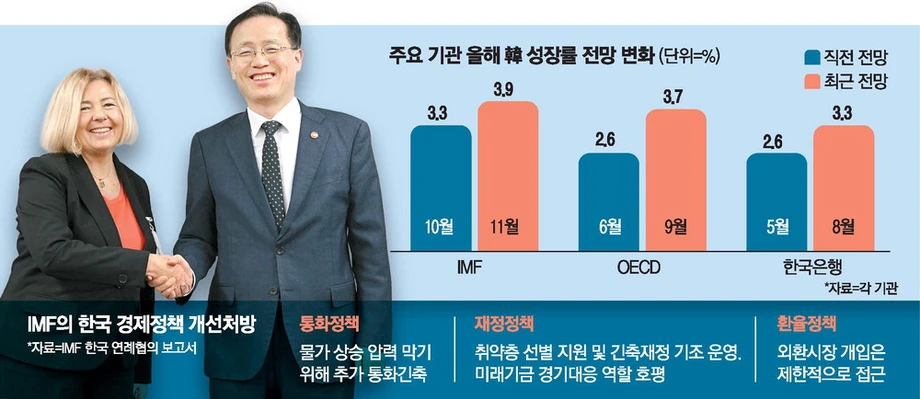
The International Monetary Fund raised South Korea's 2026 growth forecast to 3.9% on November 17, up from 3.3% just a month earlier, as the global artificial intelligence boom drives record semiconductor exports. Its recommendation to policymakers also shifted: restrain spending and tighten monetary policy to keep rising demand from sustaining inflation.
Contents
- A stronger economy brings a tougher policy prescription
- Why the growth forecast rose so quickly
- How the chip boom reaches the wider economy
- AI investment could raise the economy's capacity
- Why the IMF wants tighter monetary policy
- A growing budget meets a call for restraint
- A 162.3 trillion won fund could save part of the windfall
- Concentration makes diversification urgent
- Exchange rates and financial safeguards remain part of the response
- Key Points
The IMF mission forecast growth of 3.3% in 2027, up from its October estimate of 2.8%. That would give South Korea two consecutive years of growth above 3%, following an expansion of 1.1% in 2025.
The findings followed consultations from November 3 to 17 with the government, the Bank of Korea, public institutions and private sector representatives. The mission's annual economic review, known as an Article IV consultation, examines a member country's economy and recommends policies. The IMF Executive Board is scheduled to discuss the consultation report in January 2027.
The central challenge is that a national export boom and pressure on household finances can exist together. Semiconductor companies are earning more, investment is recovering and consumption is strengthening, yet the gains remain concentrated in advanced technology businesses. Many other companies and families will receive those benefits more gradually.
The IMF expects consumer prices to rise 2.7% in 2026 and 2.3% in 2027, above the Bank of Korea's 2% target in both years. Its advice therefore combines restraint across the economy with targeted help for vulnerable households and businesses, rather than a broad withdrawal of support.
Why the growth forecast rose so quickly
Stronger semiconductor exports, public investment and better than expected results for the third quarter prompted the latest revision. At a briefing at the Government Complex Seoul, IMF mission chief Corinne Delechat explained the immediate reason for the upgrade.
Third-quarter (results) were significantly better than expected,
The latest forecast is 2.8 percentage points above South Korea's growth rate in 2025. It is also 1.3 percentage points higher than the IMF's July forecast, showing how quickly the institution has reassessed the strength of the recovery.
The revisions developed over several rounds:
- October 2025: The IMF projected South Korean growth of 1.8% for 2026.
- Early 2026: Its forecast stood at 1.9%, including in April.
- July 2026: It raised the forecast to 2.6% for 2026 and projected 2.5% for 2027.
- October 13, 2026: The World Economic Outlook put growth at 3.3% for 2026 and 2.8% for 2027.
- November 17, 2026: The mission raised those figures to 3.9% and 3.3%.
The new estimate exceeds the existing 2026 forecasts of the government at 3.0%, the Bank of Korea at 3.3%, the Asian Development Bank at 3.2% and the Organisation for Economic Co-operation and Development at 3.7%. Those projections were prepared at different times. The IMF's revision incorporates more recent economic results.
If achieved, 3.9% would be South Korea's fastest growth since its 4.7% expansion in 2021. Excluding that rebound from the COVID-19 contraction, it would be the strongest performance since growth of 7.0% in 2010.
How the chip boom reaches the wider economy
Global demand for AI infrastructure is lifting purchases of the semiconductors that power it. The IMF said record semiconductor exports are supporting strong company earnings and increasing government tax revenue, while investment and consumer spending are also contributing to growth.
Trade figures from the industry ministry and Korea Customs Service put South Korea's exports from January 1 through November 10 at $963.663 billion. That left exports about $36.337 billion short of $1 trillion, a threshold the country was approaching for the first time.
For 2027, the IMF expects higher incomes in advanced technology industries to support spending elsewhere. Employees at successful chip companies can spend more at shops and other businesses, while companies investing in new facilities create demand for construction, equipment and services.
Delechat, describing how the benefits are spreading, cautioned that the process is gradual.
So far, gains have been largely concentrated in the technology sector, and will only gradually spill over to the broader economy,
That uneven distribution helps explain why a strong GDP figure can coexist with weak conditions for some households and firms. GDP measures the value of goods and services produced across the country; individual incomes and business sales can move at very different speeds.
AI investment could raise the economy's capacity
Investment linked to AI could also improve South Korea's ability to grow over several years. The mission expects potential growth to rise to around 2.5% over the medium term, compared with an estimate of 2.14% cited the previous month.
Potential growth means the pace at which an economy can expand sustainably without creating persistent inflation pressure. New factories, machinery and data centres can increase productive capacity, allowing the country to produce more.
Delechat said AI investment would amount to about 4% of GDP over the medium term. The calculation includes facilities, machinery, construction and data centres. She explained the scope of the estimate:
We have not factored in productivity gains from AI adoption and diffusion,
The estimate therefore rests on the investment itself. Wider use of AI could provide another source of productivity growth as businesses learn to produce more with the same resources. Rapid population ageing, meanwhile, is expected to put downward pressure on the economy's capacity to expand.
Why the IMF wants tighter monetary policy
Inflation is the reason the IMF's stronger growth forecast comes with a warning. Its projections of 2.7% inflation in 2026 and 2.3% in 2027 are unchanged from October, even though measures to contain energy costs have eased some price pressure.
Recovering domestic demand is now an important concern. When spending strengthens faster than businesses can increase supply, prices can rise more quickly. The IMF sees economic activity running above its sustainable potential and wants authorities to prevent that pressure from lasting.
Delechat, setting out the mission's monetary policy recommendation, said:
Further monetary tightening is appropriate to prevent inflationary pressures from becoming entrenched,
Monetary tightening generally means making borrowing more expensive, including through higher interest rates. That can slow spending and investment. Delechat described the Bank of Korea's two rate increases during 2026 as appropriate.
The burden falls unevenly. Higher borrowing costs can be especially difficult for households with debt and businesses with limited cash. The IMF therefore wants fiscal policy, meaning government spending and taxation, to share the work of containing demand rather than leaving the central bank to act alone.
A growing budget meets a call for restraint
The government's proposed 2027 budget is approximately 821 trillion won, an increase of 93 trillion won, or 12.8%, from 2026. Its spending plans envisage expenditure reaching roughly 1,005 trillion won by 2030, with average annual growth of 8.4%.
The planned increase over the administration's five years is about 332 trillion won. That compares with 207 trillion won under the Moon Jae-in administration, making the planned increase approximately 1.6 times as large.
The IMF's recommendation creates a policy tension with that expansion. Spending additional tax revenue during a boom can add to demand just as the central bank is trying to reduce inflation pressure. Saving part of the revenue would leave more resources available for a weaker economy later.
The mission still supports targeted assistance for vulnerable households and businesses. It also sees a role for public investment that raises productivity outside the Seoul metropolitan area. Its prescription is to limit broad demand pressure while preserving spending that protects people in difficulty or expands the economy's productive capacity.
The change from the IMF's September 2025 advice is substantial. At that time, it supported increased government spending and relief from interest costs to help the recovery. Stronger growth and inflation above target have changed the balance of its recommendations.
A 162.3 trillion won fund could save part of the windfall
The government plans a Future Response Fund worth 162.3 trillion won, using extra tax revenue generated by the semiconductor boom. The fund would support future investment and help stabilise public finances as economic conditions change.
The IMF welcomed the proposed fund. Delechat estimated the semiconductor tax windfall at more than 200 trillion won, equivalent to about 7% of GDP. The windfall estimate describes the additional revenue, while 162.3 trillion won is the proposed size of the fund.
Semiconductor activity is volatile. Holding back revenue during a strong period gives the government a financial buffer when company earnings and tax receipts weaken. The mission said the fund would retain substantially more money than it spent.
The fund's detailed arrangements have not been finalised. Delechat warned about a general budget risk: revenue can fluctuate while permanent spending commitments continue. A fund that finances lasting obligations from temporary receipts could face pressure when the boom slows.
Concentration makes diversification urgent
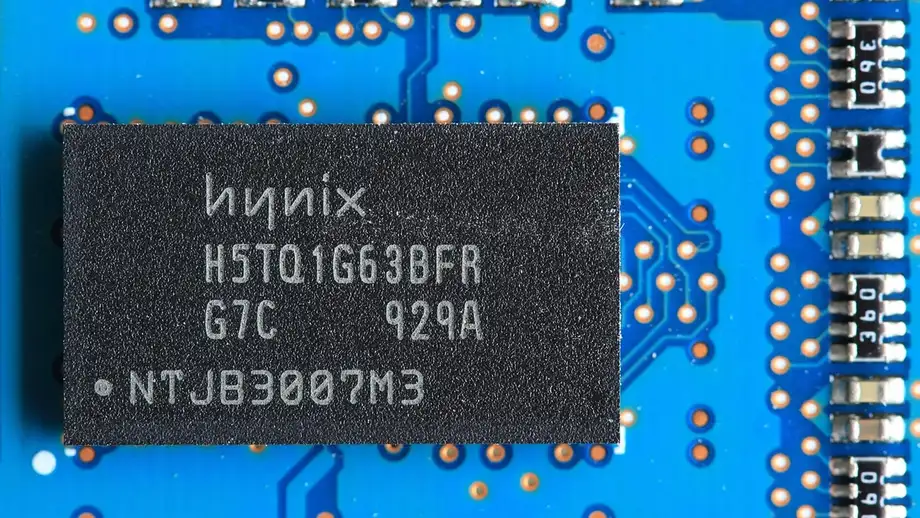
Samsung Electronics and SK hynix sit at the centre of South Korea's AI related export strength. Delechat pointed to their concentration in export performance and their combined share of roughly half the stock market's value when explaining the need for broader sources of growth.
A downturn affecting a small number of dominant companies could reach exports, tax receipts, investment and financial markets at the same time. The IMF judged uncertainty to be high and risks to growth to be tilted toward weaker outcomes, despite its substantial forecast upgrade.
The mission recommended diversifying both export products and destination markets. It also identified service exports as an area with considerable potential, saying South Korea's performance was relatively weak compared with economies of similar size.
Its recommendations extend beyond trade. More people participating in the labour force, smaller wage gaps between forms of employment and a stronger social safety net could support household incomes and consumption. Regional growth centres and public investment outside the capital region could help more businesses adopt AI and raise productivity.
The IMF also supported a continued transition toward renewable energy. Together, these measures aim to spread growth across more industries, workers and places, making the economy better able to absorb an external shock.
Exchange rates and financial safeguards remain part of the response
The IMF recommended allowing the exchange rate to move flexibly so it can absorb changes in external conditions. It said intervention in the foreign exchange market should be limited to preventing disorderly market conditions.
A flexible currency gives the economy another way to adjust when trade, investment flows or conditions abroad change. The mission's advice is to preserve that adjustment mechanism while retaining the ability to respond to market disruption.
The mission also credited preventive measures to contain housing market pressure, strengthen investor protection and address financial vulnerabilities with helping maintain financial stability.
Those safeguards sit alongside the central policy challenge: cool inflation without placing the burden on vulnerable borrowers, and use the semiconductor windfall in ways that can support the economy after the current surge has passed.
Key Points
- The IMF mission raised South Korea's growth forecast to 3.9% for 2026 and 3.3% for 2027.
- Record semiconductor exports, stronger investment and resilient consumption underpin the upgrade.
- Inflation is projected at 2.7% in 2026 and 2.3% in 2027, above the Bank of Korea's 2% target.
- The mission recommended further monetary tightening and tighter fiscal policy, alongside targeted support for vulnerable households and businesses.
- It welcomed the proposed 162.3 trillion won Future Response Fund as a way to save part of the tax windfall.
- AI investment could lift potential growth to around 2.5%, while wider reforms would help spread the gains.
- The IMF Executive Board is scheduled to discuss the consultation report in January 2027.