A fishing trip becomes a rescue off Yilan
A whale shark estimated to measure 10 metres and weigh five tonnes was freed from a fixed fishing net near Taiwan's Guishan Island on November 16, 2026, after fishermen gave up a catch worth tens of thousands of New Taiwan dollars to bring it into open water.
Contents
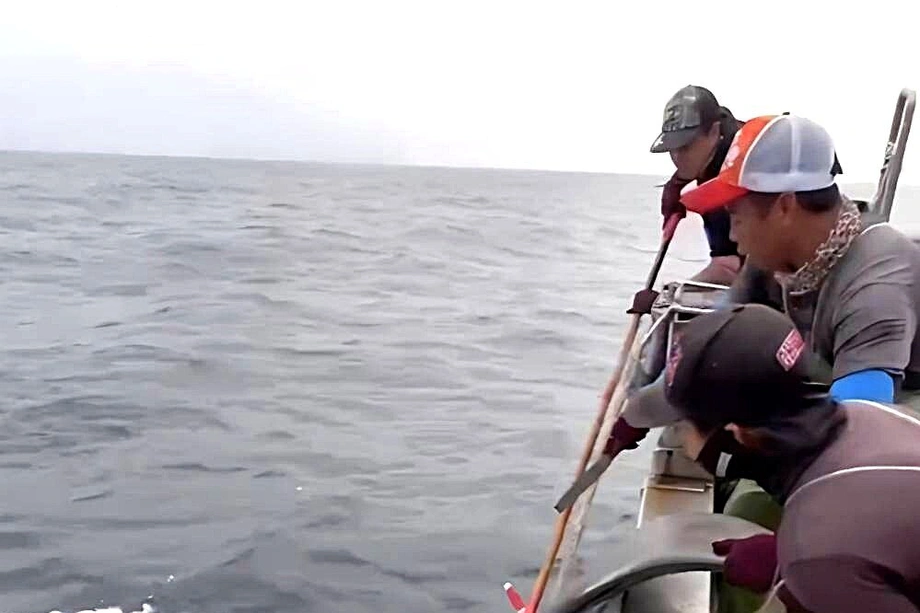
The crew discovered the protected animal at about 8 a.m. while preparing to haul in their net off Toucheng Township in Yilan County. The captain stopped the normal retrieval operation, and the fishermen spent more than an hour guiding the shark out of the fishing gear and away from the site.
The rescue ended in deeper water about two nautical miles from the coast and roughly one nautical mile from Guishan Island. Crew members cut the rope used to guide the animal, which swam away with strong movements of its tail, according to the fishing operation.
For the Guishan Island fixed net fishery, this was the second whale shark rescue described this year. In June, its workers released another animal measuring about seven metres and weighing an estimated three to four tonnes.
The latest encounter brings together two practical parts of marine conservation: the decisions fishermen make when protected wildlife enters their gear, and Taiwan's efforts to learn where whale sharks travel after they leave coastal waters.
How the crew moved the shark out of the net
The whale shark was moving slowly inside the net when workers spotted it. The animal was believed to have followed currents while feeding before entering the fishing gear.
Crew members approached carefully and slowed their handling of the net to reduce the chance of frightening the shark into striking it. They placed a rope around its tail area and used the boat's lifting equipment to help guide it out.
The captain then took the animal farther from the fishing grounds because of concern that it might turn back into the net. The crew released it only after reaching deeper water, cutting the rope to let it swim away.
Mrs Zheng, who speaks for the fishing operation through its social media page, said the net's structure was less likely to scrape animals that entered it. She described the whale shark as active when released. Its movements at that moment were the final observation described; no later tracking information for this individual was given.
The response required the crew to change the purpose of its trip. Instead of bringing the enclosed fish aboard, workers opened a route out for an animal far larger than their usual catch and stayed with it until it was away from the gear.
The cost of letting the catch swim away
Mrs Zheng estimated that abandoning the haul cost the operation tens of thousands of New Taiwan dollars. Opening the net for the rescue also allowed the fish gathered inside to escape, so the financial loss extended beyond the time spent helping the shark.
She said releasing a valuable protected marine animal was a responsibility the fishery accepted. The operation's owner, Zheng Yunhao, had recently received a Top Ten Shennong Award, a Taiwanese agricultural honour.
The fishery says its approach extends to other animals. Workers release sea turtles, hammerhead sharks and rays, as well as dolphinfish considered too small to keep. Mrs Zheng said they release hammerheads and rays even when their fins could bring income.
She also said the net arrangement allows about 70 percent of fish to swim out on their own. A fixed net stays in one location and guides fish into an enclosure, rather than being pulled through the sea behind a boat. Here, the operator described a broad entrance and a smaller exit, while saying many fish still find their way out.
The immediate tradeoff was concrete: keeping the catch would have brought income from that trip, while opening the net let both the shark and saleable fish leave. The crew chose release.
Two encounters, five months apart
The June rescue involved a smaller whale shark at the same fishing operation. That animal was also believed to have entered the net while following currents to feed, and workers escorted it offshore before releasing it.
The November shark's estimated length of 10 metres was three metres greater than the June animal's seven metres, or about 43 percent longer. Its estimated weight of five tonnes also exceeded the earlier animal's three to four tonnes.
A video of the June release drew more than 700,000 views. Footage showed the animal moving its tail and fins as it departed, and the latest rescue again attracted praise online for the fishermen's response.
The sequence of the two rescues was:
- June 2026: Workers freed a whale shark estimated at seven metres and three to four tonnes, then escorted it into open water.
- November 16, around 8 a.m.: The crew found a whale shark estimated at 10 metres and five tonnes inside the fixed net.
- More than an hour later: The larger animal was released in deeper water away from the fishing grounds.
- November 17: Details of the latest rescue became public.
Why Taiwan protects whale sharks
Taiwan's Ocean Conservation Administration describes whale sharks as the world's largest fish in its whale shark conservation page, published on August 27, 2025. They can reach about 20 metres in length and weigh around 42 tonnes, much larger than either animal released by the Guishan Island crew.
Despite their size, whale sharks mainly eat plankton and small fish. Plankton are tiny organisms carried through the water. Feeding on this food helps explain why a whale shark may follow currents into an area where fishing nets also gather fish.
The administration lists the species as Endangered under the International Union for Conservation of Nature assessment. Whale sharks are also covered by Appendix II of CITES, the international agreement that regulates trade in listed wild animals and plants.
Taiwan banned catching whale sharks in 2008 and listed them as protected marine wildlife in 2020. The administration says they may not be arbitrarily harassed, mistreated, hunted, killed or otherwise exploited.
The Whale Shark Catch Control Measures, reproduced in an official repeal proposal issued by the Council of Agriculture on October 26, 2020, set out the earlier ban's wording and legal basis. Established under Article 44, paragraph 1, subparagraphs 1, 2 and 9 of the Fisheries Act to conserve whale shark resources and maintain their sustainable use, the measures took effect from their announcement. They prohibited catching or possessing whale sharks and required accidentally caught animals to be returned to the sea immediately, whether alive or dead. An exception allowed animals to be kept for domestic teaching or scientific research with approval from the council's Fisheries Agency. Selling or possessing whale shark meat and its products was also prohibited.
The measures required anyone accidentally catching a whale shark to complete a reporting form within one day of capture or return to port and notify both the local municipal or county fisheries authority and the Fisheries Agency, to help build ecological records. They specified penalties under Article 60, paragraph 2 of the Fisheries Act for breaches of the catch and possession controls: up to three years' imprisonment, detention, or a fine of up to NT$150,000, with a fine also possible alongside imprisonment or detention. Failure to report an accidental capture carried an administrative fine of NT$30,000 to NT$150,000 under Article 65, subparagraph 6.
The 2020 designation followed the Ocean Affairs Council's April 28 amendment to the List of Protected Marine Wildlife. The October notice, numbered 農漁字第1091327729號, explained that Article 16 of the Wildlife Conservation Act prohibited possessing or trading whale shark products and Article 18 prohibited hunting or killing the animals. It proposed repealing the earlier fisheries measures because protection under the wildlife law made them unnecessary and avoiding overlapping rules was warranted.
Whale sharks grow slowly. The administration also notes an unusual discovery recorded in Taiwan: a pregnant female carried about 300 young, making whale sharks the shark species with the largest known number of offspring in a single pregnancy.
Connecting fishing crews with conservation work
The Ocean Conservation Administration established a reporting network for protected animals accidentally caught in fixed net fisheries in 2021. It works with operators to report and release whale sharks and other protected marine wildlife.
Accidental capture is often called bycatch. In this case, it means an animal entered gear intended to catch other fish. A reporting network gives fishing crews a way to bring such encounters into the wider conservation effort.
The administration also works with the Ministry of Agriculture's Fisheries Research Institute on research using satellite tags. These devices can help researchers study whale shark movements and behaviour after release, providing information for reviewing protection measures.
Whale sharks use a much greater range of ocean depths than a surface encounter suggests. The administration says they are often found in upper and middle waters but can dive to at least 1,982 metres. Learning how they move between coastal feeding areas and deeper waters is part of understanding their lives beyond a fishing net.
A growing record of Taiwan's whale sharks
The administration began building a Taiwan whale shark identification catalogue in 2025. By the time of its August 2025 publication, it had matched photographs to identify 17 individual whale sharks previously seen in Taiwanese waters.
The project organises photographs suitable for identifying individual animals. Researchers plan to keep adding records and upload them to an international platform for comparison, allowing sightings around Taiwan to contribute to research across borders.
The 17 identified animals are a count from that photographic catalogue. For conservation workers, the value lies in recognising an individual again and connecting observations made at different places or times.
At Guishan Island, the immediate result was simpler: a large protected animal left the fishing gear and swam into deeper water. The two rescues show how encounters during ordinary fishing operations can become important moments for both animal welfare and the collection of knowledge about a threatened species.
Key Points
- Fishermen freed a whale shark estimated at 10 metres and five tonnes near Guishan Island on November 16, 2026.
- The rescue took more than an hour, and the operator estimated the lost catch at tens of thousands of New Taiwan dollars.
- The same fishery released a smaller whale shark in June.
- Taiwan banned whale shark catches in 2008 and designated the species as protected marine wildlife in 2020.
- A national reporting network, satellite research and an identification catalogue support Taiwan's whale shark conservation work.