A four year delay in Taiwan's electricity transition
Taiwan now expects renewable energy to supply 20% of its electricity in 2029, four years after the original deadline, Economics Minister Kung Ming-hsin told the legislature's Economics Committee on Wednesday, October 28. Renewables supplied 13.3% in 2025, and Kung said their share should exceed 14% in 2026.
Contents
- A four year delay in Taiwan's electricity transition
- How the deadline moved from 2025 to 2029
- Why measuring capacity changes the discussion
- Solar expansion runs into tighter rules
- Offshore wind brings growth and unfinished work
- Natural gas fills a larger part of the mix
- Nuclear restart procedures reopen a political divide
- Companies need electricity they can buy
- The 2029 target depends on demand as well as construction
- Key Points
The announcement sets a new timetable for a central promise of Taiwan's energy transition. Former President Tsai Ing-wen's administration had planned an electricity mix of 50% natural gas, 30% coal and 20% renewables by 2025, alongside the end of nuclear generation. The renewable target had already been moved to 2026.
Kung pointed to offshore wind farms approaching completion as a reason for confidence. Solar projects installed on the ground face a more difficult path, with tighter environmental rules and unresolved concerns slowing construction. The government is increasingly turning to rooftops while restarting procedures for nuclear power.
The Ministry of Environment's energy situation overview, drawing on Energy Administration statistics, puts the scale of the task in perspective. Taiwan generated 289.7 billion kilowatt hours of electricity in 2025. Renewables supplied about 38.6 billion kilowatt hours, up from 12.7 billion in 2016, but still short of the promised share.
At the same total generation as in 2025, a 20% renewable share would require about 57.9 billion kilowatt hours, roughly 19.3 billion more than renewables produced that year. That is about a 50% increase. If Taiwan's electricity needs grow, the amount needed to reach 20% will rise too.
How the deadline moved from 2025 to 2029
Taiwan's renewable electricity share has increased from 4.8% in 2016 to 13.3% in 2025. The gain of 8.5 percentage points represents substantial construction, yet repeated changes to the deadline show that development has fallen behind the government's schedule.
The main milestones trace both that growth and the changing promises:
- 2016: Taiwan began its energy transition policy, with renewables supplying 4.8% of electricity.
- 2017: The government set a 20% renewable electricity target for 2025.
- 2022: Then Economics Minister Wang Mei-hua moved the deadline to 2026.
- 2024: Renewables supplied 11.55% of electricity.
- 2025: Their share reached 13.3%, below the original target.
- October 28, 2026: Kung identified 2029 as the expected year for reaching 20%.
The latest projection also follows changing estimates within 2026. In May, the ministry said the share could reach 20% in November. In June, Kung estimated about 15% by the end of the year. His latest expectation is for more than 14% this year, with 20% pushed to 2029.
Why measuring capacity changes the discussion
The Energy Administration says it will mainly use installed capacity to guide renewable development, explaining that the renewable electricity share changes with both renewable output and national electricity use. Installed capacity measures the maximum power that connected equipment can produce under suitable conditions. Generation measures how much electricity it actually produces over time.
The difference is visible in National Taiwan University's 2024 energy review, published by its Risk Society and Policy Research Center. Renewables represented 31.05% of Taiwan's installed generating capacity in 2024, but supplied 11.55% of electricity.
Solar panels generate during daylight, and wind turbines depend on wind conditions. The Ministry of Environment gives average capacity factors of about 14% for solar and 27% for wind in Taiwan. A capacity factor compares actual production with what equipment would produce if it ran at maximum output throughout the year.
Capacity figures help track construction. Electricity output shows how much those installations contribute to the grid. Publishing both allows households and businesses to follow the building programme while checking progress toward the 20% generation target.
Solar expansion runs into tighter rules
Solar power is Taiwan's largest renewable electricity source, accounting for 43.4% of renewable generation in 2025. Its slower rollout therefore weighs heavily on the national target.
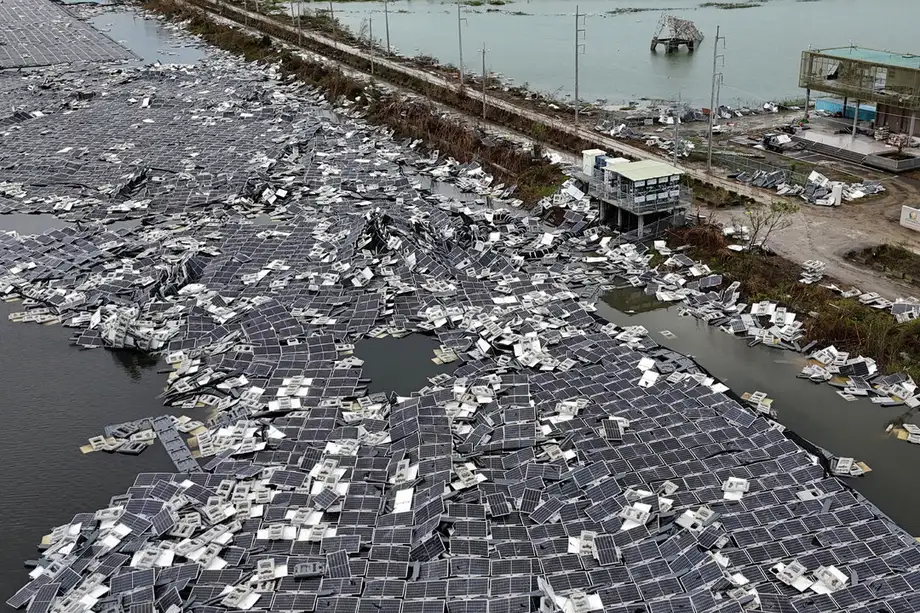
Amendments approved in November 2025 to the Environmental Impact Assessment Act, the Act for the Development of Tourism and the Geology Act expanded environmental oversight and restricted solar installations in protected areas. The changes covered projects on the ground and floating installations, following concerns that included panels becoming debris during severe storms.
Economics Ministry officials say the new requirements have made projects on the ground harder to advance. Kung told lawmakers that concerns surrounding some sites need to be resolved so development can continue. Taiwan's limited land also puts large solar projects in competition with farming, conservation and other uses.
Rooftops are now the priority. The ministry has projected that requirements for solar panels on new buildings, beginning August 1, would add about 660 megawatts annually through 2028. Household rooftop subsidies are projected to add another 272 megawatts each year. Together, those two programmes would add 932 megawatts annually if delivered as planned.
The official strategy still allows solar projects on land unsuitable for agriculture and sites with combined uses. By August 2026, Taiwan had 16,178 megawatts of solar capacity connected to the grid, compared with 14,281 megawatts at the end of 2024.
Offshore wind brings growth and unfinished work
Wind supplied 31.6% of Taiwan's renewable electricity in 2025. Its recent record helps explain Kung's confidence: the National Taiwan University review found that wind generation grew 65.58% in 2024, largely because of offshore projects.
Wind generated 10.329 billion kilowatt hours in 2024, up from 6.238 billion in 2023. Its increase of 4.091 billion kilowatt hours accounted for about 63% of the total increase in renewable generation that year. Completed projects included Greater Changhua Southeast and Southwest Phase 1, Changfang and Xidao, and Zhong Neng.
Taipower's second offshore wind project shows why construction progress can take time to become electricity production. Responding to Kuomintang Legislator Yang Chiung-ying, Kung said four turbines had been installed and completion was expected in 2027.
The project's 31 underwater foundations, three export cables and 34 cables connecting the turbines have been completed. Taipower has taken over turbine installation after Vestas ended its installation contract with contractor Foxwell Energy, which had twice requested Taipower's assistance.
Taiwan had 5,925 megawatts of wind capacity connected to the grid by August 2026, including installations on land and offshore. Further expansion faces expensive construction, financing difficulties, limited installation vessels and changes to requirements governing locally supplied equipment.
Natural gas fills a larger part of the mix
Taiwan People's Party Legislator Hung Yu-hsiang challenged the gap between the planned electricity mix and current development. He argued that a renewable share of around 14% pointed to a structural problem and warned that Taiwan was placing too much weight on natural gas.
The official annual statistics show gas supplying 47.7% of electricity in 2025 and coal 35.3%; Hung cited a gas share exceeding 53.3% in his criticism, without specifying the measurement period. In 2016, gas supplied 31.5% and coal 45.9%.
Gas first overtook coal in annual electricity generation in 2024, according to the university review. Kung defended its role by explaining that gas plants can start and stop quickly, helping operators respond when electricity demand or renewable production changes.
New units at Datan and Hsinta added 2.213 gigawatts of generating capacity in 2025. Further units at Hsinta and Taichung were expected to add 5.2 gigawatts in 2026. Kung has made stable supply conditional on construction being completed on schedule.
Fuel security remains a concern. Taiwan imports about 97% of its energy, with roughly 38% of its natural gas coming from the Middle East. Reported spare liquefied natural gas supplies amount to about 11 days, making shipping disruptions and international price changes immediate concerns for electricity planning.
Nuclear restart procedures reopen a political divide
Taiwan's last operating nuclear reactor, Maanshan Unit 2, stopped in May 2025 when its licence expired. Nuclear power supplied 1.12% of electricity across that year, falling to zero after the shutdown. Hung urged the government to reconsider it as a source of steady generation to support economic growth.
Kung said restart procedures were already underway. The legal route changed on May 23, 2025, when an amendment to Article 6 of the Nuclear Reactor Facilities Regulation Act took effect. Operators can now apply for renewed licences after an existing licence has expired, with renewals lasting up to 20 years.
Taipower must assess safety, inspect equipment, carry out necessary upgrades and submit documents for Nuclear Safety Commission review. The commission must approve a renewed operating licence before generation can resume. The government also requires nuclear safety, a solution for radioactive waste and public agreement.
The ministry has identified 2028 as the earliest possible return for Maanshan. Kuomintang communications chief Chen I-hsin said the commission approved its restart plan in September 2026. No firm date for electricity production has been given; technical work, inspections and licensing remain part of the process.
Chen attacked the governing Democratic Progressive Party for completing the nuclear shutdown while missing its renewable target. He also pointed to a referendum scheduled for November 28 on ending the nuclear free homeland policy. His criticism puts the revised renewable deadline directly into Taiwan's political argument over how to secure cleaner electricity.
Companies need electricity they can buy
Chen Chung-shun, an associate research fellow at the Chung-Hua Institution for Economic Research's Green Economy Research Center, argues that the government should address the price and purchasing rules for renewable electricity alongside construction delays. Businesses need supplies they can both obtain and afford.
Some multinational companies have renewable electricity commitments through RE100 and similar initiatives. Nuclear power can supply electricity with low carbon emissions, while those commitments specifically call for renewable sources. A nuclear restart and additional wind or solar generation therefore serve different purchasing needs.
Industry accounted for 55.56% of Taiwan's electricity consumption in 2024, according to the university review. Electricity use by electronics and electrical equipment manufacturing increased 18.48% between 2020 and 2024, adding about 10.3 billion kilowatt hours.
Ross Feingold, a Taipei based lawyer and political risk analyst, has described the effect of repeated changes to renewable energy legislation on developers:
create uncertainty for industry
Developers must arrange financing, equipment and construction around those rules. Businesses seeking renewable power face the resulting effects on project schedules and the electricity available for purchase.
The 2029 target depends on demand as well as construction
Taiwan's electricity needs help determine how quickly renewables can reach 20%. If renewable output grows but national generation rises just as fast, the renewable share stays unchanged. Faster demand growth means more renewable production is needed to gain each percentage point.
The university review cited a government forecast of average annual electricity demand growth of about 2.5% between 2024 and 2028, driven partly by semiconductors and emerging technologies. President Lai Ching-te's second energy transition programme combines more renewable sources with energy savings and advanced storage.
Electricity savings can reduce the amount of new generation needed. The ministry said Taiwan saved 10.895 billion kilowatt hours in 2025, equivalent to the annual consumption of about 2.62 million households.
Smaller renewable sources also have room to grow, although their current contribution is limited. Geothermal supplied 0.01% of electricity in 2024. The university review identified land access and local consultation as practical constraints on ambitious geothermal construction schedules.
Chen Chung-shun has also pointed out that 2029 falls beyond the current presidential term ending in 2028. The revised deadline leaves the present government responsible for advancing projects whose final contribution to the target will be measured under the next administration.
Key Points
- Taiwan now expects renewables to supply 20% of electricity in 2029, four years after the original deadline.
- Renewables supplied 13.3% in 2025; Kung expects their share to exceed 14% in 2026.
- Tighter solar rules and unfinished wind projects are slowing development, while rooftop installations are receiving greater attention.
- The Energy Administration plans to focus on installed capacity as a development indicator, alongside a generation target affected by electricity demand.
- Gas supplied 47.7% of electricity in 2025, increasing concern about imported fuel supplies.
- Nuclear restart procedures are underway, with inspections, safety work and renewed operating licences required before generation resumes.