Domestic borrowing makes up most of Bangladesh's debt
Bangladesh's government owed an estimated Tk 23.38 trillion as of June 30, 2026, Finance Minister Amir Khosru Mahmud Chowdhury told parliament on November 16. Domestic borrowing accounted for about 57.2% of the total, while foreign borrowing made up the remaining 42.8%.
Contents
- Domestic borrowing makes up most of Bangladesh's debt
- How the debt total has changed
- What the Tk 8.09 trillion repayment allocation covers
- Foreign repayments are set to become more demanding
- Foreign assistance releases fall by 60%
- New loans face checks on projects and repayment terms
- Interest costs are taking a larger share of resources
- Different debt measures need a consistent accounting base
- A unified debt office and stronger revenue collection
- Key Points
The minister gave the detailed total as Tk 23,37,575 crore, comprising Tk 13,37,250 crore in domestic debt and Tk 10,00,325 crore in external debt. One crore equals 10 million taka. In trillion terms, the government owed approximately Tk 13.37 trillion domestically and Tk 10 trillion abroad.
Chowdhury disclosed the figures in response to a question from BNP lawmaker Md Mostafizur Rahman Babul, who represents Jamalpur-3. He also outlined a large repayment allocation, tighter checks on proposed foreign loans and efforts to reverse a sharp slowdown in foreign assistance reaching development projects.
The figures describe two pressures operating at the same time. Bangladesh must find money to meet existing repayment schedules while making sure that new borrowing pays for useful projects. Slower project work can delay the release of foreign funding, even while payments on older loans continue.
How the debt total has changed
Earlier Finance Division figures put government debt at Tk 18.89 trillion in June 2024 and Tk 21.44 trillion in June 2025. The latest total is approximately Tk 1.94 trillion, or 9%, above the more precise June 2025 figure of Tk 21,44,034 crore.
The main dates show how the debt figures and repayment announcements fit together:
- June 30, 2024: Government debt stood at about Tk 18.89 trillion, equivalent to 36% of gross domestic product at that time.
- June 30, 2025: Finance Division figures put government debt at Tk 21,44,034 crore.
- June 30, 2026: The debt stock reached an estimated Tk 23,37,575 crore.
- March to September 2026: The government repaid $2,950.52 million in external loans.
- November 16, 2026: Chowdhury presented the latest debt and repayment figures to parliament.
Between June 2024 and June 2026, government debt increased by about Tk 4.49 trillion, or 23.7%, using the rounded 2024 total. Those figures measure the amount owed on particular dates. Annual repayments measure money paid out over a period, while new borrowing adds to the balance.
What the Tk 8.09 trillion repayment allocation covers
The Appropriation Act for the 2026-27 fiscal year allocates Tk 8,08,778 crore, approximately Tk 8.09 trillion, to servicing domestic and foreign debt, Chowdhury said. An appropriation law authorises government spending for the financial year.
Debt servicing includes principal, the amount originally borrowed, and interest, the charge for using that money. The allocation covers both. Principal repayments reduce outstanding obligations, while interest is an additional expense the government must pay.
The distinction matters for understanding the budget. A large repayment allocation can include the settlement of loans as they fall due, alongside fresh borrowing elsewhere in the government's financing programme. The movement in total debt depends on both new borrowing and repayments.
Chowdhury said the final amount paid during the year could change because withdrawals from the General Provident Fund, or GPF, and early cashing of national savings certificates cannot be predicted precisely. These arrangements make the government a borrower from savers and fund participants as well as from banks and foreign lenders.
A savings certificate normally has a scheduled maturity date, when repayment becomes due. If holders cash certificates earlier, the government must return money sooner than planned. Changes in withdrawals and early cashing can therefore alter the year's payment total.
Foreign repayments are set to become more demanding
Replying to BNP lawmaker Farida Yasmin, Chowdhury said the government repaid $2,950.52 million, approximately $2.95 billion, in external loans between March and September 2026. The period covers seven months.
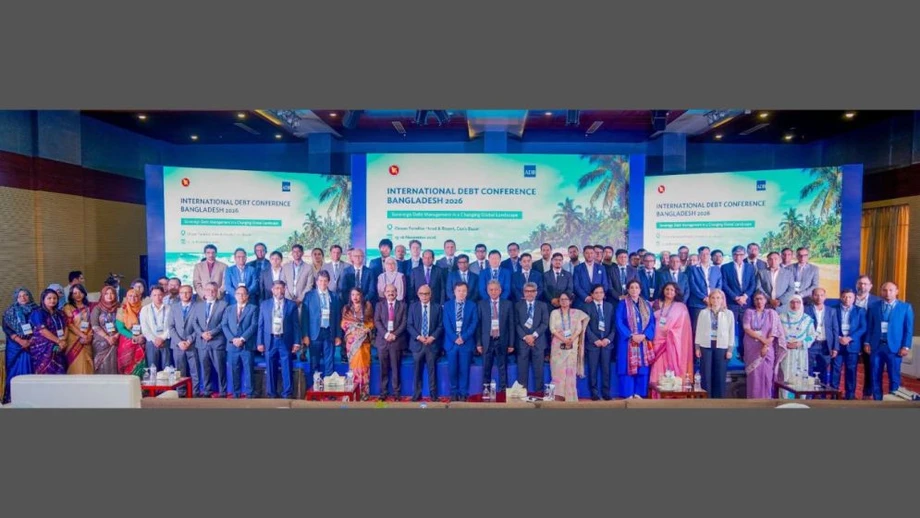
A briefing note prepared for the minister's remarks at an international debt management conference in Cox's Bazar on November 15 set out a longer repayment outlook. It projected external principal and interest payments of $4.5 billion for 2025-26 and about $5.5 billion for 2029-30.
The difference between those annual projections is $1 billion, an increase of about 22%. The same note put external principal and interest payments in 2023-24 at $3.4 billion. Compared with that figure, the projected $5.5 billion would be about 62% higher.
Foreign repayments require access to foreign currency. Bangladesh therefore has to manage the timing of these payments alongside export receipts, other foreign currency inflows and its reserves. The conference briefing note said reserves exceeded $30 billion in June 2026, compared with $20.5 billion at the end of July 2024.
The minister's parliamentary answers did not give a breakdown of how much of the March to September repayment consisted of principal and how much was interest.
Foreign assistance releases fall by 60%
Foreign aid disbursement fell 60% in the current fiscal year compared with the corresponding period a year earlier, Chowdhury told NCP lawmaker Hasnat Abdullah. Disbursement means money actually released by a development partner, rather than money merely promised or approved.
A decline of that size means releases were about 40% of the previous period's level. The minister did not specify the value of the funding released or the exact months covered by the comparison.
Chowdhury attributed the fall partly to prolonged domestic instability over nearly two years and difficult global conditions. He said these factors had slowed project implementation, which in turn reduced the release of foreign assistance.
For a project receiving funds in stages, progress on the ground and the release of money are closely connected. Delayed work can postpone the next payment, leaving the project waiting longer for resources needed to continue.
The government said it was meeting bilateral partners, meaning individual countries, and multilateral partners, meaning institutions involving several countries. It was also urging the organisations responsible for projects to speed up implementation and establishing arrangements to collect progress data and monitor agreed actions regularly.
New loans face checks on projects and repayment terms
Chowdhury said the government was examining both proposed projects and the loans intended to finance them before approving new work funded through external borrowing. The stated aim is to avoid unnecessary projects and keep foreign debt at a manageable level.
Project selection and loan selection address different costs. A project needs to serve a useful purpose, while its loan must have repayment terms the government can manage. The minister said foreign borrowing should support economic recovery and the implementation of the government's election manifesto.
He said particular caution was being applied to loans with high interest rates, short repayment periods and inflexible conditions. A shorter repayment period compresses the time available to return the borrowed money, increasing the amount that must be found each year.
Prof Mustafizur Rahman, distinguished fellow at the Centre for Policy Dialogue, has warned about the direction of government borrowing:
The current trend of government borrowing is alarming for Bangladesh,
Rahman linked the pressure to weak revenue collection, expensive domestic borrowing and foreign loans with demanding repayment terms. He called for closer attention to interest rates, repayment schedules and grace periods, the time allowed before principal repayments begin.
The November 15 briefing note similarly proposed replacing expensive borrowing over short periods with cheaper loans repayable over longer periods. It also called for borrowing to be directed towards projects capable of contributing to economic growth.
Interest costs are taking a larger share of resources
Finance Division figures for 2024-25 put government interest payments at Tk 1,32,460 crore, approximately Tk 1.32 trillion, up 17% from the preceding year. Interest on foreign loans rose 21%, while interest on domestic loans increased 16%.
The longer comparison shows how much this recurring expense has grown. Interest payments were Tk 31,669 crore in 2016 and Tk 63,823 crore in 2021. The Tk 1,32,460 crore total is more than four times the 2016 amount and slightly more than twice the 2021 figure.
Interest payments on commercial bank borrowing through treasury bills and bonds rose 43% in the same annual comparison. Bills and bonds are instruments through which the government borrows from investors, promising repayment and a return.
The November conference briefing note described a more recent easing in one borrowing rate. It said the rate on treasury bills maturing in 91 days had fallen from almost 12% in June 2025 to below 10% in June 2026, and was subsequently between 8% and 9%.
Lower rates on new borrowing can gradually reduce financing costs as obligations are replaced or refinanced. The government still has to meet payments on debt already issued under earlier terms.
Different debt measures need a consistent accounting base
Finance Division figures for September 2025 put government external debt at Tk 9,51,869 crore. Bangladesh Bank's figure for that September was approximately Tk 11,29,020 crore, using an exchange rate of Tk 122 per dollar, a gap of Tk 1,77,151 crore.
The published figures leave the reason for that gap unresolved. A shared debt database and consistent reporting rules would give budget planners a clearer account of obligations, payment dates and the institutions responsible for them.
Risk assessments also vary by institution and period. The Finance Division described external and total debt risk as low in its earlier assessment and gave an external debt to exports ratio of 140%. An IMF debt sustainability analysis classified Bangladesh as facing moderate risk in fiscal years 2022-23 and 2023-24, with a debt to exports ratio of 162.7% for 2023-24.
The ratio compares external debt with annual export earnings. At 162.7%, debt amounts to about 1.63 times one year's exports under that assessment. Export earnings matter because they help bring in the foreign currency needed for external payments.
The IMF analysis linked rising pressure partly to a downward revision in export figures. Under its lending programme, the IMF also set a foreign borrowing ceiling of $8.44 billion for 2025-26, with quarterly monitoring.
Government guarantees add another category of exposure. Finance Division figures put these guarantees at Tk 1,11,431 crore at the end of June 2025. A guarantee is a promise by the government to cover a borrower's obligation if required, such as a loan taken by a state enterprise.
A unified debt office and stronger revenue collection
Bangladesh has been preparing a unified Debt Management Office following recommendations from the IMF and World Bank. A joint mission identified responsibilities spread across several agencies, inconsistent data, and the absence of a central audited database and formal cash flow forecasting system.
The proposed office would bring debt functions together under the Finance Division. Initial responsibilities would include domestic debt issuance, annual borrowing plans, auction schedules, risk assessments and the integration of existing databases.
A cash flow forecast tracks when money is expected to arrive and when payments fall due. For the government, this can help match borrowing to actual payment needs and reduce unexpected financing pressure.
The proposed reform would require a legal framework setting out who can borrow, who is accountable and what must be reported. The mission also recommended specialised staff with skills in capital markets, pricing, settlement and risk management.
The November conference briefing note identified stronger revenue collection as the leading reform priority. Its proposals included widening the tax base, reducing unjustified tax exemptions and digitising value added tax and income tax administration.
The note also set out plans for banking reform, recapitalising state banks and broadening financing sources. Possible instruments included Eurobonds for international investors, sukuk structured according to Islamic finance principles, green bonds for environmental projects and blue bonds for marine or water related investment.
For households and businesses, the practical issue is how much public money remains available for services and investment after required payments are met. More reliable revenue, carefully chosen projects and a clear repayment calendar would help the government plan that spending while meeting its obligations.
Key Points
- Government debt stood at an estimated Tk 23,37,575 crore, or Tk 23.38 trillion, on June 30, 2026.
- Domestic debt accounted for about 57.2% of the total and external debt for 42.8%.
- The 2026-27 allocation for principal and interest payments is Tk 8,08,778 crore.
- Bangladesh repaid approximately $2.95 billion in external loans between March and September 2026.
- Foreign aid disbursement fell 60% compared with the corresponding period a year earlier, the finance minister said.
- The government is scrutinising new foreign loans, seeking faster project implementation and preparing more unified debt management.