A November 18 ruling could reshape an 807.7 billion won project
The Seoul High Court is scheduled to rule at 2 p.m. on November 18, 2026, on whether South Korea can retain the basic plan for Saemangeum International Airport, an 807.7 billion won project proposed just 1.35 kilometers south of Gunsan Airport. The appeal brings together three connected disputes: aircraft safety around large concentrations of birds, damage to protected tidal flats, and the ability to operate a civilian airport beside airspace controlled by the United States military.
Contents
- A November 18 ruling could reshape an 807.7 billion won project
- What the first court found
- Why the bird strike calculations are contested
- Radar, replacement habitat and a broader assessment
- Why Sura and Seocheon are connected
- Can birds be moved somewhere else?
- The military airspace dispute
- Investment plans meet questions about demand
- The dates and decisions ahead
- Key Points
The court's Administrative Division 4-2 will review a September 11, 2025, judgment that canceled the airport's basic plan. That decision followed a lawsuit filed by 1,308 people, including Gunsan residents, who challenged the Ministry of Land, Infrastructure and Transport's assessment of the site.
Bird strike calculations remain central. Plaintiffs cite an assessment putting the proposed airport's risk as high as 650 times that of Muan Airport. An earlier North Jeolla provincial explanation recorded campaigners citing a maximum of 610 times Muan's risk within five kilometers of the planned site. The ministry disputes the comparison between a proposed airport and airports already operating.
The plaintiffs have also asked the court to reopen arguments over their claim that 90.8 percent of the proposed airport's airspace overlaps with military controlled airspace at Gunsan. Alongside those technical arguments, footage of an endangered otter at the construction site has renewed attention to the wildlife living there.
What the first court found
The Seoul Administrative Court's judgment concerned the government's basic plan, the formal framework that sets out the airport's location and development. Canceling that plan removed a central approval needed to advance construction.
The court found that the ministry had inadequately considered bird strikes and the project's effects on the Seocheon tidal flats, part of the UNESCO World Heritage property known as Getbol, Korean Tidal Flats. Its findings also addressed the assessment methods, the area examined and the effectiveness of proposed protection measures.
The first judgment found that bird strike risk had been omitted from the evaluation used to assess the suitability of the location. It also identified inconsistent use of models and a reduced assessment area in the strategic environmental review, producing an assessment that understated the risk.
Presiding Judge Lee Joo-young described the ecological damage and the ministry's response to evidence presented during the case:
The project would destroy vital resting grounds for migratory birds and erode biodiversity," Lee said. "Evidence presented by scholars and surveys supports this conclusion, and the ministry has not convincingly refuted these findings.
The ministry appealed on September 22, 2025, citing balanced national development, investment and economic activity. North Jeolla Province joined the proceedings in support of the ministry and says it submitted additional measures, expert opinions and supporting documents to answer the court's concerns.
Why the bird strike calculations are contested
North Jeolla's Road, Airport and Railway Division set out the government's position in a January 2025 explanation. Drawing on the ministry's September 2021 strategic environmental impact assessment, the province said the proposed site had long been unmanaged grassland where birds and other wildlife could move freely without buildings obstructing their flight.
The document argued that risk calculated under those conditions was difficult to treat as an absolute figure. It said comparison with nearby Gunsan Airport was necessary and noted that Gunsan had ranked third lowest for bird strike risk among 15 domestic airports assessed, below Muan.
The ministry's assessment used a model developed for a proposed airport at Cliffe in Britain to estimate annual bird collisions. During the appeal, the ministry has argued that a model designed for a new airport produces an unsuitable comparison with an airport already operating.
Plaintiffs challenge its continued reliance on Gunsan's low assessed risk. They argue that Gunsan's relatively small number of flights and the exclusion of collision data from the American military base help explain that result. Their objection concerns the information fed into the comparison as well as the model itself.
Figures cited around the first judgment included up to 45 projected collisions annually within a radius of 13 kilometers at Saemangeum, compared with about three at Incheon and fewer than one at other regional airports. Using the stated figures, 45 is 15 times three. Flight numbers, bird movements and the size of the area examined are therefore essential to understanding each airport's calculated risk.
The safety debate has gained urgency since the December 29, 2024, crash of Jeju Air Flight 2216 at Muan, about 117 kilometers south of Saemangeum. The crash killed 179 people after a bird strike and a runway overrun.
Radar, replacement habitat and a broader assessment
The land ministry says it considered bird strikes when selecting the location and intends to develop detailed controls during the environmental impact assessment. Those measures include radar to detect birds and the creation of alternative habitat.
A strategic environmental assessment examines major choices, including location, early in planning. A later environmental impact assessment examines a project's detailed effects and proposed controls. Here, the dispute centers on how much safety and ecological work had to be completed before the location was approved.
The Ministry of Climate, Energy and Environment has prepared standardized guidance for assessing bird strike risks within 13 kilometers of airports, using International Civil Aviation Organization criteria. The approach examines bird numbers, distribution, density, flight routes and use of habitat.
The guidance also calls for considering the combined effects of development projects on bird habitats. That matters because a runway, a road and another development can each change where birds feed or rest, potentially changing their movement through the same area.
Consultations with the climate and environment ministry on Saemangeum's environmental impact assessment have been suspended since the first judgment. The land ministry's proposed later assessment and the plaintiffs' demand for stronger scrutiny of the location remain at the center of the appeal.
Why Sura and Seocheon are connected
Sura, in Okseo township in Gunsan, is the last remaining tidal flat within the reclaimed Saemangeum estuary. Scientists who coauthored an open letter published in Science described it as a crucial stop on the East Asian-Australasian Flyway, the migration route linking breeding and feeding grounds across a large part of the world.
The scientists said the stopover supports the annual migration of at least 330,000 shorebirds and provides habitat for 59 nationally protected bird species and 27 globally threatened bird species. Those categories can overlap, so they should not be added together as a total number of species.
Seocheon's World Heritage tidal flat lies about seven kilometers from Sura. Birds move between feeding and resting areas, making the ecological effects of construction relevant beyond the airport boundary. The first court found the proposed Seocheon protection measures too abstract, including promises to consult agencies and investigate protected migratory birds' movements.
Nial Moores, director of Birds of Korea and a coauthor of the scientists' letter, said far eastern curlews that once gathered in Saemangeum by the thousands now use Sura only during the highest tides. He also cited research from two other locations suggesting that airport noise could further reduce bird populations.
Research scientist Taejin Park, another coauthor, linked the location directly to passenger safety:
"Internal environmental assessments by the government itself indicate an exceptionally high risk of bird strikes at the proposed airport site," Park said.
Park also connected protection of Sura to South Korea's commitment under the United Nations Convention on Biological Diversity to halt biodiversity loss by 2030. The scientists called for a pause pending an independent feasibility and environmental review.
Can birds be moved somewhere else?
The ministry has identified Gaeya Island and the lower reaches of the Mangyeong and Dongjin rivers as possible replacement habitats. Ecologists supporting the plaintiffs argue that some candidate locations have already been dredged, while others lack the tidal flat conditions found at Sura.
Bird ecologist Lee Jin-won, head of the bird research group Saejip, has argued that shorebirds returning to the same places at the same time each year are unlikely simply to relocate to a designated replacement site. He expects birds could continue moving across the airport between habitats.
The first court also found a conflict between some proposed safety controls and wildlife protection. Measures that reduce the airport's attraction to birds could damage habitat used by legally protected species. The appeal therefore concerns both the effectiveness of replacement sites and the consequences of changing the existing habitat.
New footage brought that issue into focus on November 15, when an activist filmed an otter moving across Sura's mudflat during daylight. Otters are designated as a Class I endangered wild animal in South Korea and as Natural Monument No. 330. Their presence at Sura had previously been documented through unattended cameras and droppings.
The Joint Action for Cancellation of Saemangeum New Airport said roughly 50 lesser white-fronted geese were also observed that day, describing them as the largest known group in the country. The coalition attributes the area's wildlife diversity to its mix of wetland vegetation and tidal flat habitat.
The military airspace dispute
The plaintiffs sought to reopen proceedings after arguments concluded in September 2026, saying the claimed 90.8 percent airspace overlap with Gunsan undermines the proposal for an independent civilian international airport.
Airspace is the area above the ground used to organize aircraft movements. Although the two airports would have separate ground facilities, the plaintiffs argue that the proposed airport's operations would remain closely tied to the military controlled airspace around Gunsan.
The ministry says the plaintiffs did not raise this issue before arguments closed and that it does not justify reopening proceedings. Whether the court will reopen arguments remains unresolved ahead of the scheduled judgment.
North Jeolla says the appeal has already involved five hearings. A further appeal to the Supreme Court would chiefly address legal questions, making the High Court's examination of the factual disputes especially consequential.
Investment plans meet questions about demand
The planned airport includes one runway measuring 2,500 meters by 45 meters, a passenger terminal of 15,010 square meters and a cargo terminal of 750 square meters. Its basic plan put the total cost at 807.7 billion won, and the government secured 120 billion won for the project in the 2026 budget.
Supporters say the airport would complete a transport network linking Saemangeum's roads, railway and port. Regional lawmakers and business groups have cited Hyundai Motor's proposed investment of 9 trillion won as part of their case for international connections and freight capacity.
North Jeolla Governor Lee Won-taek said on October 7 that investment and development plans would be affected without the airport, while promising stronger bird strike prevention and environmental and safety measures. Regional commerce and construction groups have also pressed for construction to resume.
A feasibility evaluation put the project's benefit to cost ratio at 0.479. In simple terms, it estimated about 47.9 won in benefits for every 100 won in costs counted by that evaluation. The government has justified the project through regional development goals as well as its expected economic returns.
Demand forecasting has a history in the region's airport plans. The earlier Gimje Airport proposal, begun in 1996, was abandoned in 2008 after the Board of Audit and Inspection raised concerns about excessive passenger demand forecasts. North Jeolla examined three candidate locations before selecting the present Saemangeum site in 2017.
The dates and decisions ahead
The appeal follows more than a decade of planning, an exemption from a preliminary feasibility review and three years of litigation before the first judgment. The main milestones are:
- 2011: The airport was included in the Saemangeum master plan.
- 2016: It entered the government's fifth airport development plan.
- 2019: The project received an exemption from the preliminary feasibility review.
- June 2022: The land ministry announced the basic plan.
- September 2022: A total of 1,308 plaintiffs filed suit to cancel it.
- September 11, 2025: The Seoul Administrative Court canceled the basic plan.
- October 14, 2026: The original appeal judgment date was postponed.
- November 18, 2026: The High Court is scheduled to deliver its judgment at 2 p.m.
North Jeolla says a favorable ruling would allow it to advance the remaining environmental procedures and aim for construction in the first half of 2027. The original opening target was 2029; supporters now discuss 2030 if work resumes.
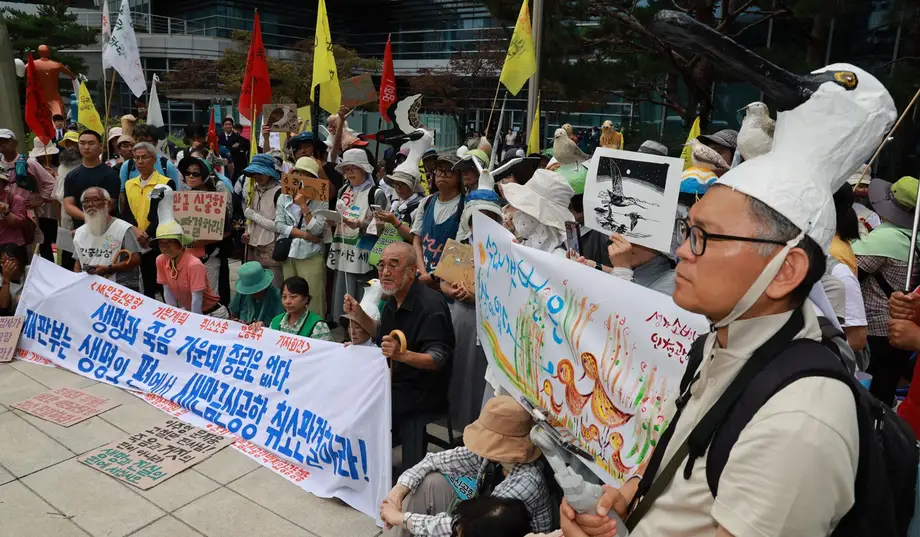
A judgment preserving the cancellation would leave the province pursuing a possible Supreme Court appeal while addressing the identified shortcomings. The wording of the High Court's decision will determine what further work the government must undertake. Campaigners, meanwhile, have pledged to continue defending Sura regardless of the outcome and planned prayers at the tidal flat through November 17.
Key Points
- The Seoul High Court is scheduled to rule on the Saemangeum airport basic plan on November 18, 2026, at 2 p.m.
- The first court canceled the plan over inadequate bird strike and environmental assessments.
- The ministry proposes radar and replacement habitats; plaintiffs dispute whether those measures can resolve the site's risks.
- Plaintiffs also claim 90.8 percent overlap with military controlled airspace at Gunsan.
- The 807.7 billion won project is backed by regional authorities seeking investment, transport links and economic development.
- Sura's protected wildlife and its ecological connection to Seocheon's World Heritage tidal flats remain central to the case.