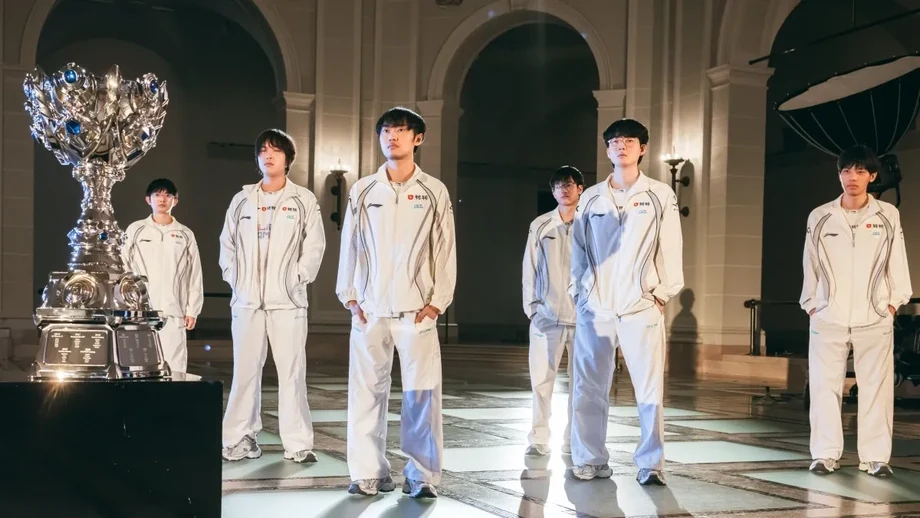
A comeback in New York ends China's five year wait
Bilibili Gaming defeated Gen.G 3-1 at Barclays Center in Brooklyn, New York, to win the 2026 League of Legends World Championship, recovering from an opening game defeat to claim the club's first Summoner's Cup. The Chinese league's second seed completed an unusual sweep of its biggest regional rival: BLG eliminated all four South Korean teams entered in the tournament.
Contents
- A comeback in New York ends China's five year wait
- How the final turned after an opening defeat
- Bin and XUN help close out the deciding game
- Four Korean opponents, four successful series
- Why beating T1 mattered beyond one semifinal
- Knight turns past disappointment into a finals award
- Daeny explains the choices behind BLG's recovery
- A Chinese league champion with an international team
- Millions watch online as cinemas fill overnight
- Key Points
The final took place on November 14 in New York, with viewers in China, Singapore and South Korea watching during the early hours of November 15. BLG midfielder Zhuo Ding, known as knight, received the finals Most Valuable Player award after finishing the four games with 13 kills, six deaths and 41 assists.
BLG earned US$1 million from a US$5 million prize pool, while runner-up Gen.G received US$800,000. The champion's share was one fifth of the total pool and US$200,000 more than the prize for second place.
The victory delivered the Chinese League of Legends Pro League, or LPL, its fourth world championship and its first since EDward Gaming won in 2021. Teams from South Korea's League of Legends Champions Korea, known as the LCK, had won the four intervening tournaments.
BLG's success also ended a painful personal wait for four starters. Chen Zebin, known as Bin; Peng Lixun, known as XUN; knight; and Luo Wenjun, known as ON, became world champions for the first time. Their teammate Park Do-hyeon, known as Viper, won his second title after helping EDG lift the trophy in 2021.
How the final turned after an opening defeat
Gen.G entered the championship match as South Korea's top seed and began with a victory in approximately 38 minutes. Park Jae-hyuk, known as Ruler, finished that opening game on Corki with seven kills, eight assists and no deaths, helping Gen.G take control of important fights and neutral monsters.
League of Legends pits two teams of five against each other, with each player controlling a character called a champion. The ultimate aim is to destroy the opposing Nexus, the main structure inside its base. Kills help players earn resources, but teams must also manage their positions across the map and choose when to fight.
Game two stretched to approximately 53 minutes, the longest game of this tournament. BLG survived setbacks around major objectives before finding a way back. At a crucial fight around the Elder Dragon in the 47th minute, Viper helped BLG kill three opponents without losing a player.
XUN finished that game on Naafiri with eight kills, nine assists and one death. BLG's victory levelled the series at 1-1, turning a possible two game deficit into a fresh contest.
BLG then took game three in approximately 37 minutes. Bin repeatedly attacked from the side, while ON helped hold opponents in place so teammates could finish fights. Viper recorded six kills and 11 assists with one death on Taliyah, putting BLG one win away from the championship.
Bin and XUN help close out the deciding game
Gen.G made the fourth game difficult from the beginning. Ruler's Xayah repeatedly punished Viper's Yunara in the bottom lane, leaving Viper with three deaths and no kills or assists after about 12 minutes. Gen.G also collected early dragons, giving BLG several problems to solve at once.
BLG responded through coordinated fights rather than relying on its struggling bottom lane. ON used Neeko to start an effective engagement near the dragon area. Bin later arrived behind Gen.G with a teleport, helping BLG secure three kills without a loss and take Baron Nashor.
Baron is a powerful neutral monster whose defeat gives the winning team a temporary advantage, making it easier to advance toward the enemy base. Dragons provide other bonuses, so deciding which objective to contest can change the direction of a game.
XUN secured another crucial Baron during the closing stages. Gen.G continued fighting beyond 40 minutes, but BLG won the late confrontation and pushed into the base to destroy the Nexus. Bin ended the approximately 42 minute game on Gwen with eight kills, nine assists and two deaths.
The final showed BLG could recover at two different levels: from losing the first game of the series and from falling behind early in the game that ultimately secured the trophy.
Four Korean opponents, four successful series
BLG's route began unevenly in the Swiss Stage, where teams progress by collecting three series wins and are eliminated after three defeats. BLG lost to Movistar KOI, beat Team Liquid Alienware and Karmine Corp, then fell to Chinese rival Top Esports.
Those results left BLG at two wins and two losses. Its fifth and final Swiss Stage match against Hanwha Life Esports became a direct contest for survival. BLG won 2-0 to reach the quarterfinals.
BLG then beat Dplus KIA 3-0, defending champion T1 3-1 and Gen.G 3-1. Across those four series against Korean opposition, BLG won 11 games and lost two. Its elimination of all four LCK representatives began before the quarterfinals, with the decisive Swiss Stage victory over Hanwha Life.
Gen.G had taken a smoother route. It defeated Invictus Gaming, Hanwha Life and LYON in the Swiss Stage, then swept LYON in the quarterfinals and Invictus Gaming in the semifinals. The final was Gen.G's best finish in eight Worlds appearances, following four finishes in third or fourth place in 2021, 2022, 2024 and 2025.
Why beating T1 mattered beyond one semifinal
T1, led by Lee Sang-hyeok, known as Faker, had been an especially difficult obstacle for Chinese teams. Before this semifinal, T1 and its predecessor SK Telecom T1 had won all 13 of their best of five series against LPL opponents at Worlds.
BLG's 3-1 semifinal victory ended that record. It also stopped T1's attempt to win a fourth consecutive world championship and reversed the outcome of the 2024 final, when BLG led T1 2-1 before losing the final two games.
BLG had already shown it could challenge Gen.G on this stage. Their previous Worlds meeting, in 2023, ended in a 3-2 victory for BLG. Before the 2026 final, the clubs had split their four best of five meetings in official competition, with two wins each.
The LPL's championship timeline now includes four different organisations:
- 2018: Invictus Gaming won the LPL's first world title.
- 2019: FunPlus Phoenix followed with the region's second.
- 2021: EDward Gaming claimed the third championship.
- 2024: BLG reached the final but lost to T1 in five games.
- November 14, 2026, in New York: BLG beat Gen.G to become the fourth LPL organisation to lift the trophy.
Knight turns past disappointment into a finals award
Knight's MVP award placed him at the centre of BLG's breakthrough. Playing in the middle lane, he faced Gen.G star Jeong Ji-hun, known as Chovy, in a matchup between two players seeking their first world championship.
Knight described the result as an answer to doubts about both himself and his team. Speaking after receiving the finals MVP award, the BLG midfielder said:
Before the match, I don't think many people predicted our victory. But today, I beat Chovy, and BLG defeated Gen.G.
His combined 13 kills and 41 assists meant he was involved in 54 BLG kills during the final. An assist is awarded when a player helps a teammate secure a kill, so that figure captures contributions beyond delivering the final blow.
Knight, who was born in 2000, also connected the championship with earlier disappointments. Asked how he felt about winning, he said:
I feel like I've made up for a lot of past regrets. I'm happy to have proven that the LPL is back on top.
Daeny explains the choices behind BLG's recovery
Head coach Yang Dae-in, known as Daeny, credited BLG's understanding of the tournament's game version and its decisions across the map. League of Legends receives updates, called patches, that change the strength of characters and tactics. Teams must work out which combinations suit those changes before their opponents do.
Daeny said BLG believed it had an advantage in that preparation. Discussing the Korean teams, the BLG head coach said:
Looking at the LCK teams this year, I was confident that we were ahead when it came to reading the patch, and that the LCK was following behind. Once we understood the macro side of things, I felt we held the upper hand.
Macro refers to decisions involving the whole map: where players move, which lanes they pressure and when they exchange one objective for another. BLG's recovery in the final included precisely those choices, such as building resources while Gen.G collected dragons.
Daeny also pointed to unusual bottom lane selections rather than always using a conventional ranged damage dealer. Gen.G's wide range of playable champions made preparation difficult, he said, so BLG concentrated on its own strengths.
The coach described a patient approach to mistakes, saying he trusted players to recognise their errors. BLG's season had included communication problems and a temporary break for Bin before the team found its strongest form at Worlds.
A Chinese league champion with an international team
BLG's championship belongs to the Chinese league, while its team brings together people from several places. Viper is South Korean, as are head coach Daeny and assistant coach Nam Dong-hyeon, known as Ben. Coach Lee Chieh, known as Chieh, is from Taiwan.
Viper's second championship linked BLG's victory directly to the LPL's previous title in 2021. Reflecting on a difficult season, the BLG bottom lane player said:
It was the hardest year of my life. Although I won in 2021, returning as a challenger and standing in this spot with such great teammates makes me so happy, and it feels unbelievable.
Bin completed a collection of titles across the domestic league, First Stand, the Mid-Season Invitational and Worlds. Officials in his hometown of Huanggang, Hubei province, sent congratulations and encouraged him to help promote esports.
Bilibili built the club in December 2017 after acquiring the former I May team. The organisation's rise from the middle of the Chinese league to world champion culminated in its third Worlds appearance.
Millions watch online as cinemas fill overnight
Bilibili said its final livestream attracted more than 20 million viewers and generated over 3.3 million scrolling comments. Those comments, often called bullet comments, move across the video screen as viewers react together.
Cinema viewing events covered more than 300 venues in over 110 Chinese cities, with roughly 2,000 screenings. More than 20 cinemas in Wuhan screened the match, selling over 5,000 tickets. At one Wuhan venue, more than 500 spectators gathered around 2 a.m.
A Wuhan cinema added a second screening after demand rose following BLG's qualification for the final. The overnight crowds gave fans a shared place to watch a competition taking place on the other side of the world.
Celebrations also included a DJ Sona music event at Invictus Gaming's Shanghai venue on November 14 and 15, and a gathering at Beijing's PH Club. Bilibili announced a free premium membership promotion from noon on November 15 until noon on November 16, accessible by searching for its membership service on the platform.
League of Legends also announced celebration activities for its computer and mobile games. BLG's commemorative champion skin selections were still being discussed after the final, with ON considering Lulu or Neeko.
Key Points
- BLG recovered from losing the opening game to beat Gen.G 3-1 at Barclays Center in New York.
- The victory was BLG's first world championship and the Chinese LPL's fourth.
- BLG eliminated Hanwha Life Esports, Dplus KIA, T1 and Gen.G, all four South Korean entrants.
- Knight won finals MVP with 13 kills, six deaths and 41 assists across four games.
- The semifinal victory ended T1's record of 13 consecutive Worlds series wins against LPL teams in the best of five format.
- BLG received US$1 million, while Gen.G earned US$800,000.
- Bilibili reported more than 20 million livestream viewers, while cinema events reached over 110 Chinese cities.