Record crowds set the stage for league changes
China League One will expand from 16 to 18 clubs in 2028, following a season in which the Chinese Super League attracted a record 7.096 million spectators. The changes announced in Guangzhou on November 10, 2026, also increase space for young players and restore financial deposits for selected clubs in China League Two.
Contents
- Record crowds set the stage for league changes
- Where the attendance growth came from
- What an expanded League One will look like
- How promotion and relegation will change
- Fixtures will stop following a mirrored order
- More squad places for young players
- The U20 league and reserve teams provide routes upward
- A new category for selected foreign players
- Deposits return as ownership rules loosen
- Club naming rules will also change
- Key Points
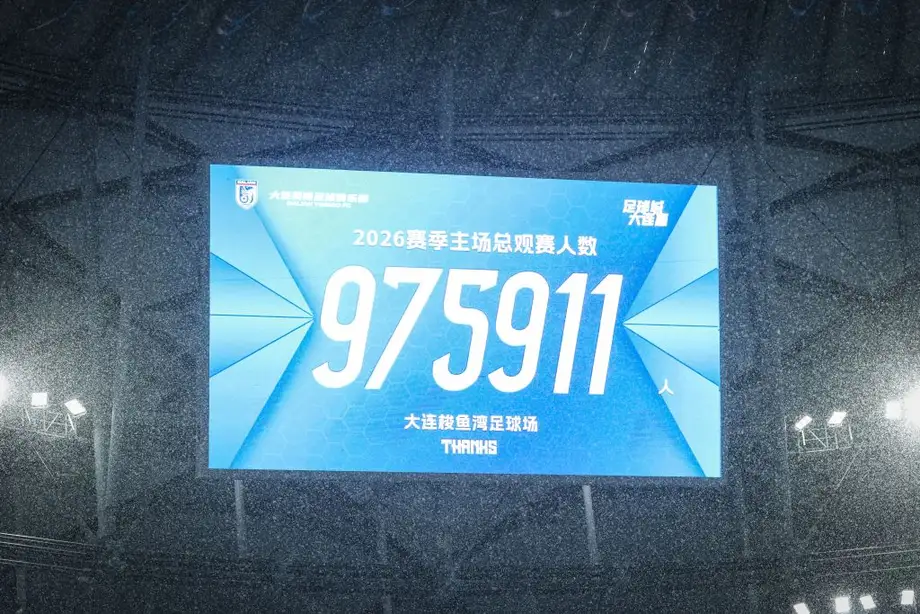
Yang Xu, vice chairman of the Chinese Professional Football League, said the CSL averaged 29,567 spectators per match in 2026, up 14.8% from the previous season. Both total attendance and the average crowd reached records, while combined attendance across the three men's professional divisions exceeded 9.8 million.
The Chinese Football Association Professional League Union, known as the CFL, outlined changes covering promotion, relegation, player registration, scheduling and club ownership. Most begin in 2027, with that season serving as the transition to a larger second division in 2028.
The eventual structure will have 16 clubs in the CSL, 18 in League One and 24 in League Two. Expansion is concentrated in the middle of the professional system rather than the top flight, giving more clubs access to the division immediately below the CSL.
For supporters, the package means more League One fixtures from 2028 and a different arrangement of opponents from 2027. For clubs, it changes the routes between divisions, the balance of squad places and some conditions for attracting investment.
The CFL also plans to give certain young foreign players a new route into League One and permit clubs competing in Asia to register dedicated foreign players for those competitions. Alongside those opportunities, the return of deposits in League Two addresses a more basic concern: keeping clubs operating through the season when wage and debt problems arise.
Where the attendance growth came from
The CSL's eighth round in April attracted more than 307,000 spectators, a record for a single round. Beijing Guoan's third round match against Shanghai Shenhua brought 64,118 people to Workers' Stadium, the second largest attendance for a match in CSL history.
Travelling supporters also contributed to the season's crowds. The CSL recorded 238,810 away supporters, showing the scale of attendance by fans following their clubs outside their home grounds.
League One attracted 2.194 million spectators, an increase of 15.69%, while League Two drew 535,000. League One's percentage increase was slightly higher than the CSL's 14.8%, although the top division continued to account for most spectators across the men's professional leagues.
Women's football recorded growth too. The Women's Super League season opener drew 24,193 spectators, a record for a domestic women's professional league match. Attendance through round 14 reached 298,500, up 64.8% against the same stage of the previous season. That comparison covers the first 14 rounds rather than a completed season.
What an expanded League One will look like
League One will move from 30 to 34 rounds in 2028. Its 18 clubs will play a double round robin, meaning each team faces every other team twice, once at home and once away.
Each club will consequently play four more league matches than under the 16 team format. Across the division, the schedule rises from 240 to 306 matches, calculated from the number of clubs and games per club, with each match counted once. That creates 66 additional fixtures, an increase of 27.5%.
The three professional divisions will keep their existing competition formats in 2027. Expansion follows a transition season with adjusted promotion and relegation places, rather than an immediate change to League One's size.
How promotion and relegation will change
The CSL and League One will continue exchanging two teams after the 2027 season. Two clubs will move up to the top division and two will move down, keeping the CSL at 16 teams.
Between League One and League Two, the CFL described the transition allocation as 1.5 relegation places and 3.5 promotion places. The half place refers to a route decided through a playoff: a club's place in League One depends on the result of an additional contest rather than an automatic move.
The arrangement allows League One to gain two clubs in total. Below that, the announced allocation is 3.5 relegation places from League Two, four promotion places from the China Champions League and 1.5 promotion places from the U20 league.
Yang Guang, the CFL's competition department director, presented the competition changes in Guangzhou. The main dates are:
- November 10, 2026: The CFL announced the expansion and explained the planned rules in Guangzhou.
- 2027 season: Transitional promotion and relegation rules apply, alongside changes to scheduling and player registration.
- Before 2027 League Two admission is announced: Clubs covered by the restored deposit rules must pay their deposits.
- 2028 season: League One expands to 18 clubs and begins its 34 round schedule.
Fixtures will stop following a mirrored order
From 2027, scheduling will change from a symmetrical to an asymmetrical arrangement. Under a symmetrical schedule, the order of opponents in the second half of the season mirrors the first half, with home and away venues reversed.
An asymmetrical schedule allows the return fixtures to appear in a different order. Teams still play their opponents home and away; the change concerns when those meetings happen.
The CFL said the adjustment is intended to better serve teams and spectators. For supporters planning trips, the practical difference is that the second half of the fixture list will no longer follow the same sequence of opponents as the first.
More squad places for young players
League One's registration allowance will change in 2027 from 30 general squad places plus five U21 places to 27 plus eight. The total remains 35, but three places shift into the category reserved for players under 21.
The CSL will retain its existing 27 plus eight arrangement, while League Two will keep 30 plus five. League One is therefore moving into line with the top division's allocation rather than increasing its total squad size.
Across the three men's professional divisions, 580 U21 players were registered in 2026. They represented 34.3% of domestic registrations, an increase of 5.1 percentage points from 29.2% the previous year.
The CSL recorded increases beyond squad lists. U21 registrations rose 12.7%, their playing time increased 42.9% and their goals increased 31.4%. Playing time grew faster than registrations, meaning the rise in young players' involvement extended beyond simply having more names registered.
League Two had 320 U21 players, accounting for 45.1% of registrations. They scored 257 goals, roughly one third of the division's total. In the women's second division, U21 players made up 57.5% of registrations and the average player age was 21.6.
The U20 league and reserve teams provide routes upward
The newly established U20 league registered 1,047 players. During the summer transfer window, 43 signed professional contracts: 22 moved to other clubs and 21 advanced to their own clubs' first teams.
Yang Xu, the league body's vice chairman, linked the growth in young players' involvement to the development of national team talent.
"Young players are accelerating their development through the professional leagues, and a group of outstanding talents have emerged to join national teams at various levels, continuously strengthening the talent pipeline," Yang said.
Club reserve teams provide another route. Shandong Taishan B will enter League One for the first time in 2027, after Shandong Taishan B and Shanghai Port B first participated in League Two in 2024.
The CFL will retain the rule allowing B teams to earn promotion into League One or League Two. However, two teams belonging to the same club cannot compete in the same professional division, placing a limit on how far a reserve side can advance alongside its parent team.
A new category for selected foreign players
League One will trial a special player category in 2027, replacing its existing category for eligible players from Hong Kong, Macao and Taiwan. Those players remain included, while the category expands to cover qualifying foreign players.
A foreign player must have been under 22 at the time of their most recent transfer to China and must play a position other than goalkeeper. The age condition is tied to that transfer, rather than being described simply as the player's age throughout the coming season.
The CFL said the trial takes account of young foreign players' development potential, integration into teams, cultural adjustment and salary levels. The CSL's existing policy for players from Hong Kong, Macao and Taiwan will remain unchanged while League One tests the new approach.
Clubs participating in the AFC Champions League Elite or AFC Champions League Two may also register up to two foreign players specifically for those competitions. Replacements are allowed during registration windows, but the total registered in any one registration period cannot exceed two.
That limit concerns the dedicated category for Asian competition. It gives participating clubs a defined registration option as they prepare squads for continental matches, while retaining a ceiling within each registration period.
Deposits return as ownership rules loosen
League Two will restore a deposit system in 2027 that had previously operated before being suspended. It targets specified clubs with wage or debt concerns, with payments required before league admission is announced.
The detailed competition explanation identifies existing League Two clubs whose previous season's weighted index for paying wages on time was below 1 and ranked among the division's bottom four on that measure. Newly promoted clubs with unresolved wage arrears or debts within football are also covered.
The deposit is intended to help support a club's completion of the season in exceptional circumstances. For players, the concern is unpaid wages; for opponents and supporters, it is whether a financially troubled club can continue fulfilling its fixtures.
The CFL has yet to provide the deposit amounts or the detailed playoff arrangements and dates. It said further implementation rules would be developed as part of putting the policies into practice.
Club ownership rules will move in a less restrictive direction. Major ownership changes will generally be limited to once per season, while full clearance of all debts will no longer be mandatory for an ownership transfer. The stated aim is to lower barriers to investment and encourage a wider mix of owners.
The contrast is practical: investors gain more room to take over clubs carrying debts, while selected League Two clubs must provide financial security before entering the competition.
Club naming rules will also change
From 2027, the usual interval between club renamings will fall from five years to four. The CFL will retain the principle that a club's underlying name should not be a corporate name.
Sponsorship naming rules will become more flexible. The limit rises from four Chinese characters to five, and permitted names may include categories of products or services.
The ownership and naming changes broaden clubs' commercial options alongside the expansion of League One. Their practical effect will depend on clubs attracting investors and sponsors, while meeting the competition and admission requirements that remain in place.
Key Points
- The CSL drew a record 7.096 million spectators in 2026, averaging 29,567 per match.
- League One will expand from 16 to 18 clubs in 2028, with its schedule increasing from 30 to 34 rounds.
- Transitional promotion and relegation rules will apply in 2027, while two teams will continue moving each way between the CSL and League One.
- League One will reserve eight registration places for U21 players in 2027, up from five, within an unchanged total allowance of 35.
- Selected young foreign players will qualify for a new League One registration category.
- League Two deposits will return for specified clubs with wage or debt concerns, while ownership and sponsorship naming rules become less restrictive.