A deadly journey home exposes gaps in enforcement
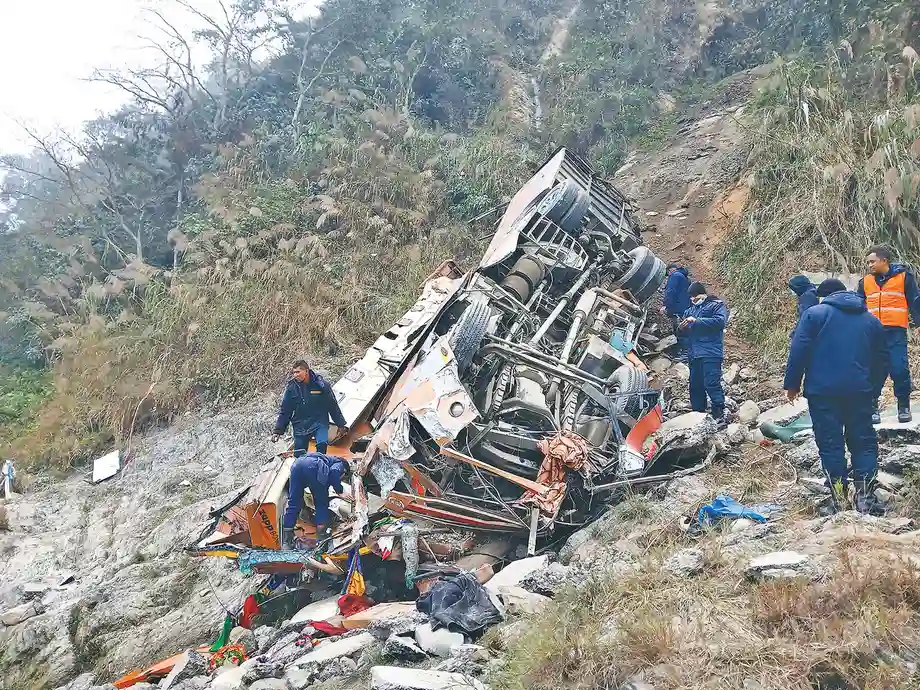
An electric microbus carrying about 20 people left Kathmandu for Sarlahi before dawn to take families home for Chhath. At around 5:45am on Thursday, it plunged down a slope at Chisapanigadhi in Bhimphedi Rural Municipality, Makawanpur, killing 13 passengers and the driver. Six members of one family were among the dead.
Contents
- A deadly journey home exposes gaps in enforcement
- Chhath preparations turn into mourning
- What the new inquiry will examine
- Repeated disasters, familiar recommendations
- A rest rule already exists
- Why reports stop short of action
- Police data show crashes rising
- The cost of unsafe roads
- Electric vehicles need suitable operation and testing
- Enforcement and justice must reach beyond the driver
- Key Points
Police suspect overloading and driver fatigue. The vehicle had reportedly completed a journey from Sarlahi to Kathmandu before collecting passengers again around 2am. It also reportedly passed about five security checkpoints during a journey of nearly 61 kilometres from Kathmandu to the crash site.
The disaster brings together failures repeatedly identified by Nepal's accident investigations: drivers working without enough rest, vehicles carrying too many passengers, weak roadside inspections and safety recommendations that remain unfinished after inquiry committees submit their reports.
Nepal Police figures cited for a period described as nine years record 187,949 accidents, 21,031 deaths and 51,049 serious injuries. The stated reporting period runs from fiscal year 2018/19 to mid October of 2026/27. A complete annual count for 2024/25 records 2,549 deaths, equivalent to about seven people every day.
The wider public health burden may be much larger. The Asian Transport Observatory's Nepal Road Safety Profile, published in September 2025, presents a World Health Organization estimate of about 8,000 deaths in 2021, compared with roughly 2,000 in official statistics and Global Burden of Disease estimates.
Those figures give Nepal two urgent tasks: prevent the dangerous journeys already visible to police, and build a more reliable picture of how many people die or suffer serious injuries on its roads.
Chhath preparations turn into mourning
Sundarpur in Sarlahi had been preparing to welcome relatives returning from Kathmandu for Chhath. Thirteen of those killed were from the village. Many worked in the fruit and vegetable trade in the capital.
Deputy Superintendent of Police Madhav Prasad Kafle identified members of one family among the victims: Punam Devi Yadav, 35, her three young daughters and two male relatives. Her husband, Awadhesh, had put his family in the microbus and planned to follow on his motorcycle. Their infant son survived with injuries.
Police initially reported six injured people; a subsequent account of hospital transfers put the number at seven. The vehicle's capacity was described as 11 seats in the initial police account and 14 in subsequent coverage. Its fall was estimated at about 500 metres in the inquiry announcement and about 700 metres in another detailed account.
Passenger records added to the confusion. A record at the Pharping police post reportedly listed only 11 passengers. Makawanpur police Superintendent Shyam Khatri said uncertainty about the number of young children had complicated the count during rescue operations.
Sanjay Yadav, a passenger who survived, described being thrown clear as the microbus fell. He said most passengers had been asleep and that he, too, had been dozing.
"The vehicle had stopped at Chisapanigadhi. As the driver tried to move forward, it suddenly lurched and plunged down the slope. I fell along with the vehicle but was thrown clear midway down and survived," he said.
What the new inquiry will examine
Makawanpur Chief District Officer Basanta Adhikari announced a committee of five members led by Assistant Chief District Officer Shesh Kanta Poudel. It has one week to examine the crash and recommend measures to prevent another.
The committee includes traffic official Ramesh Bista, Police Inspector Umashankar Prasad, an infrastructure engineer and a provincial law officer. Its remit covers the vehicle's route permit, passenger capacity, the driver's condition and the road.
Investigators have yet to establish the cause. Inspection logs, boarding points and ticket records would help explain how the vehicle accumulated passengers and passed checkpoints. Adhikari said three major accidents had occurred on the Bhimphedi to Deurali road during the previous 13 months.
Repeated disasters, familiar recommendations
Nepal's recent inquiries have repeatedly returned to rest periods, passenger limits, safer roads and closer supervision. Several major events show how quickly another disaster can follow a completed investigation.
- July 12, 2024: A landslide swept two buses from the Narayanghat-Muglin road at Simaltal into the Trishuli River. Of 62 people aboard, three survived, 19 bodies were recovered and 40 people remained missing.
- July 15, 2024: A task force of six members, led by Home Ministry Joint Secretary Chhabi Rijal, was formed to investigate Simaltal.
- February, in the Benighat Rorang crash: A bus travelling from Pokhara to Kathmandu fell about 200 metres, killing 19. The crash date is given as February 24 in the account of the inquiry and February 22 in a subsequent account of road accident justice.
- April 30: A vehicle travelling from Rukum East towards Jaljala in Rolpa crashed, killing 20. Its inquiry report was submitted, but the findings were not published.
- Thursday, in Bhimphedi: The electric microbus crash killed 14 and prompted another investigation with a deadline of seven days.
The Benighat Rorang task force identified driver fatigue and recommended maximum working hours for night services, compulsory breaks, digital monitoring, cameras and tracking systems. Those recommendations remained unimplemented when the later crashes were described.
Police linked the Rolpa crash to continuous rain, overloading and inadequate vehicle monitoring. Each investigation addressed circumstances specific to its crash, while returning to risks already familiar to transport authorities.
A rest rule already exists
Section 104 of the Motor Vehicles and Transport Management Act, 1993, requires passenger vehicles on long distance services to have at least two drivers. The operator or owner must ensure they alternate every six hours.
Former Additional Inspector General of Police Bhim Prasad Dhakal said the requirement was not fully enforced. He also called for regular vehicle inspections, road improvements and greater caution during bad weather.
Superintendent Naresh Raj Subedi of the Kathmandu Valley Traffic Police Office described a further operational limit: a driver should change after 250 kilometres. Another account describes a requirement for three drivers on bus routes exceeding that distance, leaving differing descriptions of staffing requirements alongside the specific provision in Section 104.
For passengers, the immediate protection is concrete: an operator must plan enough rested drivers for the service, and inspectors must check compliance before an exhausted driver continues another trip.
Why reports stop short of action
The Simaltal task force recommended a Road Safety Act, a National Road Safety Council, a national road safety policy and supporting standards and procedures. It also called for crash barriers on hazardous roads, publication of major highway risk assessments, and streetlights and CCTV cameras at dangerous locations.
Those measures had not been introduced and implemented in line with its recommendations. A parliamentary Development and Technology Committee report from 2020 had also called for a lasting road safety strategy and a council with effective authority.
Home Ministry Joint Secretary and spokesperson Anand Kafle said responsibility was spread across government bodies. He explained how the ministry handled completed investigations.
"Once a report is received, the issues it raises often concern multiple agencies. The ministry forwards the recommendations to those agencies for implementation, while also carrying out measures within its own jurisdiction," he said.
Kafle said some reports had been published and some recommendations implemented. Other measures depended on agency resources and regular budgets. He said proposed changes to vehicle legislation were being considered through the Ministry of Infrastructure Development.
Former Home Secretary Umesh Mainali identified the missing step as follow through after an investigation.
"Task forces are formed to investigate major accidents and prepare reports, but there is no follow-up on the recommendations they make," he said.
Another Transport Improvement Suggestion Task Force submitted a report of 201 pages on February 2, covering registration, licensing, public transport, accident reduction and pollution. Transport professional Deknath Gautam claimed implementing its proposals could reduce accidents by 80 percent. That was his forecast; the practical test would be published implementation records and measured changes in crashes.
Police data show crashes rising
A police data study published in the Journal of Nepal Medical Association examined pooled records from fiscal years 2020/21 to 2024/25. Recorded road accidents rose from 20,640 to 28,692, an increase of about 39 percent.
The study's separate vehicle crash measure rose from 33,135 to 43,165, about 30 percent. Accidents can involve several vehicles, so vehicle counts and accident counts describe different parts of the problem.
Six provinces recorded increases. Motorcycles, vehicles with four wheels and public transport accounted for most incidents. The study identified speeding, mechanical failures, potholes, pedestrian crossings and fog or mist among recorded contributing factors. Injuries increased without deaths rising in the same proportion.
Nepal Police's 2024/25 figures list 6,976 people seriously injured and 37,283 with minor injuries, alongside 2,549 deaths. Serious injuries can leave families facing lengthy treatment, lost earnings and lasting disability.
A separate police compilation covering five fiscal years records 12,371 deaths, 171,098 vehicles involved in accidents and 12,155 bus accidents. Madhes recorded 2,604 deaths, compared with 695 in Karnali. Lumbini recorded 2,218 and Koshi 2,210. The burden extends far beyond dramatic crashes on mountain roads.
The cost of unsafe roads
The Asian Transport Observatory profile puts Nepal's estimated 2021 death rate at 28.2 per 100,000 people, compared with 15.2 across Asia and the Pacific and about 16.1 in South Asia. Nepal's rate was roughly 1.9 times the regional figure.
WHO estimates cited in the profile show fatalities increasing by about 5.4 percent annually between 2016 and 2021. The international goal for 2030 is to halve road deaths, requiring sustained reductions rather than continued growth.
The profile estimates that deaths and serious injuries cost Nepal about US$3 billion in 2021, roughly 7 percent of gross domestic product. Health expenditure was equivalent to 5.4 percent of GDP that year. The crash cost estimate captures an economic burden, including lost productive life, rather than a single government bill.
Road design is another measurable weakness. For 2024, the profile reports that only 17 percent of roads assessed for pedestrians and 27 percent for motorcyclists achieved an iRAP safety rating of at least three stars. The corresponding figures were 32 percent for cyclists and at least 35 percent for vehicle occupants.
iRAP, the International Road Assessment Programme, evaluates road features associated with crash risk. Its estimate cited in the profile suggests annual investment of US$134 million could save around 3,000 lives a year. Nepal's Road Safety Action Plan for 2021 to 2030 was published in 2022, but the profile identifies a lack of specific, measurable safety targets.
Electric vehicles need suitable operation and testing
The Bhimphedi crash has brought scrutiny to electric public transport. Punya Prasad Sitaula, president of the Federation of Nepalese National Transport Entrepreneurs, called for government attention to vehicle safety, technical condition and operating standards.
Mechanical engineer Abhishek Karki, founder of Abhiyantriki Karmashala, explains that electric motors can produce pulling force immediately. Accelerator response, control settings and a driver's habits all affect how smoothly a vehicle moves.
Karki also points to the need for brakes, tyres and suspension suited to vehicle weight and passenger loads. Batteries mounted beneath a vehicle require adequate clearance and protection from rocks and rough surfaces. Regenerative braking recovers energy while slowing the vehicle, but its availability varies with battery condition and charge.
A fatal fire in a GAC Aion car in Chitwan, which killed driver Amar Parajuli, 56, has added to public concern. Karki identifies internal battery faults and electrical short circuits as fire risks. Damaged batteries can undergo thermal runaway, a chain reaction in which rising heat triggers further reactions and makes cooling difficult.
Nepal lacks a dedicated study comparing electric vehicle crash rates with those of conventional vehicles. Local safety decisions therefore need vehicle inspections, operating data and testing suited to gradients, passenger loads and weather, alongside training for drivers and emergency responders.
Enforcement and justice must reach beyond the driver
Makawanpur Police introduced a time card system in 2022 under Superintendent Bamdev Gautam, alongside stronger checks for driving under the influence of alcohol or drugs. Gautam said the measures produced positive results. Time cards record travel between checkpoints to help monitor journey times.
Transport operator Chandra Man Shrestha has argued that excessive checkpoints and slow journeys on poor roads add stress and pressure to speed. Bhimphedi's reported passage through five checkpoints highlights the practical issue: checks must cover passenger numbers, driver fitness and vehicle condition, rather than paperwork alone.
Dhakal called for extra inspections during festival travel and penalties for violations. Mainali said operators must respect seating capacity and use vehicles suited to the roads they serve. Passenger records, seat belts, technical inspections and enforced rest periods address different stages of the same journey.
Accountability after a death can also be slow. In February 2026, the Dhading District Court sentenced driver Hareram Chamar to three years in prison and a fine of 40,000 rupees over a March 2024 bus crash that killed 12 people. Prosecutors had sought 10 years; the driver said a suspension leaf spring had broken.
Office of the Attorney General figures list 5,046 vehicular homicide cases registered in district courts in 2024/25 and decisions to file 2,826 cases naming 3,574 defendants. These figures describe different stages of legal work. Expert Bhagwati Sedhain has called for faster case resolution, CCTV, higher fines and stronger enforcement of licensing, route permits, passenger limits and drink driving rules.
Bhimphedi's inquiry now has a short deadline and a wide responsibility. Its findings can identify the immediate cause, while inspection and operating records can show where passenger protection failed before the vehicle reached the slope.
Key Points
- The Bhimphedi electric microbus crash killed 14 people, including six members of one family returning for Chhath.
- A committee of five members has one week to investigate passenger capacity, permits, driver fitness and road conditions.
- Nepal Police recorded 2,549 road deaths and 28,692 accidents in fiscal year 2024/25.
- Investigations have repeatedly recommended driver rest, passenger limits, safer roads and stronger monitoring, with implementation still incomplete.
- An official regional profile estimates road deaths and serious injuries cost Nepal about US$3 billion in 2021.
- Existing law requires at least two drivers on long distance passenger services, alternating every six hours.