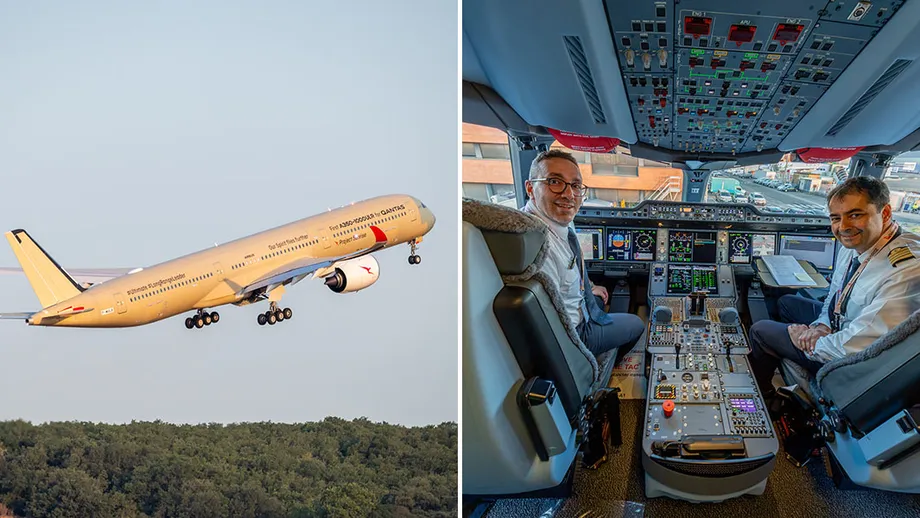
A day in the air, with 13 people aboard
An Airbus A350-1000ULR flew 23,155 kilometres without landing during a development flight from Melbourne to Toulouse, earning Guinness World Records recognition on 9 November 2026. The aircraft spent 24 hours and 24 minutes in the air, crossing the Pacific, North America and the Atlantic as Airbus tested the endurance needed for Qantas' planned nonstop services to London and New York.
Contents
- A day in the air, with 13 people aboard
- Why the aircraft flew through North America
- What Airbus needed to test
- An extra tank supplies the range
- How the pilots managed a full day aloft
- How the record was measured
- Millions watched the journey unfold
- What changes for Qantas passengers
- Delivery comes before the passenger launch
- Key Points
Operating under the call sign AIB35LR, the aircraft left Melbourne on 27 July and reached southern France the following morning. Its 13 occupants included Airbus test pilots and engineers, two Qantas pilots and a representative of the International Aeronautical Federation. They saw two sunsets and two sunrises during the journey.
Airbus operated the flight as part of Project Sunrise, the Qantas programme intended to connect Australia's east coast directly with destinations that have traditionally required a stop. The first aircraft is scheduled for delivery in April 2027, with Sydney to London services expected to begin in October and ticket sales planned for February.
Airbus' official record announcement gives the recognised distance as 12,503 nautical miles, equivalent to 23,155 kilometres. Aircraft data was independently validated by the International Aeronautical Federation and Flightradar24.
The record flight carried a small technical team. Qantas' passenger aircraft will have 238 seats across four cabin classes, with planned services lasting up to about 22 hours. The practical challenge now is turning that endurance into a regular operation in which passengers can eat, sleep and move comfortably while crews manage an exceptionally long working journey.
Why the aircraft flew through North America
Melbourne and Toulouse are about 16,888 kilometres apart by the shortest route around the Earth's surface. Airbus took a much longer path because the mission was designed to test endurance rather than reach France as quickly as possible.
AIB35LR first passed over Sydney, the planned starting point for Project Sunrise. It then headed northeast across the Pacific towards Los Angeles, crossed the United States and Canada, and continued over the North Atlantic, south of Greenland. The final part of the route passed over Britain before reaching Toulouse.
The flight also passed Rolls-Royce's Derby facility, where the aircraft's Trent XWB-97 engines are produced, and London Heathrow, the destination for the first planned Project Sunrise service. Its path therefore connected the future route's departure point, an important manufacturing location and its intended arrival airport.
Airbus test pilot Xavier Pepin, who captained the return flight, explained that the northerly Atlantic route helped avoid potential air traffic control complications involving airline tracks that might change before departure. The journey crossed 17 time zones and 19 Flight Information Regions, the areas within which designated authorities provide air traffic services.
What Airbus needed to test
Airbus classified the journey as a development flight test. Its purpose was to demonstrate a capability of 23 hours of block time and examine how the aircraft's systems performed over a very long mission.
Block time covers the complete period from leaving the departure stand to reaching the arrival stand, including taxiing. Airbus designed the test around Qantas' intended flight time of 21 hours and 40 minutes, with additional allowance for taxiing, holding and diversion. Holding means remaining airborne while waiting to land; diversion means flying to another airport when the planned destination cannot be used.
Airbus' development flight account identifies fuel management and cabin comfort as the main areas of testing. Engineers checked the additional fuel tank, air conditioning and temperatures in the crew rest areas. Long periods at stable settings allowed them to make accurate measurements.
Pepin, the Airbus test pilot commanding the return journey, described the fuel tank work:
So we filled this tank to validate all necessary parameters during the mission, making this, along with cabin comfort, the primary focus of our testing.
The outward flight from Toulouse to Melbourne had already lasted roughly 20 hours. Engineers used the return journey to complete remaining test points and provide another opportunity to check systems over an extended period.
An extra tank supplies the range
The A350-1000ULR uses two Rolls-Royce Trent XWB-97 engines and an additional rear centre fuel tank with a capacity of 20,900 litres. ULR stands for Ultra Long Range, identifying the version developed for these unusually lengthy routes.
Airbus says the tank increases range by 1,000 nautical miles, approximately 1,852 kilometres. It is integrated into the aircraft's structure and supplies the extra fuel needed for planned routes approaching 10,000 nautical miles.
Fuel capacity is only part of the engineering work. The fuel must move through the aircraft's systems correctly throughout the journey, while the cabin maintains suitable temperatures and the crew has somewhere to rest. Those requirements explain why the development programme measured both fuel management and cabin conditions.
Lars Wagner, chief executive officer of Airbus Commercial Aircraft, said the flight demonstrated the aircraft's capability:
Flying 12,503 nautical miles non-stop, we have fully proven the aircraft's capability to fulfill its mission.
Wagner also credited Qantas, Rolls-Royce and other partners for their contributions. Qantas has ordered 12 A350-1000ULRs for Project Sunrise and another 12 standard A350-1000s for its wider international network.
How the pilots managed a full day aloft
Five pilots were aboard the Melbourne to Toulouse flight: Airbus test pilots Xavier Pepin, Vincent Sibelle and Josef Bayoud, alongside Qantas captains Andrew Coull and David Summergreene. Five Airbus flight test engineers, two Airbus design engineers and International Aeronautical Federation representative Gilles Darriau completed the group of 13.
Airbus arranged four hour shifts for each pilot, with a crew change every two hours. The staggered pattern meant a pilot entering the cockpit overlapped with another who was already following the flight. That gave the incoming pilot time to understand the aircraft's condition, route and current tasks.
At least one Airbus test pilot remained in a pilot seat whenever a Qantas pilot occupied the other seat. Airbus held responsibility for the operation, while the Qantas pilots, already qualified to fly the A350, gained their first experience of the ULR version.
The aircraft's new flight crew rest module has two separate sections with individual entrances, allowing pilots to enter or leave without disturbing someone resting nearby. During this test, ventilation measurement equipment occupied those spaces. The crew instead slept in the cabin crew rest compartment at the rear, which has eight berths.
How the record was measured
Guinness recognition followed validation of the aircraft's flight data by the International Aeronautical Federation and Flightradar24. The tracking work used ADS-B data, the position and other information that aircraft broadcast and tracking networks receive.
Airbus' November announcement gives the final record distance as 12,503 nautical miles. Its earlier development account recorded 12,460 nautical miles, approximately 23,076 kilometres. The recognised figure is about 79 kilometres longer than that earlier measurement.
The July flight exceeded the 21,601.7 kilometres flown by a Boeing 777-200LR from Hong Kong to London in 2005. Using Airbus' recognised figure, the A350 travelled about 1,553 kilometres farther, an increase of roughly 7.2%. The Boeing flight lasted 22 hours and 42 minutes.
The A350 achievement is a record for distance flown by a commercial airliner. Scheduled passenger services form a different comparison: Singapore Airlines' Singapore to New York route, lasting more than 18 hours, is identified as the current longest passenger service. Qantas expects Project Sunrise to extend the duration of regular nonstop passenger travel further.
Distance also helps explain the unusual route. The recognised 23,155 kilometres is about 6,267 kilometres longer than the shortest distance between Melbourne and Toulouse. Airbus used that additional flying to demonstrate the aircraft's endurance across an entire day.
Millions watched the journey unfold
AIB35LR attracted 3,652,947 follows on Flightradar24, making it the platform's second most tracked flight at the time, behind the final flight carrying Queen Elizabeth II. The figure measures follows recorded by the service.
People watching could trace a journey that crossed three continents and two oceans. Tracking figures recorded a maximum altitude of 41,000 feet and a maximum ground speed of 662 knots. Ground speed is the aircraft's speed relative to the Earth's surface, which changes with winds as well as the aircraft's own movement through the air.
The development aircraft, identified as MSN707, had first flown on 2 June 2026. Its trip to Australia and back became a public demonstration of the programme's progress, while engineers aboard used instruments to assess performance.
The main dates show how the test campaign connects with the planned passenger launch:
- 2 June 2026: Development aircraft MSN707 made its first flight.
- 23 July 2026: The aircraft departed Toulouse for the outward development flight to Melbourne.
- 27 July 2026: AIB35LR left Melbourne at 17:27 local time, or 07:27 UTC.
- 28 July 2026: The aircraft reached Toulouse at 09:51 local time, or 07:51 UTC, after 24 hours and 24 minutes.
- 9 November 2026: Airbus announced Guinness World Records recognition.
- February 2027: Ticket sales for the planned nonstop Sydney to London service are scheduled to begin.
- April 2027: Qantas expects its first A350-1000ULR delivery.
- October 2027: Nonstop Sydney to London passenger services are expected to start.
What changes for Qantas passengers
Qantas plans to begin with Sydney to London, expected to operate daily under flight numbers QF1 and QF2. Sydney to New York is the second planned destination. A firm launch date for the New York service has not been given.
Sydney to London is expected to take around 19 to 21 hours depending on winds and routing, while Airbus describes Project Sunrise missions as lasting up to 22 hours. For passengers, the central change is completing the journey without leaving the aircraft at an intermediate airport.
The aircraft will carry 238 passengers across four cabin classes, fewer than a typical A350-1000 configuration. Qantas is using the additional cabin space to support comfort during journeys that can occupy most of a day.
Planned features include LED lighting designed around the body's circadian rhythm, the internal clock that helps regulate sleeping and waking. Meal planning will also form part of the onboard experience. A Wellbeing Zone will provide space for passengers to stretch and get refreshments, giving them somewhere to move beyond their seats.
The test programme's attention to cabin temperature and crew rest connects directly with that passenger experience. A flight lasting about 20 hours requires the aircraft to remain comfortable through several meals, periods of sleep and changing conditions outside.
Delivery comes before the passenger launch
Qantas' next major aircraft milestone is the first scheduled delivery in April 2027. The planned October start for Sydney to London leaves several months between receiving the first aircraft and beginning the route.
Airbus describes the ULR as the fourth passenger version in the A350 family, alongside the A350-900, A350-900ULR and standard A350-1000. At the end of October 2026, the family had accumulated 1,628 orders from 70 customers, with more than 740 aircraft in service at 42 operators.
Project Sunrise adds a specialised mission to that established aircraft family. The Melbourne to Toulouse journey demonstrated endurance over 23,155 kilometres; the next stage is preparing the aircraft and airline operation for repeated journeys carrying 238 passengers between Australia's east coast and London.
Key Points
- Airbus flew an A350-1000ULR from Melbourne to Toulouse over 23,155 kilometres in 24 hours and 24 minutes.
- Guinness World Records recognition was announced on 9 November 2026 after independent flight data validation.
- The development flight carried 13 people and tested fuel management, cabin conditions and extended operation.
- A rear centre tank holds 20,900 litres and adds approximately 1,852 kilometres of range.
- Qantas has ordered 12 ULR aircraft, with the first delivery scheduled for April 2027.
- Sydney to London flights are expected to begin in October 2027, with ticket sales planned for February.
- The passenger configuration will have 238 seats, four cabin classes and a Wellbeing Zone.