A new route between two mountain lakes
Kazakhstan plans to build a cable car stretching 6.3 kilometers between Lower and Middle Kolsai Lakes in Almaty region, with an investment of 15 billion tenge and 90 new jobs. The proposed line would introduce a new way to travel between lakes that visitors currently reach on foot or horseback.
Contents
- A new route between two mountain lakes
- What the cable car would change
- Where the project stands
- Who would build and equip it?
- Visitor numbers explain the push for access
- Saty parking brings a separate public investment
- Environmental assurances meet a larger visitor flow
- Road and border traffic add to the regional picture
- Key Points
Kegen district governor Tanat Aidarbekov said Stroy Industriya LLP would develop the project and that documents were being prepared for state expert review. The route would have two sections, measuring 3.5 kilometers and 2.8 kilometers, with locations already selected for 43 support towers.
The target is to complete the cable car by the end of 2027. Its preparation comes alongside other changes around the national park, including a publicly funded parking area in Saty village and a road to Kaindy Lake that entered service in summer 2026.
The scale of demand is already substantial. Aidarbekov put visits to Kolsai Lakes National Park at 497,341 during 2026 up to the time of his briefing. About 600,000 people visited during the whole of 2025, including 128,000 international tourists.
What the cable car would change
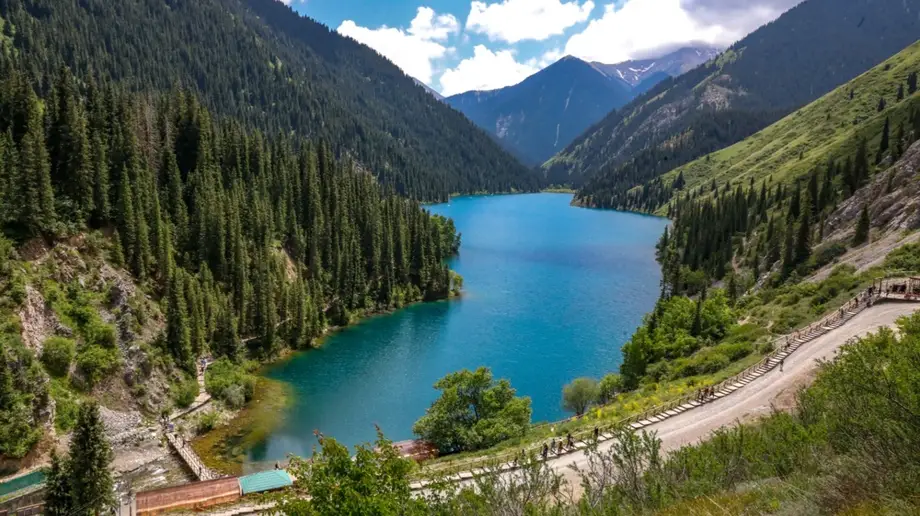
Kolsai is a system of three mountain lakes in the northern Tian Shan, roughly 300 kilometers from Almaty and close to the Kyrgyz border. The lakes lie at elevations ranging from about 1,800 to 2,700 meters above sea level. The planned cable car would connect the lower and middle lakes.
Visitors now make that journey by walking or riding horses. A cable car would give people another transport option, including those for whom a mountain walk or horse ride is difficult. It would also change how visitors arrive at the middle lake, concentrating arrivals around a station instead of relying entirely on the existing trail.
Local authorities describe the first section as running approximately 3.5 kilometers toward the Batan valley. The second would continue for 2.8 kilometers toward Middle Kolsai. Together, those sections account for the full announced length.
The planned cabins would seat eight people, and the system would have a capacity of up to 1,500 passengers an hour. That figure describes how many people the equipment could transport under its planned operating conditions. Actual daily use would depend on demand and the service's operating schedule.
Where the project stands
Aidarbekov's account places the cable car at the documentation stage ahead of state expert review. Such a review examines a project's technical and cost documentation before it proceeds through the required approval process. Selecting tower locations is one part of preparing that design.
The construction plan calls for work to begin in 2026 and finish by the end of 2027. The precise construction start date, passenger opening date, ticket prices and final financing arrangements have not been announced. The Development Bank of Kazakhstan is being considered as a possible lender, with the application at the document collection stage.
The sequence of announced milestones shows how the project fits into wider access improvements:
- May 2025: The developer and the proposed Chinese equipment supplier signed a cooperation agreement in Hangzhou.
- 2025: Kolsai Lakes National Park received approximately 600,000 visitors.
- Summer 2026: The district road leading to Kaindy Lake entered service.
- 2026: Construction of the cable car was planned to begin, while project documents were being prepared for state expert review.
- End of 2027: The announced target for completing the cable car.
The review and financing processes are central to turning the announced route into a working transport service. For visitors planning a trip, the practical point is that the cable car remains a project under preparation, while walking and horseback travel remain the existing ways to move between the two lakes.
Who would build and equip it?
Stroy Industriya, also identified as Company Stroy Industriya, has operated in construction since 2005. Its founder is Samat Akhman, who also owns several other construction companies. The business holds Category I licenses for construction and design work and has participated in housing, public facilities and infrastructure projects.
The company's activities extend beyond construction to the manufacture of bricks and other products made from fired clay. In 2025, it began work on a multistory residential building with commercial premises in Qonaev.
By June 2026, the company had 255 public procurement contracts with a combined value of approximately 105.13 billion tenge, excluding value added tax. Of those, 204 were contracts with government bodies. Those figures describe its contracting record, while the proposed Kolsai investment is 15 billion tenge.
The proposed equipment supplier is China's Hanzhong Daqin Machinery Co., Ltd., a company specializing in cable car design, production and maintenance. The parties signed their cooperation agreement in Hangzhou in May 2025. The equipment arrangement and possible bank lending are separate parts of the same project: one concerns the machinery, while the other concerns how construction could be paid for.
Visitor numbers explain the push for access
Kolsai Lakes National Park received more than 400,000 visitors in 2024 and approximately 600,000 in 2025. Local authorities have described annual growth in tourist traffic as around 40 to 45 percent. The rounded annual totals show the size of the increase, although they do not allow an exact growth calculation.
The 128,000 international visitors recorded in 2025 represented about 21 percent of the park's approximately 600,000 visitors, or roughly one in five. That leaves about 472,000 domestic visitors, using the same rounded total. Kazakhstan's own travelers therefore accounted for most visits.
The largest groups of international visitors came from India, Japan, China, South Korea, Malaysia, Türkiye, France, the United Kingdom and Russia. The range spans nearby countries, other parts of Asia and Europe, giving the park a tourism market that reaches well beyond Almaty region.
Aidarbekov's 2026 count of 497,341 visits had already reached roughly 83 percent of the full 2025 total of about 600,000. Because the 2026 figure covers only the period before his briefing, the two figures measure different lengths of time. The completed annual count will provide the direct comparison.
Saty parking brings a separate public investment
Saty village has received a new parking facility intended to serve visitors to both Kolsai and Kaindy Lakes. The site covers 1.5 hectares, equivalent to 15,000 square meters, and cost 394.3 million tenge from the state budget.
Aidarbekov said the completed facility was expected to be transferred to private management for three years. Under that arrangement, a private operator would manage the facility built with public funds. The proposed management period is three years, rather than a permanent transfer of the site.
The cable car route has been described as starting from a large parking area designed for more than 500 vehicles. Earlier project details placed that parking area near completion; Aidarbekov's subsequent briefing described the Saty facility as built.
The 394.3 million tenge parking expenditure is separate from the announced 15 billion tenge cable car investment. Keeping the two amounts distinct helps explain the development: public money has funded an access facility, while a company is preparing the much larger transport project and exploring bank financing.
Environmental assurances meet a larger visitor flow
Saty rural district head Nurym Sagymzhan has said the cable car project would cause no environmental harm and require no tree cutting. He also said Chinese technology would be used in construction. Those assurances concern a route through a national park where the landscape itself is the main attraction.
The planned 43 support towers make the route's physical footprint a concrete part of the project. Even with cabins carrying passengers above the ground, construction still involves tower sites and the facilities where travelers board and leave the system. The placement of those structures is therefore an important part of the design submitted for review.
The proposed capacity of up to 1,500 passengers an hour also gives a sense of the visitor flow that stations and nearby facilities would need to handle. Transporting people between lakes is one task; accommodating them when they arrive is another. The Saty parking project addresses vehicle access at the village, while the cable car would move passengers farther into the lake area.
The promise of no tree cutting is particularly relevant to the selected tower locations. As the project moves through review, its design will determine how that commitment is carried into construction. For the park, the central practical challenge is to provide easier access while caring for the setting that brings visitors there.
Road and border traffic add to the regional picture
The district road to Kaindy Lake entered service in summer 2026, adding another completed access improvement near Saty. Kaindy and Kolsai are separate destinations served by the village's new parking facility, so the changes affect a wider tourism area than the proposed cable car route alone.
The Kegen border checkpoint also handled 164,800 people crossing into Kyrgyzstan from the start of 2026 to the time of Aidarbekov's briefing. That is a count of border crossings, separate from the national park's visitor count. It shows the district's role as both a destination and a route into a neighboring country.
For local residents and businesses, the announced package has several concrete elements: 90 projected cable car jobs, a parking operation intended for private management, a completed road to Kaindy and a proposed new connection between two Kolsai lakes. Their delivery is at different stages, with the road and parking completed and the cable car still moving through project preparation.
Key Points
- A proposed cable car would connect Lower and Middle Kolsai Lakes over 6.3 kilometers.
- The announced investment is 15 billion tenge, with 90 jobs projected.
- The design includes two sections, 43 support towers and cabins seating eight people.
- Project documents are being prepared for state expert review, with completion targeted for the end of 2027.
- Kolsai Lakes National Park received about 600,000 visitors in 2025, including 128,000 from abroad.
- Saty's completed parking facility cost 394.3 million tenge in public funds and is intended for private management for three years.
- Local officials say the cable car would require no tree cutting; possible bank financing remains at the application preparation stage.