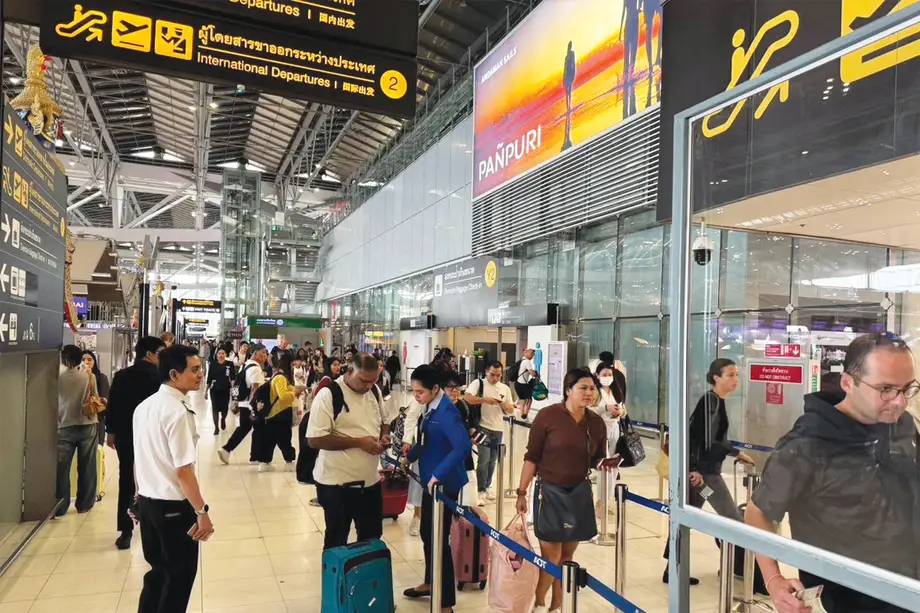
A proposed departure charge faces widening opposition
Thailand's proposed 1,000-baht tax on passengers leaving the country by air has drawn opposition from travel agents, hotels and airlines, with tourism businesses warning of annual revenue losses of 50 billion to 150 billion baht. The draft would cover travelers of every nationality, set a legal ceiling of 5,000 baht per departure and initially exempt journeys by land and water.
Contents
- A proposed departure charge faces widening opposition
- Who would pay, and who would be exempt?
- How foreign visitors could face 2,570 baht in charges
- Families, students and frequent travelers would share the cost
- Why airlines see a risk to flights in both directions
- The revenue forecasts need a clearer calculation
- What the demand estimates suggest
- The proposal has changed since April
- Ministers face questions over how the money would be used
- What happens after the consultation?
- Key Points
The Revenue Department's public consultation notice sets the comment period at September 30 to October 29, 2026. Its central change is the inclusion of all nationalities, expanding beyond the Thai citizens and foreign permanent residents covered by the existing 1983 departure tax decree.
The Tourism Council of Thailand, Thai Hotel Association and Association of Thai Travel Agents want the Finance Ministry to reconsider or halt the proposal, or first publish an assessment of its effects on travelers, airlines, hotels, employment and government revenue.
The Finance Ministry says the money could support tourism sites and domestic tourism projects, provide another source of public revenue and help reduce the budget deficit. Tourism and Sports Minister Surasak Phancharoenworakul has questioned whether the charge would overlap with a separate proposed tourism fee.
For travelers, the immediate point is that the 1,000-baht charge remains a proposal. The consultation deadline is the next firm date, while implementation would depend on the legislative process and a further waiting period written into the draft. The ministry says economic conditions will inform its decision on whether to proceed.
Who would pay, and who would be exempt?
The draft would require payment each time a traveler leaves Thailand, with the initial charge for air travel set at 1,000 baht. A Thai resident flying abroad and a foreign tourist flying home would therefore face the same starting rate, unless they qualify for an exemption.
The 5,000-baht figure is the proposed maximum allowed by law. Rates would be set through ministerial regulations, beginning at 1,000 baht for air departures. Travelers leaving by road or water would initially be exempt.
Air travel exemptions would follow the rules used for the Passenger Service Charge, the airport fee commonly included in a ticket price. They include children aged two or younger, qualifying transit passengers, specified royal and official guests, and passengers traveling on aircraft used for Thai or foreign government missions.
Transit exemptions have conditions. International passengers remaining within the transit area would qualify, along with specified passengers staying inside an airport to change aircraft. The draft also excludes certain transport employees traveling as part of their duties without paying a fare.
Airlines or ticket agents would collect the tax alongside the fare. Travelers whose journeys involve no ticket, or whose fares are not paid through those businesses, would pay under procedures set by the Revenue Department director-general.
How foreign visitors could face 2,570 baht in charges
Travel associations calculate that a foreign visitor could face combined charges of 2,570 baht if the departure tax and a separate tourism fee both take effect. Their calculation brings together three items:
- A proposed departure tax of 1,000 baht.
- A Passenger Service Charge of 1,120 baht at Airports of Thailand airports.
- A proposed tourism fee of 450 baht for foreign arrivals, targeted for 2027.
The airport charge rose from 730 baht to 1,120 baht on June 20, an increase of 390 baht. The domestic passenger charge remained at 130 baht. The two proposed levies would add another 1,450 baht to the charges associated with an international visit.
Naresuan University researchers put the combined 2,570 baht at 5.14% of average tourist spending of 50,000 baht per trip. That comparison shows why businesses are considering the charges together: visitors have one travel budget, even when different agencies collect the money for different purposes.
Families, students and frequent travelers would share the cost
The Association of Thai Travel Agents, known as Atta, petitioned Finance Minister Ekniti Nitithanprapas on October 8, asking for the draft to be delayed and assessed alongside other travel charges. The association said international journeys also serve education, employment, trade and investment.
A fixed charge takes a larger share of a cheap trip than an expensive one. At the proposed starting rate, four travelers who all qualify to pay would owe 4,000 baht for one departure each. A person taking several overseas business trips would pay the charge on every qualifying departure.
Atta honorary secretary-general Adith Chiranattananon said households and small businesses were also dealing with repairs, replacement vehicles and equipment, and interrupted income after flooding. He urged the government to consider their ability to pay:
"Any increase in tax should take the recovery period into account, and not be based on an assumption that all travelers possess high purchasing power," he said.
The association projects 13.1 million outbound Thai travelers in 2026. Its concerns extend to businesses selling those journeys, including travel agencies, ticket sellers and companies arranging meetings, conferences, exhibitions and incentive trips for employees or customers.
The Tourism Council of Thailand warns that higher prices could prompt people to postpone journeys, travel less often or choose another destination. Hotels and inbound agents fear that foreign visitors facing larger fixed charges could spend less on accommodation, meals, excursions and other services.
Why airlines see a risk to flights in both directions
The Tourism Council of Thailand says weaker demand could reduce airline passenger numbers and load factors. A load factor is the share of available seats occupied by passengers. When too many seats remain empty, an airline has less reason to maintain a flight or launch another route.
Thai Travel Agents Association vice-president Chotechuang Soorungara raised the connection between outbound and inbound travel when opposing an earlier version of the plan in April:
"If imposed, this levy will clearly affect outbound travel, which in turn could hurt inbound arrivals as air traffic relies on two-way demand to survive and sustain capacity," Mr Chotechuang said.
Airlines need customers traveling in both directions. Fewer Thai passengers flying abroad can affect the same services that bring foreign visitors into Thailand. Reduced frequency would leave travelers with fewer departure times and connections, while postponed routes would limit access to new markets.
Tassapon Bijleveld, executive chairman of Asia Aviation, which operates Thai AirAsia, says the Association of Thai Airlines and its seven members oppose the tax. He warned that additional costs could weaken Thailand's position against competing destinations, including Vietnam, and suggested raising value-added tax instead if the government needs more revenue.
The revenue forecasts need a clearer calculation
Adith puts possible annual tourism revenue losses at 50 billion to 150 billion baht, compared with an estimated 45.9 billion baht in departure tax receipts. At the lower end, the forecast loss exceeds the projected collection by 4.1 billion baht.
His spending calculation is straightforward: losing one million visitors who would each spend an average of 50,000 baht would mean 50 billion baht less in tourism revenue. Under the same assumption, a loss of three million visitors would amount to 150 billion baht.
The tax collection estimate needs more explanation. The figures cited alongside the 45.9-billion-baht forecast are 9.32 million foreign tourists and about 13 million outbound Thai travelers in 2025. Together, those total 22.32 million travelers. Charging each once at 1,000 baht produces 22.32 billion baht, leaving a gap that requires clarification in a published revenue model.
The government receipts and tourism spending figures also describe different flows of money. The departure tax would go to the state, while visitor spending pays hotels, restaurants, shops, transport businesses and their workers. Atta wants the assessment to examine both, along with employment, investment and changes in other tax receipts.
Adith explained why the association wants a wider calculation:
"Revenue from tax collection alone should not serve as the sole proof of cost effectiveness," Mr Adith said.
What the demand estimates suggest
Adith cites a study published in the Journal of Travel Research in 2023 that estimated a 4.5% decline in tourist demand for every 10% increase in taxes related to tourism activities. He says Naresuan University researchers used those research measures when examining the possible effects of Thailand's proposed charges.
For China, India and Malaysia, three major source markets, the association estimates that a 5% reduction could mean about 446,000 fewer arrivals. A 10% reduction could mean about 891,000 fewer arrivals. These are scenarios used to assess the proposal, with the eventual response depending on travel prices and decisions.
Adith also pointed to the Maldives, where the introduction of a Tourism Goods and Services Tax in 2010 was followed by fewer arrivals from major markets including China, India, the United Kingdom and Russia. He used that experience to argue for examining how visitors respond when destinations become more expensive.
For Thailand, the concrete concern is how much spending businesses could lose if travelers cut a trip, shorten a stay or reduce purchases. The hotel and travel associations want those effects measured before the government settles the tax's rate and scope.
The proposal has changed since April
The current draft is broader than the version discussed earlier in 2026. In April, Surasak described a plan to revive the 1983 Emergency Decree on the Departure Levy for Thai travelers. Using an estimate of 10 million outbound passengers, he put possible annual receipts at about 10 billion baht.
The Revenue Department's current notice explicitly proposes taxation of every nationality. The older decree covered Thai nationals and foreign nationals permitted to reside in Thailand. Its original purpose was to limit foreign currency leaving the country and protect the balance of payments, the record of money moving into and out of Thailand.
The main stages are:
- December 28, 1983: The earlier departure tax took effect, with rates of 1,000 baht by air and 500 baht by land or water.
- May 1, 1986: Departures by land and water became exempt.
- July 1, 1991: Air departures became exempt.
- April 2026: Tourism businesses opposed a revival focused on Thai travelers.
- September 30 to October 29, 2026: The Revenue Department scheduled consultation on a new law covering all nationalities.
- October 8, 2026: Atta submitted its petition to the finance minister.
The Revenue Department gives September 30 as the consultation's opening date; an October 9 description of the hearing gave September 29. Both give October 29 as the deadline. The department invites comments from travelers, international transport operators, ticket agents, airport operators, public agencies, private organizations and the public.
Ministers face questions over how the money would be used
The Finance Ministry presents the departure tax as a way to support tourism development and domestic travel while easing pressure on the national budget. Surasak says the rules for distributing the proceeds remain unclear, particularly when foreign visitors would also be paying.
The tourism minister is concerned about overlap with the proposed 450-baht arrival fee. That separate measure has stated purposes including tourist insurance and tourism development. Earlier discussions in April referred to a 300-baht foreign arrival fee; the later proposal uses 450 baht and targets collection in 2027.
Collection has also been a practical concern. Earlier attempts to collect a fee applying only to foreign visitors through airlines prompted objections about airline systems and possible discrimination under International Civil Aviation Organization rules. The current departure draft instead covers all nationalities, while requiring carriers and agents to collect the money.
Tourism groups have proposed alternatives. Thai Travel Agents Association vice-president Kriengphong Piayekchai suggested bringing unlicensed accommodation and other informal operators into the tax system. The association also supported domestic travel tax deductions requiring limited public funding. These ideas would raise revenue or encourage spending through different channels from a departure charge.
What happens after the consultation?
The draft provides for the law to take effect 180 days after publication in the Royal Gazette. It would also exempt travelers who bought their tickets before the effective date, even if their departure takes place afterward. No implementation date has been announced, and the final collection arrangements and allocation of revenue remain undecided.
The proposed enforcement provisions include a penalty equal to twice the tax owed and a surcharge of 1.5% for each month or part of a month. Officials would have powers to assess and collect unpaid tax and examine relevant records. Airlines and agents would therefore need procedures for collecting and passing on the charge.
Surasak considers introduction unlikely in the near term, pointing to the long effort to establish the separate arrival fee. Tourism operators plan further discussions with the finance minister, possibly after the 2026 IMF-World Bank Annual Meetings in Bangkok.
The industry is asking for a cumulative assessment before the draft advances: how the departure tax, airport charge and proposed arrival fee would together affect travel decisions, airline capacity, hotel income and public finances. The government's next decision is whether the expected revenue justifies proceeding under current economic conditions.
Key Points
- The proposed departure tax would initially charge qualifying air passengers of every nationality 1,000 baht per trip.
- The draft sets a 5,000-baht ceiling and initially exempts land and water departures.
- Foreign visitors could face combined airport charges and proposed taxes of 2,570 baht.
- Travel agents, hotels and airlines oppose the measure and want a broader economic assessment.
- Tourism businesses forecast annual spending losses of 50 billion to 150 billion baht; the cited 45.9-billion-baht tax revenue estimate needs a clearer calculation.
- The Revenue Department's consultation closes on October 29, 2026. No implementation date has been set.