Air arrivals would pay first under revised tourism plan
Thailand is advancing a proposed 450 baht fee for eligible foreign tourists arriving by air, with the Ministry of Tourism and Sports expecting at least about 8 billion baht a year to remain for tourism projects after collection and insurance costs. The money would go into the Tourism Promotion Fund, with part used to buy insurance for visitors and the rest supporting destinations, natural resources and communities.
Contents
- Air arrivals would pay first under revised tourism plan
- Who would pay, and who could be exempt?
- How the proposal reached this stage
- Why unpaid hospital bills are central to the plan
- What insurance would visitors receive?
- How much money could the fee generate?
- Collection remains a practical challenge
- A new charge as arrival targets fall
- Who would watch how the fund is spent?
- Key Points
The proposal follows a public consultation involving 5,954 participants and a government, business and civil society meeting on October 6, 2026. In its October 6 statement, the ministry said 80.50% of consultation participants supported the draft and 78.30% supported the proposed charge.
Collection would begin with air arrivals, while implementation at land and sea borders would be deferred for about a year. The ministry expects collection to begin during 2027, with the first quarter identified as a target. The revised proposal still needs consideration by the National Tourism Policy Committee and Cabinet, and no confirmed collection date has been announced.
The government presents the fee as a way for visitors to contribute directly to the services and places they use. Public hospitals would receive a more reliable route to payment for covered treatment, while tourism authorities would gain funding outside their annual government allocation.
For travellers, the practical change would be an additional payment linked to insurance protection. For Thailand, the harder task is designing a system that collects the money without creating queues, pays hospitals efficiently and shows the public where the remaining funds go.
Who would pay, and who could be exempt?
The proposed charge applies to eligible foreign visitors entering temporarily for tourism or another purpose that does not generate income or compensation. The ministry says Thai nationals would not be charged.
The draft describes exemptions for royal and official government guests, holders of diplomatic and official passports, foreigners with work permits, border pass holders, passengers in transit, crew members and children younger than two. Authorities are also discussing arrangements for border traders and people who cross frequently.
A visitor who pays could make multiple entries within 30 days without paying again, provided the insurance linked to the payment remains valid. That provision matters for someone who visits a neighbouring country during a holiday and then returns to Thailand.
The draft ultimately envisages the same 450 baht rate across air, land and sea arrivals. The staged introduction gives border authorities more preparation time, particularly at busy crossings used by travellers from Malaysia. Consultation participants expressed disagreement over charging the same amount across all three arrival modes.
How the proposal reached this stage
Thailand has discussed a tourism charge for several years. An earlier framework proposed 300 baht for air arrivals and 150 baht for entry by land or sea. The current 450 baht air charge is 150 baht, or 50%, higher than that earlier air proposal.
Tourism and Sports Permanent Secretary Natthriya Thaweewong said a more recent study considered inflation, economic conditions and associated costs, arriving at an underlying rate above 490 baht. The proposed amount was reduced to 450 baht to limit the burden on visitors.
The main steps described by authorities are:
- February 14, 2023: Cabinet approved an earlier fee announcement, but implementation was delayed amid the effects of COVID-19 and economic conditions.
- August 24 to September 28, 2026: The revised draft underwent online public consultation.
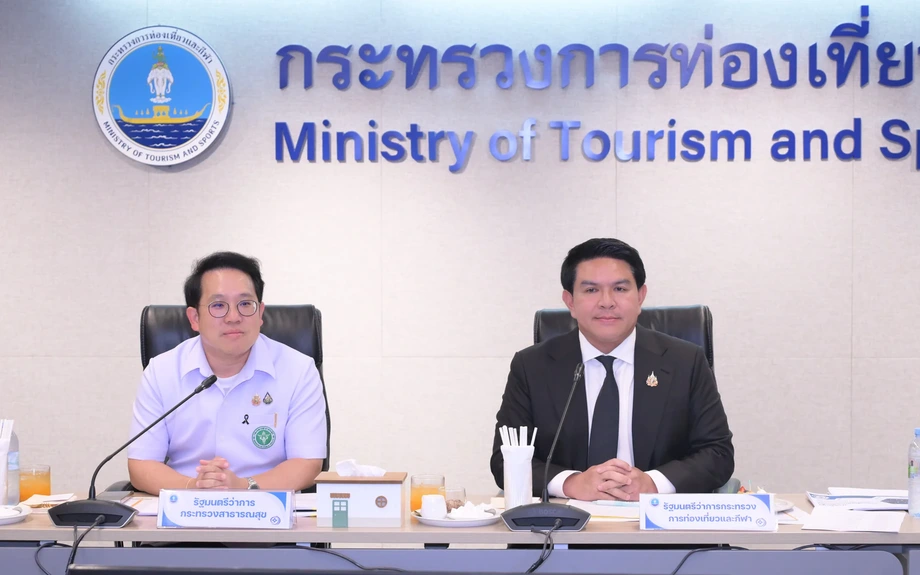
- October 6, 2026: Tourism Minister Surasak Phancharoenworakul chaired discussions with government, business and civil society representatives. Public Health Minister Pattana Promphat also attended.
- 2027: The ministry aims to begin collection, initially for eligible air arrivals, after the remaining approval and preparation steps.
Natthriya described an implementation timetable under which air collection would begin 180 days after the relevant announcement appears in the Royal Gazette, Thailand's official publication for government notices. Land and sea collection would follow around 360 days later. The timetable makes publication an essential step between political approval and payments beginning.
Why unpaid hospital bills are central to the plan
The Ministry of Public Health's figures show why insurance has become a major part of the proposal. In 2024, 32 large public and provincial hospitals recorded about 1.12 million treatment visits by foreign patients. They billed approximately 16.957 billion baht and collected about 9.935 billion baht.
The ministry put the unpaid balance at roughly 7.021 billion baht, or 41% of the amount billed. Another estimate cited in the policy debate places unpaid bills attributable to foreign visitors at around 2.5 billion baht a year; the hospital survey covers foreign patients across several groups, while the proposed insurance would cover tourists who pay the fee.
Pattana supports using the tourism fund to purchase insurance. Hospitals face several practical problems when seeking payment: patients may have to advance money, insurance information can be difficult to obtain, and policies may cover only part of a bill.
The health ministry has proposed a system for checking insurance policies and treatment entitlements, alongside a common process for hospitals to claim payment from insurers. In everyday terms, a hospital needs to know whether a patient is covered, which treatment the policy pays for and how to submit the bill.
The link between the fee and hospital finances therefore depends on administration as well as insurance purchases. A policy that hospital staff can check and claim against quickly would make the protection more useful to both patients and healthcare providers.
What insurance would visitors receive?
The ministry says the fee would finance protection covering death and medical expenses, subject to the insurance policy's conditions. Officials are considering broader coverage and want hospitals to be able to verify eligibility and receive payments in practice.
Private sector participants have asked for clear explanations of benefits and conditions. Their concern is especially relevant for travellers who already buy travel insurance: business representatives estimated that more than 80% of tourists, particularly those from Europe and America, already have such protection.
Authorities are also considering additional insurance requirements for activities such as diving and hiking, and liability coverage for rented vehicles. Liability insurance pays for injury or damage caused to other people, rather than simply covering the person who rents the vehicle.
The practical details still requiring decisions include coverage limits, exclusions, the insurance provider, payment arrangements and final exemptions. Those decisions will determine how much protection a traveller receives in exchange for the fee and how much money remains for tourism projects.
How much money could the fee generate?
The ministry's main estimate is that at least about 8 billion baht a year could remain for tourism development after collection expenses and insurance premiums. That is the amount officials expect to have available for destinations, conservation, restoration and tourism promotion.
Planning calculations also suggest annual receipts above 12 billion baht from air arrivals alone, based on a forecast of approximately 35.4 million foreign arrivals in 2027 and an air share above 80%. Once land and sea arrivals are included, projected annual receipts could reach around 15 billion baht.
These figures measure different stages of the money flow. Gross receipts are all the fees collected. The amount available for tourism projects comes after paying the costs of collection and buying insurance.
A study calculation put potential fee receipts at 15.897 billion baht and estimated that the charge could reduce arrivals by about 70,000, cutting visitor spending by 3.32 billion baht. Subtracting that estimated spending loss produced a calculated economic benefit of 12.577 billion baht. That calculation compares fee income with a possible loss of tourism spending, while the ministry's 8 billion baht estimate concerns money remaining after operating and insurance costs.
Revenue would enter the Tourism Promotion Fund rather than the general state budget. Proposed uses include restoring attractions and natural resources, developing visitor experiences, supporting communities, research and training people working in tourism.
Collection remains a practical challenge
Airline tickets, a dedicated payment website, mobile applications, airport kiosks and a payment step associated with the Thai Digital Arrival Card are among the options under discussion. The arrival card is the electronic form foreign visitors submit as part of entering Thailand.
Ticket collection attracted support from 36.26% of consultation participants. Supporters see it as a way to complete payment before arrival and avoid extra steps at immigration. Airlines helping collect the fee could receive a processing payment.
Airlines have raised difficulties with charging foreign passengers while excluding Thai passengers. One option discussed was collecting from everyone and allowing Thai nationals to request refunds through an application. The ministry's stated policy is that Thai nationals would bear no fee, so the payment design must accommodate that exemption.
Web payments and kiosks could give travellers alternatives, including those who cannot easily use a mobile application. Authorities still need to coordinate with airlines, immigration officials and other agencies on the collection method.
A new charge as arrival targets fall
Thailand recorded 26,100,738 foreign arrivals from January 1 to November 7, 2026, generating more than 1.272 trillion baht in tourism revenue. The full year arrival target was reduced from 33 million to 31.5 million because of expensive air tickets and competition from other destinations.
The reduction amounts to 1.5 million visitors, or about 4.5% of the earlier target. Against that weaker outlook, tourism businesses want the charge set and collected in a way that causes minimal disruption to travel decisions.
The proposed 450 baht charge would total 1,800 baht for a family of four if every member were eligible to pay. For a person making several short trips, the proposed 30 day multiple entry arrangement could reduce repeated payments.
Weerasak Kowsurat, a former tourism minister who advises Deputy Prime Minister Suphajee Suthumpun and chairs a working group on creative economy and visitor economy development, has acknowledged that some travellers sensitive to price could choose another destination. He argues that investment in better destinations would help sustain demand.
The tourism ministry says more than 80 countries collect tourism taxes or fees in various forms, citing places including Japan, Australia and New Zealand, as well as Bali. Thailand's proposed approach would collect a visitor contribution and divide it between insurance and tourism investment.
Who would watch how the fund is spent?
Weerasak has called for an Open Government approach to overseeing the fund, with stakeholders able to observe spending and budget decisions. His suggestions include an additional oversight body and cameras allowing the public to watch fund management meetings.
Tourism operators and foreign chambers of commerce could participate as observers. Private sector representatives have also requested disclosure of receipts, disbursements, insurance costs and the results of destination projects.
Weerasak described the need for broad participation while discussing the consultation process:
We need to listen to as many perspectives as possible in order to implement the foreign tourism fee efficiently,
The ministry says it will combine the online responses with proposals from the October meeting before submitting the draft to the National Tourism Policy Committee and then Cabinet. It will also continue discussions on insurance, exemptions, collection and fund spending.
Public disclosure would let visitors and residents track the proposed exchange: tourists contribute money, insurers provide defined protection, and the fund pays for improvements to places and services. Publishing both financial records and project results would make it possible to follow that money beyond the point of collection.
Key Points
- Thailand proposes a 450 baht fee for eligible foreign tourists, starting with air arrivals.
- The ministry targets collection during 2027, subject to approvals and implementation arrangements.
- Land and sea collection would be deferred for about a year.
- The fee would finance visitor insurance and tourism development through the Tourism Promotion Fund.
- Officials expect at least about 8 billion baht annually for tourism projects after collection and insurance costs.
- Among 5,954 consultation participants, 80.50% supported the draft and 78.30% supported the rate.
- Final decisions are still needed on payment methods, insurance terms, exemptions and oversight.