Generation will meet only seven tenths of demand
Myanmar expects to generate just 3,540 megawatts against forecast electricity demand of 5,010 megawatts in summer 2027, leaving a shortfall of 1,470 megawatts and extending rotating blackouts across the country. Deputy Energy Minister Aye Kyaw gave the figures to the military authorities' parliament on Wednesday, warning that new generation projects would take years to deliver.
Contents
- Generation will meet only seven tenths of demand
- Why power stations cannot deliver their full capacity
- Gas shortages meet an export dependent economy
- Fighting makes the shortage harder to repair
- Yangon families organise life around four hour blocks
- Small businesses pay for power twice
- Solar grows, but the purchase price excludes many
- Electricity access has grown faster than reliability
- Nuclear plans run well beyond the immediate crisis
- Key Points
The planned supply amounts to about 70.7 percent of demand. For households already arranging cooking, water pumping and work around brief periods with electricity, the announcement means another summer of rationing rather than a return to dependable service.
Aye Kyaw explained why the authorities would keep switching electricity between different areas:
"That's why we need to continue the load shedding measures," he said.
Load shedding means deliberately cutting electricity to some customers because the system cannot supply everyone at once. The deputy minister also indicated that nationwide electricity around the clock could take another 20 years, with the necessary generation projects still in the pipeline.
That longer warning leaves a much wider gap between immediate needs and government plans. The authorities are promoting household solar installations while discussing nuclear reactors with Russia that are scheduled for completion only in fiscal 2035-36.
The World Bank had already documented the scale of the reversal in its 2024 Energy Sector Update. Operational generation capacity had fallen back to its fiscal 2015/16 level by early 2024, after electricity demand served by the system reached a historic peak of 3,997 megawatts in May 2021.
Myanmar is trying to meet growing needs with a power system that has lost usable plants, fuel supplies, investment and transmission links since the February 2021 military takeover.
Why power stations cannot deliver their full capacity
Myanmar's shortage involves more than the number of power stations on paper. A plant needs fuel, working machinery and an intact connection to customers before its rated capacity becomes usable electricity.
The World Bank's August 2023 power sector assessment recorded 7,179 megawatts of installed capacity at the end of 2022, but only 4,500 megawatts were available. The combined maximum capacity actually used by individual plants over December 31 was lower still, at 2,964 megawatts.
Installed capacity describes the output plants are designed to produce. Available capacity reflects what can operate under existing conditions. Electricity delivered to homes and factories also depends on how plants run throughout the day and whether transmission lines can carry their output.
The bank found that capacity available for dispatch, meaning generation that system operators can call upon, had fallen by more than 2,500 megawatts after 2021. Suspended plants using imported liquefied natural gas, falling domestic gas supplies and low water levels at dams all contributed.
Hydropower provides a large share of supply, making the dry season particularly difficult. The bank recorded a fall in available capacity during that season from 3,500-4,000 megawatts to 2,400-3,000 megawatts. Drawing down reservoirs too quickly also reduced water available for later electricity generation and irrigation.
Gas shortages meet an export dependent economy
Two large plants using liquefied natural gas in the Yangon area, with a combined capacity of 750 megawatts, stopped generating in July 2021. The World Bank identified high international fuel prices, payment problems and limited foreign currency as reasons for the shutdowns.
VPower, a major foreign operator, reduced its operating gas plant capacity from 1,310 megawatts in early 2021 to 109 megawatts in 2023. National electricity generation from gas fell from 12,607 gigawatt hours in fiscal 2020/21 to 11,468 in fiscal 2022/23, then totalled 5,189 in the first half of fiscal 2023/24. Gigawatt hours measure electricity produced over time, rather than a plant's possible output at a particular moment.
Domestic gas production is declining while exports to China and Thailand continue. The state owned Myanma Oil and Gas Enterprise is estimated to earn more than $2 billion annually, making gas an important source of foreign currency for the military authorities even as domestic users face shortages.
Chevron, TotalEnergies and Woodside withdrew from Myanmar after 2021. PTTEP, Gulf Petroleum Myanmar, CNPC and POSCO International have continued operating with the state enterprise. In May 2025, MOGE signed its first offshore production sharing contract since the coup with Thai owned Gulf Petroleum Myanmar.
New exploration takes time to produce usable fuel. The World Bank's 2023 assessment projected that gas available to domestic industries could fall by about 80 percent between 2022 and 2030 if export shares stayed constant and no new fields or connections for imported gas were developed.
Fighting makes the shortage harder to repair
Myanmar's electricity network has also suffered damage to transmission towers, substations and gas pipelines during armed conflict. A failure on one important line can interrupt supply far beyond the fighting because the grid has little spare capacity to reroute electricity.
The World Bank's 2023 assessment cited authorities' claims of 229 attacks on the grid between February 2021 and April 2023. It documented a nationwide outage lasting six hours after an attack on a key substation in eastern Bago on April 4, 2023.
Conflict intensified after Operation 1027 began in late 2023, as ethnic armed groups and allied resistance forces captured territory from the military. Some areas outside military control have been disconnected entirely from the national grid.
The bank's 2024 update described full days without power in Chin, Rakhine and Kayah states. Nay Pyi Taw had the most consistent supply, although residential rationing also occurred there. Fighting was expected to obstruct repairs, the resumption of abandoned hydropower projects and construction of solar plants connected to the grid.
Building generation and restoring transmission therefore have to proceed together. A repaired plant still needs a functioning route to the households, clinics and workplaces that depend on it.
Yangon families organise life around four hour blocks
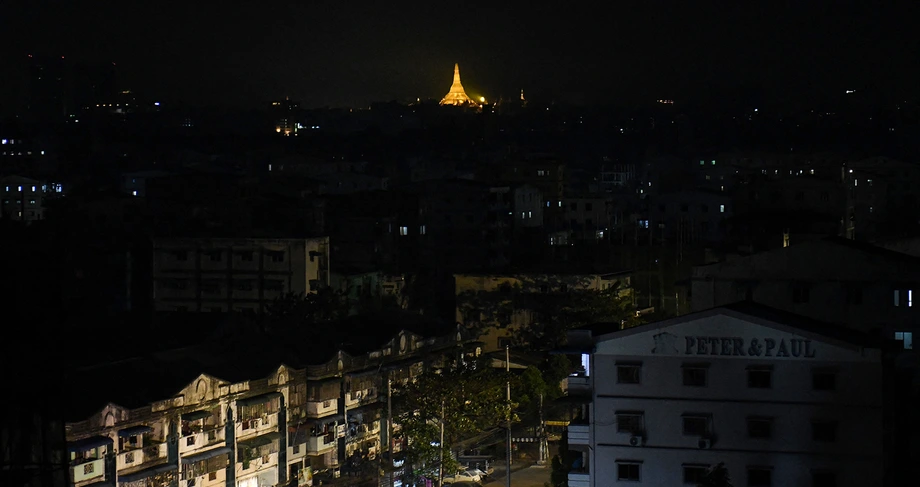
Ko Thant Zin, a resident of Yangon's Insein Township, described a supply pattern of four hours with power followed by four hours without it. Ordinary chores must fit into those windows.
"We have to be ready to fill up the water, cook meals, and iron our clothes the moment the power comes back on," he said.
The Asia Foundation's Yangon household study documents how deeply that scheduling reaches into daily life. Researchers conducted 40 interviews, monitored about 100 Facebook groups and walked routes through 13 townships during April and May 2023.
The study recorded four hour rotations between 5 a.m. and 9 p.m. during the March-May rationing periods in 2022 and 2023. Unscheduled cuts added uncertainty. Some housing complexes went without water for days because pumps could not operate.
Thet San's household sometimes woke at 2 or 3 a.m. to cook while electricity was available and prepare food to take to work. The family combined charcoal and gas cooking with a 300 watt inverter and battery for lights and Wi-Fi. An inverter converts stored battery power into electricity suitable for household equipment, but its capacity limits which appliances can run.
Hot rooms and broken sleep affected health and work, while dark streets caused worries about safety. Children studying online also faced interrupted connections and devices running out of charge.
Small businesses pay for power twice
Factories and shops must pay for electricity when the grid works, then spend again on generators, fuel and repairs when it fails. The World Bank reported that industrial zones received less than two hours of electricity a day in 2023 as residential consumers were prioritised.
Aung Min, a welding business owner with six employees featured in the Asia Foundation study, had a generator rated at 3,000 watts. It could support only one person's work at a time. Unexpected cuts delayed orders by days, and some employees left because there was too little work to support them.
His used generator cost more than 500,000 kyats, and an engine problem later required repairs costing about 180,000 kyats. A new generator suitable for his needs cost around 3 million kyats, beyond what his business could afford at the time.
Ko Win, who helped operate an ice cream business in the same study, followed a different routine. During a scheduled outage lasting four hours, he waited one hour, ran the generator for two and switched it off for the last hour to save fuel while keeping stock cold. Fuel cost approximately 70,000 kyats every two days during April.
Public services face similar pressures. The World Bank documented queues at compressed natural gas filling stations that disrupted buses and taxis, alongside difficulties keeping medicines and medical samples refrigerated. Its 2023 assessment found that 84 percent of surveyed firms used their own diesel generators to cope with unstable supply.
Solar grows, but the purchase price excludes many
Aye Kyaw advised people seeking reliable electricity to install solar panels. Yangon residents, however, put the cost of a household system at at least 10 million kyats, while import restrictions have pushed up prices for panels, batteries and portable power equipment.
Solar adoption had already accelerated during the surge in panel imports in 2025. Myanmar imported about $100 million worth of panels from China in the first nine months of that year, more than double the amount a year earlier. Household installations had risen from a few hundred in 2019 to roughly 300,000.
Small basic systems were available for less than $1,000 in that earlier period, while larger installations cost much more. The electricity a system can provide depends on panel output, battery storage and the appliances connected to it. Keeping lights and a phone charger running requires far less power than operating lifts, refrigeration or welding equipment.
Yangon authorities have required commercial projects and buildings with many storeys to install solar systems for elevators and emergency lighting. The Asia Foundation found that household adoption also faced limits from available space, access to finance and confusing sales information.
Large solar projects have progressed slowly. The World Bank's 2024 update recorded only 142 megawatts commissioned from tenders covering up to 2,150 megawatts, about 6.6 percent. It said 29 projects from the 2020 tender were cancelled, while another account put cancellations of projects approved before the coup at 26.
Smaller systems have shown greater durability in some communities. Of 93 National Electrification Project mini grids surveyed by the bank, 89 continued operating and 29 supplied electricity around the clock. These local networks can serve communities without depending entirely on distant power stations and national transmission lines.
Electricity access has grown faster than reliability
Myanmar's earlier electrification drive connected millions of people. The World Bank recorded household access rising from 39.1 percent in September 2017 to 57.9 percent in November 2020, then 61.6 percent in December 2021. More than four million households still lacked electricity at that point.
The National Electrification Plan, launched in 2015, aimed for universal access by 2030. The World Bank supported National Electrification Project paused implementation after the military takeover and closed in September 2021. Its work included solar home systems for 421,000 households and 52,000 public streetlights.
The bank's electricity access dataset lists 80.4 percent of Myanmar's population as having access in 2024, compared with 96.5 percent in Laos and 99.2 percent in Cambodia. This indicator measures the share of people with access; the earlier figures measure households. Reliability is a further concern: a connection can serve a home that still experiences hours of blackouts every day.
Myanmar's electricity consumption was just 308 kilowatt hours per person in fiscal 2022/23, about one third of the average for countries in the lower middle income group, according to the bank. Limited supply restricts how much electricity people and businesses can actually use.
Nuclear plans run well beyond the immediate crisis
Aye Kyaw announced plans for two small modular reactors, each rated at 55 megawatts, in cooperation with Russia's state nuclear corporation Rosatom. Work is planned to begin in fiscal 2028-29, with completion in fiscal 2035-36. Locations have not been announced.
Small modular reactors are nuclear generating units designed at a smaller scale than conventional large reactors. The proposed pair would provide 110 megawatts combined, equivalent to about 7.5 percent of the 1,470 megawatt shortfall forecast for summer 2027.
The World Bank's 2023 assessment estimated that Myanmar needed to add 300-500 megawatts annually through 2030 merely to sustain its existing level of supply as other generation declined. The nuclear timetable therefore extends years beyond the immediate need for replacement capacity.
Several dates trace the widening gap between Myanmar's ambitions and electricity available to consumers:
- 2015: The National Electrification Plan sets a goal of universal access by 2030.
- February-July 2021: The military takeover interrupts development programmes, followed by shutdowns at two major plants using imported gas.
- February 2023: The authorities sign a nuclear cooperation agreement with Rosatom.
- Early 2024: Operational generation capacity falls back to its fiscal 2015/16 level.
- Summer 2027: Forecast demand reaches 5,010 megawatts against expected generation of 3,540 megawatts.
- Fiscal 2028-29 to 2035-36: The proposed nuclear project moves from its planned start to its target completion.
For families and businesses, the immediate task remains securing enough electricity for water, cooling, food storage and paid work. Restoring dependable national supply requires fuel, investment and repairs alongside new generation, while affordable local systems can cover some needs sooner.
Key Points
- Myanmar expects rotating blackouts to continue through 2027, with generation meeting about 70 percent of forecast summer demand.
- Declining gas supplies, suspended plants, damaged infrastructure and stalled investment have reduced usable electricity capacity.
- Households face disrupted water supplies and sleep, while businesses spend scarce income on generators, fuel and repairs.
- Solar installations are growing, but purchase costs and practical limits keep many families from adopting them.
- Two proposed nuclear reactors would total 110 megawatts and are scheduled for completion in fiscal 2035-36.