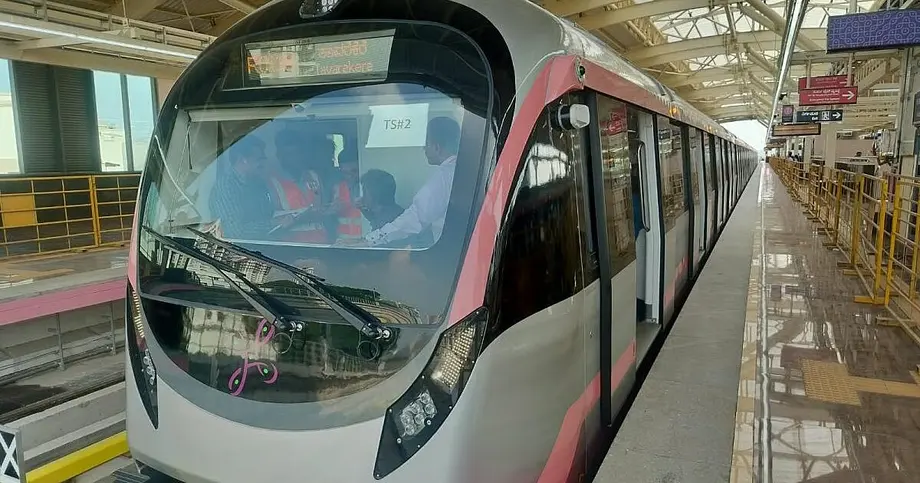
Bannerghatta Road gets a confirmed Metro opening date
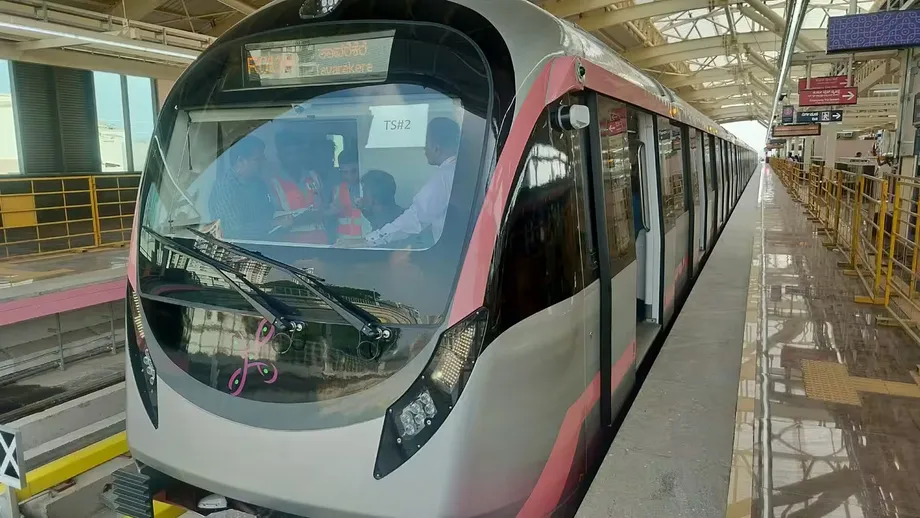
Bengaluru's 7.5 km elevated Pink Line between Kalena Agrahara and Tavarekere will begin carrying passengers on November 14, 2026, Greater Bengaluru Development Minister Krishna Byre Gowda said. The opening will take the city's operational Metro network from 96.1 km to 103.6 km, an increase of about 7.8%, and create a new connection to the Yellow Line at Jayadeva Hospital.
Contents
- Bannerghatta Road gets a confirmed Metro opening date
- Four trains will run, with one kept ready
- Jayadeva connects the new stretch to a larger network
- Why some commuters will stay on the bus
- Reaching the stations remains a daily concern
- The underground section carries most of the route
- How the opening schedule developed
- Airport services are planned in stages
- Orange and Red lines await further decisions
- Funding is part of the expansion dispute
- Key Points
Prime Minister Narendra Modi is scheduled to inaugurate the stretch at 12:30 pm on November 13, a day before public services begin. Gowda said Modi would arrive at the Fire Station near Dairy Circle, proceed to Tavarekere station, travel by Metro to the station near the Indian Institute of Management Bangalore, and attend an inaugural event at the IIMB Auditorium.
The announcement settles the opening schedule after earlier targets slipped. It follows the October safety clearance, when November 15 was still being discussed as a possible inauguration date and the proposed peak service interval was six minutes. Gowda's latest announcement sets public service for November 14, with trains initially running every eight minutes during peak periods.
Residents travelling along Bannerghatta Road will gain a rail option serving hospitals, educational institutions and employment areas. Passengers heading farther north to M.G. Road, Shivajinagar or Nagawara will have to wait for the underground section, which Gowda expects to open in 2027. The immediate benefit therefore depends heavily on where a passenger needs to go and how easily they can reach a station.
Four trains will run, with one kept ready
Bangalore Metro Rail Corporation Limited, or BMRCL, will initially allocate five trains to the elevated corridor. Four will carry passengers, while one will remain on standby to support operations when needed.
The eight minute peak interval describes the planned gap between trains. Gowda said the frequency could improve after the signalling system settles into operation and BMRCL assesses passenger demand. Signalling controls train movements and helps keep trains safely separated.
Gowda explained the conditions for increasing services:
Once the signalling system stabilises, and based on passenger demand, the frequency will be improved,
No date was given for a shorter interval. Passengers planning journeys at opening should therefore use the announced eight minute peak frequency rather than the six minute plan discussed before the final launch announcement.
Jayadeva connects the new stretch to a larger network
Jayadeva Hospital station is central to Gowda's argument that the short elevated section will attract passengers. Travellers will be able to transfer between the Pink and Yellow lines, opening routes towards Electronics City and onward connections for areas including HSR Layout and Jayanagar.
An interchange lets a passenger change lines during a journey. For someone whose destination lies along the Yellow Line, that connection can make the new Pink Line useful immediately, even while its northern section remains under construction.
Jayadeva spans six levels and is Bengaluru's tallest Metro interchange station. Its structure also accommodates a road flyover. The station already partly serves Yellow Line passengers, with the Pink Line opening adding the second rail connection.
The difference between a useful local journey and an incomplete longer journey explains much of the debate over the launch. A passenger travelling to Jayadeva Hospital or the IIMB area may gain a direct rail option. Someone travelling from the same neighbourhood to Shivajinagar will still need another form of transport for part of the trip.
Why some commuters will stay on the bus
Ananth S., a resident of Hulimavu, said a journey towards central Bengaluru could still involve leaving the Metro, finding an autorickshaw or waiting for a BMTC bus around Dairy Circle. He estimated that this transition could take 30 minutes during peak periods.
Meera K., who travels from Arekere to Shivajinagar for work near Cubbon Park, currently uses a 368-series BMTC bus. She said the need to change back to a bus after a short Metro ride would leave her preferring her existing journey.
Transport expert M.N. Srihari said the corridor's main transport value comes from connecting southern Bengaluru continuously through the city centre to northern neighbourhoods:
The real value of the Pink Line lies in its ability to create a continuous north-south public transport corridor between the southern parts of Bengaluru, the CBD and the northern areas.
The CBD is the central business district, where many offices and commercial destinations are concentrated. Srihari said opening short sections limits the benefits passengers gain from an interconnected network, particularly when they must make additional transfers to finish their journeys.
Gowda's expectation of demand through Jayadeva and commuters' concerns about central Bengaluru address different travel needs. The elevated section offers new options for local trips and Yellow Line connections. A continuous Pink Line journey through the centre depends on the underground opening.
Reaching the stations remains a daily concern
Kalena Agrahara will be the nearest Pink Line access point for residents of Gottigere and neighbourhoods beyond NICE Road. Conditions on the approach include missing footpaths, rubbish covering walking space, open drains and potholes, leaving pedestrians to walk on the main road in places.
A makeshift bus stop near the junction of Himagiri Main Road and Bannerghatta Road sits beside an open drain. Around Hulimavu station, buses stop nearby, but passengers lack a shelter. Residential areas along Hulimavu Main Road, BDA 80 Feet Road and Arekere Road also lack proper walking connections to the station.
Bilekahalli resident Ravindranath identified poor pedestrian access on Devarachikanahalli Road and Sir M Visvesvaraya Road, which feed towards the IIMB and JP Nagar stations. Srinidhi, a resident of Vijaya Bank Layout, described poor road conditions near Vega City Mall and the Bilekahalli bus stand despite recent repairs.
Station spacing makes those access problems more pressing in some locations. IIMB and JP Nagar stations are more than 1.5 km apart, while JP Nagar and Jayadeva are less than 750 metres apart. Residents between more widely separated stations may face a longer walk before their rail journey begins.
Parking at Tavarekere, IIMB, Hulimavu and Kalena Agrahara has a combined capacity for 575 two wheelers. That gives some passengers an option for reaching the Metro, while people arriving on foot or by bus still depend on safe approaches and convenient stops.
Bilekahalli residents had also asked for the nearby station to be named Bilekahalli-IIMB to reflect the locality. BMRCL retained IIMB, although Gowda referred to the inauguration destination as IIMB Bilekahalli station.
The underground section carries most of the route
The remaining 13.76 km of the Pink Line runs underground from Dairy Circle to Nagawara through M.G. Road, Shivajinagar and Tannery Road. Gowda said this section would open next year, placing the expected opening in 2027.
Together, the elevated and underground sections total 21.26 km. The first opening therefore brings roughly 35% of the route into service, with about 65% still to follow. That explains why the November launch can be a meaningful addition for some passengers while leaving many longer journeys unfinished.
BMRCL completed underground tunnelling in October 2024. Construction encountered granite and hard dolerite rock, while work beneath densely populated neighbourhoods added difficulty. About 21 km of tunnelling was undertaken for the roughly 14 km underground corridor's two directional tunnels.
Finishing tunnelling and opening a railway are separate construction milestones. Trains also need completed tracks, power, signalling, stations and operating checks before passengers can travel. The underground section remains under construction despite the earlier completion of tunnelling.
The Pink Line was originally targeted for completion in 2020 and later scheduled for December 2025. Earlier plans also pointed to September 2026 for the elevated opening. The confirmed November schedule moves that first passenger service later, while leaving completion of the continuous route for the following year.
How the opening schedule developed
The project has moved through several construction, safety and launch milestones. The latest dates distinguish the ceremonial inauguration from the day ordinary passengers can begin travelling.
- October 2024: BMRCL completed tunnelling across the underground Pink Line corridor.
- September 2026: An earlier target placed the elevated opening in this month.
- October 28, 2026: Safety authorisation cleared passenger operations on the elevated section, with requirements to be completed before service.
- November 11, 2026: Gowda announced the November 14 public opening and initial eight minute peak service interval.
- November 13, 2026: Modi is scheduled to inaugurate the elevated stretch at 12:30 pm.
- November 14, 2026: Passenger services are scheduled to begin.
- 2027: Gowda expects the underground Dairy Circle to Nagawara section to open.
The safety approval covered inspections and technical checks before passenger operations. BMRCL's remaining responsibilities before opening include certifying fitness for use, staff training and checks on passenger facilities and security equipment.
Airport services are planned in stages
Gowda also set out a staged schedule for the 58.44 km Blue Line, which will connect Silk Board Junction to Kempegowda International Airport through KR Puram and Hebbal. He expects completion within about 18 months of the November announcement.
The Silk Board Junction to KR Puram section and the Hebbal to airport section are expected to open in about a year. The connecting stretch between KR Puram and Hebbal would follow roughly six months later. On that schedule, the first openings would fall around November 2027 and the final connecting section around May 2028.
For passengers, the sequence matters because the first two sections would begin operating before the middle link is ready. The complete Blue Line connection from Silk Board to the airport depends on that final section entering service.
Gowda has described an ambition to expand Bengaluru's operational Metro network to 170 km by 2027, while another stated target gives an 18 month window. Those are different completion windows. Both point to a substantial expansion from the 103.6 km network expected after the elevated Pink Line opens.
Orange and Red lines await further decisions
Gowda said tendering and a groundbreaking ceremony for the 44.65 km Orange Line under Phase 3 were planned within six months. Its corridors would connect JP Nagar 4th Phase to Hebbal, via Kanakapura Road and Mysuru Road, and Hosahalli to Kadabagere along Magadi Road.
Phase 3 received approval in October 2024, but construction has not begun. Gowda attributed the delay to the Union government's objection to Karnataka's proposal for an end-to-end double-decker viaduct carrying both Metro infrastructure and a road flyover.
The design would place rail and road infrastructure within a shared elevated structure. Gowda said the Centre had approved such an arrangement for Nagpur while withholding approval for Bengaluru.
The proposed 37.8 km Red Line between Sarjapur and Hebbal also awaits Union approval. Gowda said Karnataka submitted its request in January 2025 and had waited 22 months. The state plans to ask Modi to speed up approval during his November 13 visit.
Funding is part of the expansion dispute
Karnataka is seeking a larger Union contribution alongside faster project approvals. Gowda said the state bears 84% of Bengaluru Metro project costs and the Centre contributes 16%.
He put the combined outlay for phases 1, 2, 2A and 2B, together with estimated Phase 3 costs, at Rs 77,891 crore. A crore equals 10 million rupees, making that combined figure about Rs 778.91 billion. The amount covers several Metro phases rather than the elevated Pink Line alone.
Using Gowda's stated shares, Karnataka's proportion is more than five times the Centre's. The minister has linked his request for more central funding with the need for quicker clearances as Bengaluru pursues further construction.
Gowda said the state had worked with BMRCL and other agencies to resolve project obstacles and keep the Pink Line moving. For Bannerghatta Road passengers, the next concrete change is now close: trains are scheduled to start on November 14. The wider gains depend on safe station access, reliable initial services and completion of the underground connection through central Bengaluru.
Key Points
- The elevated Pink Line between Kalena Agrahara and Tavarekere is scheduled to open to passengers on November 14, 2026.
- Modi is scheduled to inaugurate the stretch on November 13 at 12:30 pm.
- Four trains will operate initially, with one on standby and an eight minute interval during peak periods.
- Jayadeva Hospital will connect Pink and Yellow Line passengers.
- The opening will expand Bengaluru's operational Metro network to 103.6 km.
- Missing footpaths, poor road conditions and inadequate bus facilities remain concerns around stations.
- The 13.76 km underground Pink Line section is expected to open in 2027.
- The Blue Line is planned to open in stages, while Orange Line construction and Red Line approval remain pending.