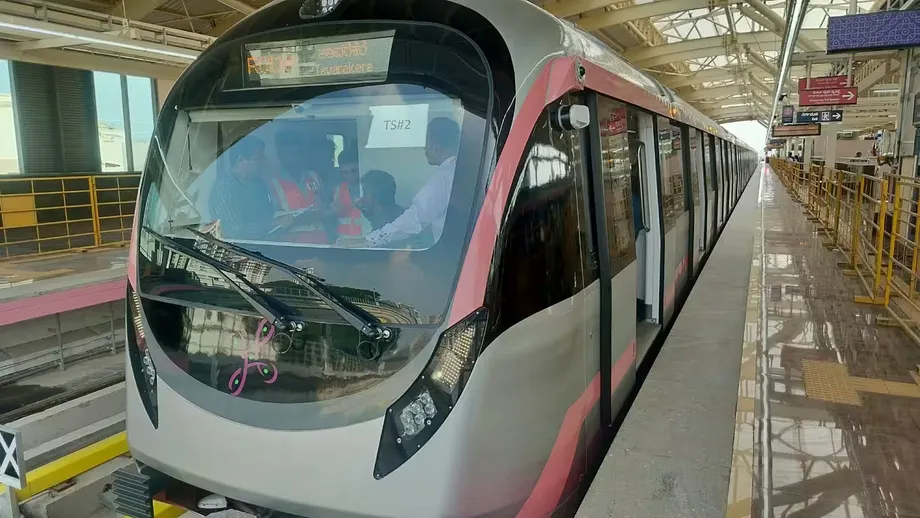
Safety approval brings Bannerghatta Road Metro closer to opening
Bengaluru Metro's elevated Pink Line has received safety clearance for passenger operations between Kalena Agrahara and Tavarekere, bringing six stations along Bannerghatta Road closer to opening. The authorisation, dated October 28, clears a major regulatory step, while the inauguration date still awaits confirmation.
Contents
- Safety approval brings Bannerghatta Road Metro closer to opening
- What the safety commissioner authorised
- From October inspections to clearance
- Why the inauguration date is still pending
- Six stations and a new interchange
- Why a 90 kmph trial leads to an 80 kmph limit
- Passenger safety work extends beyond the tracks
- Automation, cameras and the first month of service
- The elevated section is the first part of a longer line
- Key Points
Karnataka Deputy Chief Minister D.K. Shivakumar said Prime Minister Narendra Modi may inaugurate the section on November 15. Greater Bengaluru Development Minister Krishna Byre Gowda said Central representatives had indicated a possible visit in mid-November but had not definitively confirmed a date.
The corridor is generally described as 7.5 km long. Details of the safety order put the authorised section at 7.38 km. Bangalore Metro Rail Corporation Limited (BMRCL) plans to deploy five trains, with services every six minutes during peak periods and every 10 minutes outside them.
Opening the elevated stretch would increase Bengaluru's operational Metro network from 96.10 km to 103.60 km. For passengers, the immediate change would be a new rail connection along Bannerghatta Road, including an interchange at Jayadeva Hospital. The longer journey north through central Bengaluru to Nagawara depends on the remaining Pink Line corridor opening later.
What the safety commissioner authorised
V. Venkatasubramanian, Commissioner of Metro Railway Safety for the Southern Circle, authorised passenger operations following inspections, technical submissions and a speed trial. The October 28, 2026 order covers the newly constructed tracks in both directions and the introduction of electric traction using a 750 volt direct current supply.
The commissioner assessed the section under Section 15(1) of the Metro Railways (Operation and Maintenance) Act, 2002. This is part of the legal process for allowing a new Metro railway to carry passengers.
Venkatasubramanian explained the basis of his decision in the authorisation order:
Based on the inspections, results of tests carried out, speed trials and perusal of the certificates/documents and other information submitted by BMRCL, I am of the opinion that the provisions of Section 15(1) of the Metro Railways (Operation and Maintenance) Act, 2002, have been substantially complied with,
The permission includes operating limits and further requirements for BMRCL. Before passenger services begin, the corporation must certify that the tracks and trains are fit for use, provide adequate training for operations and maintenance staff, and complete the required checks on passenger facilities and security equipment.
From October inspections to clearance
Venkatasubramanian and his team inspected the elevated corridor from October 6 to 8. Their review also covered the Kothanur maintenance depot and the Operations Control Centre at Baiyappanahalli, extending the examination beyond stations and tracks to the facilities that maintain and supervise trains.
BMRCL received the inspection observations on October 9. The review flagged 36 issues, including missing fire safety arrangements, malfunctioning lifts, damaged electrical earthing connections and unresolved train testing matters. Earthing provides a safe route for an electrical fault, helping protect people and equipment from electric shock.
BMRCL officials described the observations as part of the final verification process and said they did not involve structural defects or serious safety concerns. The corporation prepared compliance material with photographs and technical details, submitted documents on October 15, and was subsequently asked for additional information.
The main steps toward authorisation were:
- October 6 to 8: The safety commissioner and his team inspected the corridor and associated facilities.
- October 9: BMRCL received the inspection observations.
- October 15: BMRCL submitted compliance documents, followed by requests for further material.
- October 22: Byre Gowda said trial runs were complete and clearance was expected within four to five days.
- October 27: A special train reached 90 kmph during speed trials.
- October 28: The safety commissioner authorised passenger operations subject to conditions.
Byre Gowda said safety and electrical tests had taken place over seven to eight months. The final inspection and subsequent document checks were the closing stages of that longer testing programme.
Why the inauguration date is still pending
November 15 is the date publicly suggested by Shivakumar, but Byre Gowda said a firm commitment from Central representatives was still needed. He planned to seek meetings with Union ministers in early November to secure an inauguration date.
Byre Gowda, the minister responsible for Greater Bengaluru Development, described the state government's position in a public statement:
We are ready to launch public service as soon as the Govt of India gives a date for inauguration. We have already written to them requesting for the date. We are eagerly looking forward to inaugurate the elevated Pink Line.
November 3 had also been discussed as a possible inauguration date, depending on Modi's availability around a scheduled event for Pune Metro's Line 3. Some Bengaluru residents had hoped the corridor would open on November 1, Kannada Rajyotsava, which marks Karnataka's formation.
The confirmed inauguration date, the first day of passenger services, fares and daily operating hours have not been announced in these statements. For commuters planning a journey, the next practical milestone is BMRCL's announcement of when trains will actually accept passengers.
The wait follows earlier public demands that completed Metro sections open promptly after safety approval. Residents have previously held symbolic inaugurations to protest delays, while some sections have begun services without waiting for formal ceremonies after public pressure.
Six stations and a new interchange
The elevated corridor serves six stations in order from Kalena Agrahara toward Tavarekere:
- Kalena Agrahara
- Hulimavu
- IIMB
- JP Nagar 4th Phase
- Jayadeva Hospital
- Tavarekere
Jayadeva Hospital is set to become Bengaluru's third Metro interchange station. An interchange lets passengers change between lines, allowing a journey to continue beyond the stations served directly by a single corridor.
BMRCL's proposed six minute frequency during peak periods amounts to about 10 trains an hour in each direction if services run evenly. A 10 minute interval outside peak periods would mean about six trains an hour. These calculations describe the proposed frequency; passengers will need the published timetable for the actual service pattern.
The five planned trains would provide the initial service on the elevated section. For people travelling along Bannerghatta Road, the corridor would create a new public transport option connecting the six station areas and the interchange. Trips extending beyond those stations would still require another Metro service or a journey by road or on foot.
Why a 90 kmph trial leads to an 80 kmph limit
The October 27 speed trial used a special train on both tracks and reached 90 kmph. The safety order permits normal operations at up to 80 kmph, or the lower speed allowed by the Automatic Train Protection system. The maximum speed at platforms is restricted to 60 kmph.
Automatic Train Protection, usually shortened to ATP, supervises a train's movement and can enforce safety limits. If the system permits less than 80 kmph on a particular part of the route, the train must follow that lower limit.
The trial train carried an OMS 2000 measuring system. The order records that peak acceleration during the trial did not exceed 0.15 g, with g being the acceleration caused by gravity. This measurement formed part of the technical information reviewed before approval.
Testing a train above its authorised passenger speed gives the commissioner information about how the railway behaves during a controlled trial. Everyday running will follow the limits in the authorisation, alongside station stops and the restrictions applied by the train protection system.
Passenger safety work extends beyond the tracks
The commissioner's instructions cover equipment that passengers will encounter throughout their journey. All lifts and escalators must be tested for proper operation and safety. BMRCL must also mark train door positions on platforms so passengers can identify where doors normally stop.
Other requirements include installing and testing signage at specified stations and commissioning baggage scanners, door frame metal detectors, handheld metal detectors and cameras. These measures connect the railway's technical approval with the practical work of preparing stations for public use.
The commissioner also called for an anti-drag feature to detect obstructions during door closure. Such protection is intended to identify an object caught at a doorway before it can be pulled along by a departing train.
Drainage improvements are among the instructions for the elevated section. BMRCL must also give priority to commissioning a backup Operations Control Centre at Peenya. A backup control centre provides another location from which railway operations can be supervised if the main centre becomes unavailable.
The authorisation requires full compliance with conditions set by the Independent Safety Assessor, which reviews safety arrangements separately from the organisation delivering or operating the railway.
Automation, cameras and the first month of service
The elevated Pink Line is authorised to operate at Grade of Automation 2, commonly called GoA2. This means some train control functions are automatic while a driver remains involved in operation. BMRCL eventually plans to move to GoA4, which allows unattended train operation.
Before upgrading beyond GoA2, BMRCL must obtain the competent authority's approval for its cybersecurity case. This is the documented explanation of how critical systems are protected against digital threats. Certified independent experts must assess the cybersecurity of critical safety systems.
The commissioner also instructed BMRCL to increase CCTV bandwidth so recorded information can be retrieved effectively, and to use artificial intelligence tools for facial recognition and overcrowding detection. The crowd detection requirement concerns identifying areas where passenger numbers may need closer management.
BMRCL must closely monitor the first month of passenger services and submit a report recording observations and corrective measures where necessary. The opening will therefore be followed by a defined period of operational review, covering how the railway performs with passengers aboard.
The elevated section is the first part of a longer line
The full Pink Line is planned to run from Kalena Agrahara to Nagawara. Its stated length of 21.3 km includes the 7.5 km elevated section and a 13.8 km underground corridor through areas including Dairy Circle, M.G. Road, Shivajinagar and Tannery Road.
The underground section accounts for nearly 65% of the planned line, using those published lengths. The elevated opening would therefore bring roughly one third of the Pink Line into service, with most of the route still dependent on the underground section being commissioned.
BMRCL planned to begin trial runs on the remaining corridor in November, with that section potentially opening the following year. The underground route would extend the Pink Line's reach through central Bengaluru toward Nagawara, creating a longer connection between southern and northern parts of the city.
Construction of the elevated stretch began in 2017. Delays included BMRCL terminating the original contractor's contract over alleged failures to meet obligations. The safety clearance marks progress after that extended construction period, while the opening schedule remains tied to the pending inauguration arrangements.
Across the wider Metro network, adding 7.5 km to the existing 96.10 km would represent an increase of about 7.8%. The new total of 103.60 km would take Bengaluru beyond 100 km of operational Metro routes, building on the Purple, Green and Yellow lines already carrying passengers.
Key Points
- The October 28 safety authorisation covers the elevated Pink Line between Kalena Agrahara and Tavarekere.
- The section has six stations, including the future interchange at Jayadeva Hospital.
- November 15 has been suggested for inauguration, but a firm date and the passenger service start remain unconfirmed.
- BMRCL plans five trains, running every six minutes at peak times and every 10 minutes outside them.
- Passenger operations are limited to 80 kmph or the lower train protection limit, with a 60 kmph limit at platforms.
- BMRCL must complete readiness requirements and report on the first month of passenger operations.
- The elevated opening would increase Bengaluru's operational Metro network from 96.10 km to 103.60 km.
- The underground corridor toward Nagawara is a later stage of the full 21.3 km Pink Line.