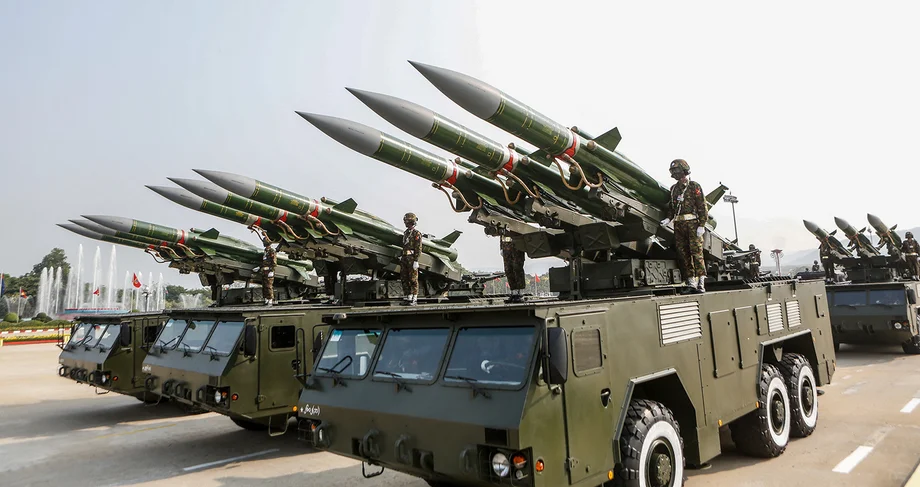
A larger military budget in a country under strain
Myanmar's military authorities are seeking defense spending of 10.53 trillion kyats for the 2026–27 fiscal year, combining an initial allocation of 7.95 trillion kyats with a proposed supplement of 2.58 trillion. The extra money would increase the original military budget by about 32 percent, as the United Nations Development Programme says 17.9 million people face overlapping hardships in health, education and living conditions.
Contents
- A larger military budget in a country under strain
- Lawmakers had eight days to examine the figures
- How military spending reached this point
- Where military funds are going
- What poverty means beyond a small income
- Conflict areas face the deepest deprivation
- A widening deficit brings more borrowing
- Currency losses reach household shopping baskets
- Growth forecasts meet earthquake and war damage
- Key Points
The proposed total is more than three times the 3.4 trillion kyats allocated to defense in 2020–21, under the civilian government led by Aung San Suu Kyi. It comes as fighting between the military, established ethnic armed organizations and resistance groups including the People's Defense Force continues across much of the country.
UNDP's Layers of Deprivation report, titled "Layers of Deprivation: Multidimensional Poverty in Myanmar" and published on October 8, puts the share of people experiencing multidimensional poverty at 32.6 percent. Another 19.5 million are vulnerable to falling into it. Together, those groups number about 37.4 million, or more than two thirds of the population.
The military proposal is still a draft. Its approval would commit more public money to the armed forces while households struggle with expensive food, disrupted livelihoods and limited access to essential services. A final vote date has not been given.
The financial pressure reaches beyond defense. Additional spending requests would also widen the government's deficit, meaning authorities would need to borrow more or find other ways to cover the gap between revenue and expenditure.
Lawmakers had eight days to examine the figures
Chit Swe, an Upper House lawmaker representing Ayeyarwady Region's Constituency No. 11, urged approval of the proposed budgets on November 5. He is also first deputy chair of the Joint Public Accounts Committee, which examines government finances.
His explanation exposed a constraint on that scrutiny: the committee had only eight days to verify the budget. Some spending items required observation on the ground, he said, and verification would need at least two weeks.
The Union Parliament, formally known as the Pyidaungsu Hluttaw, is dominated by the military backed Union Solidarity and Development Party and its allies. Its consideration of the supplementary allocation therefore takes place within a legislature controlled by forces aligned with the military.
A supplementary budget adds spending authority after the initial budget has been set. Here, the proposed defense supplement alone is equivalent to roughly three quarters of the entire military allocation for 2020–21. That comparison shows the size of the additional request before considering the 7.95 trillion kyats already planned.
How military spending reached this point
Myanmar's defense allocations have risen sharply since the military seized power in 2021. Spending exceeded 5.6 trillion kyats in 2023–24, compared with 3.4 trillion in 2020–21. The proposed 10.53 trillion total would put spending at nearly twice the 2023–24 level.
These are comparisons in kyats at the prices of each period. Inflation has also risen sharply, so a larger budget buys less than the same increase would have bought under stable prices. The figures nevertheless show how much more money authorities intend to direct toward defense.
- 2020–21: Defense expenditure stood at 3.4 trillion kyats under the last civilian government.
- 2021: The military seized power, followed by widening armed resistance.
- 2023–24: Defense spending rose to more than 5.6 trillion kyats.
- October 8, 2026: UNDP published its findings on multidimensional poverty.
- October 16, 2026: Deputy Finance and Revenue Minister Daw Than Than Lin presented revised deficit figures to parliament.
- November 5: Chit Swe urged lawmakers to approve the proposed budgets, including the defense supplement.
Defense figures for the intervening fiscal years were not officially released. That leaves gaps in the annual spending record, even as the proposed total marks a new high.
Where military funds are going
The Myanmar Defense & Security Institute, a research organization, says the Directorate of Defense Industries has consumed the largest share of the military budget since the coup. The directorate manufactures ammunition and aerial bombs used in military attacks, including attacks the institute describes as indiscriminate.
Naung Yoe, a military defector who now works with the institute, criticized the priorities reflected in the proposed allocation.
The budgets that should be spent on the country's education, health, social welfare and nation-building are instead being used to kill the people,
His criticism connects the spending decision to two pressures facing civilians: the danger from continued warfare and the shortage of resources for services such as schools and healthcare. The proposed budget expands military funding while UNDP's findings identify basic services as central to the country's deprivation.
The spending figures cited in parliament do not include a detailed public breakdown of the proposed defense supplement. The allocation between ammunition production, personnel, equipment and other military costs therefore remains undisclosed.
What poverty means beyond a small income
UNDP's study measures more than how much money a household earns. Its adapted Multidimensional Poverty Index examines overlapping disadvantages in health, education and living standards. A family may face several at once, such as difficulty obtaining medical care, inadequate housing and a lack of clean water.
Health and living standards account for more than 80 percent of the measured poverty. This means those disadvantages make up most of the deprivation captured by the index. Access to healthcare, housing, sanitation and other essential services is therefore central to understanding the findings.
The study drew on a nationwide telephone survey of about 7,500 households. It found that poverty varies substantially between places and population groups, with longstanding disadvantages compounded by conflict, displacement and repeated economic and natural shocks.
The 19.5 million people classified as vulnerable form a larger group than the 17.9 million already experiencing multidimensional poverty. For households near that threshold, illness, displacement or the loss of work can remove what little protection remains.
Conflict areas face the deepest deprivation
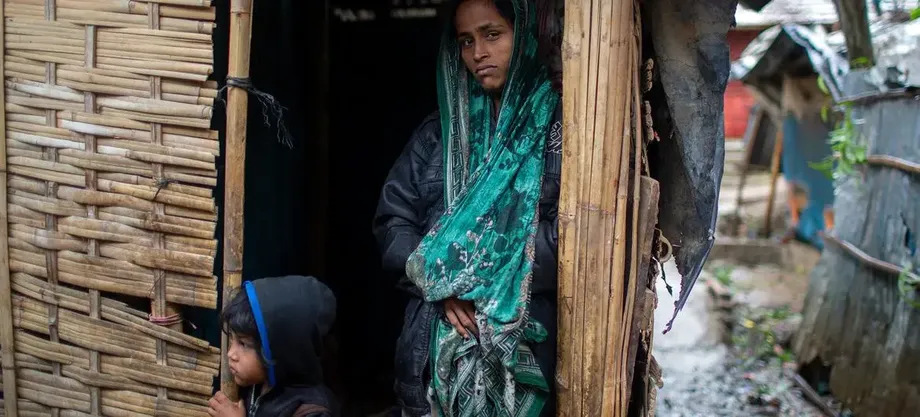
Rakhine State in western Myanmar and Kayah State in the east are among the places where poverty is especially widespread and severe. They are also known as Arakan and Karenni respectively. Insecurity and restrictions on access make it harder for residents to reach markets, services and assistance.
In Rakhine, more than two-thirds of the population are multidimensionally poor and nearly a third are severely poor. Limitations in collecting data by phone may understate deprivation among some stateless and displaced populations there, including Rohingya communities.
The findings also show that poverty is not confined to rural areas. Yangon Region has lower poverty rates than many conflict-affected states but one of the largest concentrations of multidimensionally poor people, reflecting vulnerabilities among urban and peri-urban households.
UNDP links worsening deprivation to insecure employment, low incomes, limited education, disrupted markets and fragmented public services. These pressures reinforce each other: losing work reduces a family's ability to pay for transport or treatment, while poor health can make earning a living harder.
Kanni Wignaraja, a UN assistant secretary general and UNDP's regional director for Asia and the Pacific, described the damage in human terms.
We are seeing a depth of poverty in Myanmar that is eroding human development itself. This is a no-win war. Everyone is losing. The core muscle of the country is being systematically eroded.
UNDP also estimates that at least 1 million young people may have left Myanmar since 2021 because of limited opportunities and growing uncertainty. Their departure reduces the workers and skills available for businesses and public services, while separating families from people who might otherwise support them locally.
A widening deficit brings more borrowing
Chit Swe put the projected deficit at 11.41 trillion kyats after supplementary allocations, up from 8.98 trillion. Deputy Finance and Revenue Minister Daw Than Than Lin gave a slightly different starting estimate on October 16, 2026: 9.015181 trillion kyats, rising to 11.418878 trillion.
Both sets of figures point to an increase of about 2.4 trillion kyats. Using the minister's figures, the revised deficit is roughly 27 percent larger than initially projected. A deficit is the amount by which government spending exceeds revenue during a budget period.
Authorities have approved plans to borrow more than 2.1 trillion kyats directly from the Central Bank of Myanmar. Domestic and external government debt had already exceeded 70 trillion kyats in the 2024–25 fiscal year.
Parliament has also approved an export credit loan from Belarus carrying interest above 9 percent. The borrowing is intended to pay for Belarusian industrial equipment and technology, with repayments covering both the purchase and interest. It adds another obligation to public finances already under pressure.
Currency losses reach household shopping baskets
Myanmar's currency has weakened from about 1,300 kyats per US dollar in 2020 to around 3,600–4,000 in 2026. A dollar therefore costs roughly three times as many kyats, making imported goods and inputs more expensive for people earning in the local currency.
Prices of rice, cooking oil and salt have risen to nearly five times their levels before the coup. For households whose earnings have failed to keep pace, that means buying less food or reducing spending on other needs.
The World Bank recorded inflation of 34.1 percent in April 2025. Inflation measures how quickly prices rise over time. When essentials become more expensive, families need more money simply to maintain the same living conditions.
The proposed military total has been valued at about US$5.01 billion using the official exchange rate. At the cited market range of 3,600–4,000 kyats per dollar, 10.53 trillion kyats would instead equal about US$2.63 billion to US$2.93 billion. The kyat amount is the same; the dollar value changes with the exchange rate used.
Central bank financing also draws attention because of inflation concerns. Economic analyst U Thet Zaw said the government authorizes the amount of banknotes that can be issued and explained that borrowing from the central bank does not automatically lead to printing new banknotes each time.
Growth forecasts meet earthquake and war damage
Military leader Min Aung Hlaing has projected national output of 195.03 trillion kyats and economic growth of 3.4 percent for 2026–27. He has called for budget priorities that would allow the incoming government to continue the military's agenda without interruption.
The World Bank forecast growth of 3 percent for the same fiscal year, following an estimated contraction of 2 percent in 2025–26. Its earlier estimate had been a contraction of 2.5 percent. Growth after a contraction means output is increasing from a smaller base, while households may still face much worse conditions than before the downturn.
The March 2025 earthquake caused an estimated US$11 billion in physical damage. Factory closures, damaged infrastructure, shortages of workers and disrupted supplies have weighed on production. Reconstruction can increase economic activity while still leaving substantial losses to repair.
Economist Sean Turnell has called Min Aung Hlaing's output and growth projections unrealistic. Alongside the economic damage, at least 3.6 million people are internally displaced and more than 15 million face acute food insecurity, meaning they struggle to obtain enough food.
UNDP's findings place the budget debate against a concrete measure of public need: millions of people lack dependable access to the services and living conditions necessary for a secure life. Parliament's decision will determine how much additional money goes to the military while the government finances a larger deficit.
Key Points
- Myanmar's proposed military budget totals 10.53 trillion kyats, including a supplementary request of 2.58 trillion.
- The proposed total is more than three times the 3.4 trillion kyats allocated in 2020–21, before adjusting for inflation.
- UNDP identifies 17.9 million people as multidimensionally poor and another 19.5 million as vulnerable.
- Health and living standards account for more than 80 percent of measured multidimensional poverty.
- The revised government deficit is about 11.42 trillion kyats, with plans to borrow more than 2.1 trillion directly from the central bank.
- The defense supplement remains a proposal, with no final vote date given.