More business, little change in earnings
Kaspi.kz generated 3.31 trillion tenge in revenue during the first nine months of 2026, an increase of 14.2%, but net profit barely changed at 791.8 billion tenge. Growing lending, shopping and payment activity brought in more money, while higher deposit costs and spending on new services absorbed much of the gain.
Contents
- More business, little change in earnings
- Why currency changes matter
- Deposit costs squeeze lending earnings
- Shopping revenue outpaces spending
- Payments grow while investment absorbs gains
- Grocery expansion moves into neighbourhood stores
- Kasper brings AI into shopping
- Türkiye links commerce with consumer credit
- Lower sales guidance, unchanged earnings target
- Key Points
The Kazakhstan company published its unaudited consolidated results on November 9 for the period ending September 30. Its financial results statement, prepared under International Financial Reporting Standards, also outlined plans to expand neighbourhood grocery stores, develop its Kasper artificial intelligence assistant and build lending services in Türkiye.
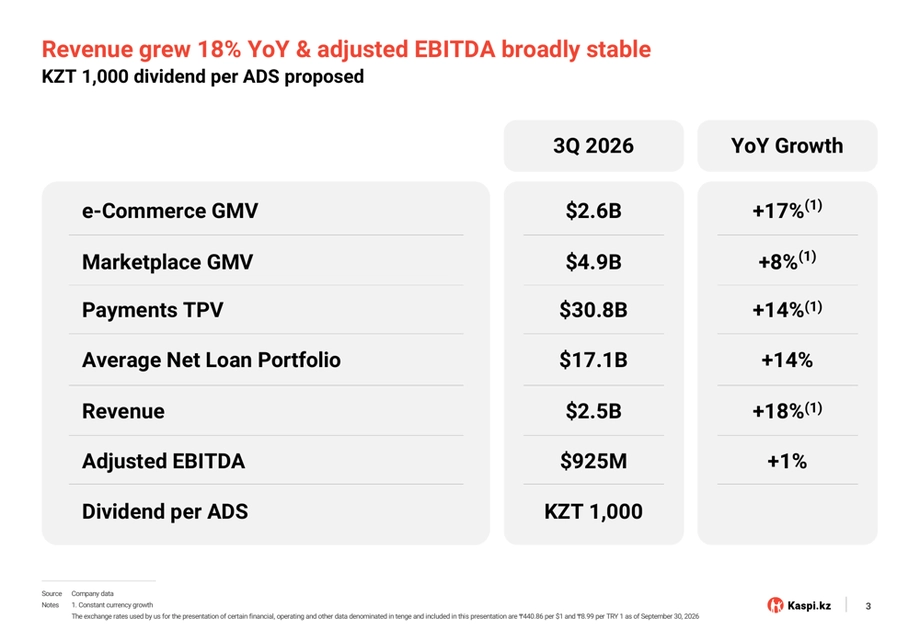
Third quarter revenue reached 1.12 trillion tenge, roughly 1% higher than a year earlier. Net profit increased 1.1% to 281 billion tenge. Revenue growth was much stronger, at 18%, when calculated using constant exchange rates, which remove the effect of currency movements from the comparison.
Adjusted EBITDA rose 1% to 408 billion tenge for the quarter and 5% to 1.17 trillion tenge for the nine months. EBITDA measures earnings before interest, taxes, depreciation and amortization; the adjusted version also reflects company adjustments. Net profit is the final earnings figure after expenses.
For shareholders, the central issue is when rising activity will translate into faster profit growth. For customers, the same results describe more frequent shopping, cheaper imported goods and a growing network of grocery services, alongside lower rates on some deposits.
Why currency changes matter
Kaspi.kz reports its consolidated accounts in tenge, including business conducted in Türkiye through Hepsiburada. When the Turkish lira falls against the tenge, revenue earned in lira converts into fewer tenge. That helps explain why reported quarterly revenue growth was about 1%, compared with 18% at constant exchange rates.
The company said the US dollar and Turkish lira declined 20% and 32%, respectively, against the tenge over the year to September. A stronger tenge also reduced the local currency cost of imported goods in Kazakhstan, giving merchants room to lower prices.
Kazakhstan shoppers bought 24% more items through the company's commerce operations in the third quarter, while the average value per item fell 8%. More purchases therefore produced a smaller increase in the total money spent.
Gross merchandise value, or GMV, is the total value of goods and services sold through a platform. It differs from Kaspi.kz's revenue, which includes the fees and other income the company earns from that activity. Lower prices can slow GMV growth even when customers buy more often.
Deposit costs squeeze lending earnings
Fintech revenue rose 19% in the third quarter to 489 billion tenge, supported by a 14% increase in the average net loan portfolio to 7.5 trillion tenge. Adjusted EBITDA nevertheless slipped 1% to 179 billion tenge.
Kazakh economist Turar Abdi attributed part of the pressure to the higher cost of attracting depositors' money. Kaspi.kz's average deposit cost increased from 13.4% to 14.9%, while deposits grew 21% to 8.3 trillion tenge.
Quarterly interest expenses on deposits consequently rose from 246 billion tenge to 303.8 billion tenge. That is an additional 57.8 billion tenge, or about 23.5%. Kaspi.kz was paying a higher rate on a larger pool of deposits.
Kaspi.kz reduced its rate on deposits with a term of three months by one percentage point in August and another percentage point in October. The company expects funding pressure to ease from the fourth quarter, with a larger earnings benefit in 2027. Depositors renewing at the lower rates will receive less interest, while the company will spend less on funding.
Credit quality also weakened. Nonperforming loans accounted for 6.9% of loans after nine months, compared with 6.1% at the end of 2025, an increase of 0.8 percentage points. These are loans whose borrowers are having difficulty meeting repayment obligations, making the measure relevant alongside loan growth.
Shopping revenue outpaces spending
Kaspi.kz's Marketplace includes its shopping platform, merchant services, travel, delivery, advertising and other commerce activities. Third quarter revenue increased 20% at constant exchange rates to 466 billion tenge, while adjusted EBITDA rose 8% to 124 billion tenge.
Marketplace GMV grew more slowly, increasing 8% at constant exchange rates to 2.2 trillion tenge. Advertising and delivery revenue rose 42%, helping the company earn more from the activity taking place across its platforms.
The narrower e-commerce business recorded revenue growth of 23% at constant exchange rates to 343 billion tenge, compared with GMV growth of 17%. Its third party take rate increased by 2.1 percentage points to 16.3%. A take rate measures the revenue a platform earns relative to the value of transactions in the relevant business.
Customers also returned more often. E-commerce orders reached 231.1 million in the first nine months, up 29%. Annualized purchases per consumer rose from 12.8 to 16.3, an increase of about 27%. Annualized figures express purchasing frequency as a yearly pace.
Mikheil Lomtadze, Kaspi.kz's cofounder and chief executive, linked more frequent purchases and lower prices to the company's customer strategy:
We believe more frequent purchases and more competitive prices strengthen our customer proposition and support long-term growth, even as lower average selling values and easing inflation moderate GMV growth today.
The figures show two changes happening together: shoppers are buying more items, while advertising, delivery and other services allow Kaspi.kz to earn more revenue relative to the value of goods sold.
Payments grow while investment absorbs gains
Kaspi.kz processed 13.6 trillion tenge in payments during the third quarter, up 14% at constant exchange rates. Payments revenue increased 6% to 182 billion tenge, but adjusted EBITDA declined about 1% to 105 billion tenge.
The company described payments profitability as broadly stable and said investment in Kaspi Alaqan affected the result. Payment volume measures money moving through the service, while revenue measures the income Kaspi.kz earns from processing and related activities.
During the first nine months, payment services processed 37.6 trillion tenge, 14% more than a year earlier, and generated 509 billion tenge in revenue. The business continued to provide substantial earnings, although its revenue grew more slowly than the value of payments handled.
Grocery expansion moves into neighbourhood stores
Kaspi.kz's online grocery business served 1.7 million consumers and increased GMV by 39% in the first nine months to about $447 million. Third quarter GMV grew 40%, making grocery the company's fastest growing category.
The next expansion centres on Magnum Daily, a neighbourhood grocery format tested through 42 partner stores in Almaty. Kaspi.kz said the pilot achieved an EBITDA margin of approximately 15% and set a target of around 300 stores by the end of 2027, with an ambition of approximately 3,000 over the medium term.
The stores use the existing online grocery supply network, including facilities known as darkstores. These are locations used to prepare delivery orders rather than receive shoppers. Local partners operate the neighbourhood stores, allowing Kaspi.kz to use its established supply chain instead of creating another one.
The store model calls for approximately 100 million tenge in capital investment per location and an estimated payback period of 18 months. Kaspi.kz funds store capital, manages assortment and pricing, and pays partners 7% of turnover, while partners focus on customer service.
Moving from 42 stores to 300 would increase the network to more than seven times its pilot size. The company estimates Kazakhstan's neighbourhood grocery market at about $9 billion annually and sees a possible further role for the stores in delivering e-commerce orders within 30 minutes.
The 15% margin comes from the initial pilot. Reaching hundreds of stores will require the company and its partners to reproduce those operating results across a much larger network.
Kasper brings AI into shopping
Kasper, the company's artificial intelligence assistant, had been used by 1.4 million consumers since its July launch. Kaspi.kz said purchase conversion was 1.5 times higher than with traditional text search, while average GMV per order was twice as high.
Conversion describes how often a shopping interaction results in a purchase. The company's early figures suggest that consumers using Kasper were more likely to buy and placed orders of greater value than consumers using ordinary text searches.
Lomtadze said the company planned to introduce a new generation of Kasper later in 2026. Planned capabilities include using photographs to find products, understanding requests written in everyday language and remembering preferences from previous interactions.
The company wants Kasper to handle more everyday tasks within the Kaspi Super App. Its reported usage figures so far concern the shopping service, where product discovery and recommendations can influence both purchase frequency and order value.
Türkiye links commerce with consumer credit
Hepsiburada customers in Türkiye increased their order frequency by 11% in the third quarter. Kaspi.kz's strategy is to combine that commerce platform with lending products for consumers and merchants.
In October, its Hepsicredit shopping loan financed approximately 8% of Hepsiburada's smartphone GMV. The figure gives an early measure of how much purchasing in one product category was being funded through the new credit service.
Lomtadze said the company was building its fintech platform after launching consumer shopping loans. Kaspi.kz expects investment in Türkiye to moderate substantially in 2027, which would reduce one source of pressure on consolidated earnings.
Türkiye therefore connects two parts of the earnings outlook: currency translation is holding back reported growth, while spending to develop new services is affecting current profitability. Management expects lower investment spending next year to help earnings.
Lower sales guidance, unchanged earnings target
Kaspi.kz reduced its forecast for 2026 Marketplace GMV growth at constant exchange rates to around 12%, from approximately 20%. Management attributed the reduction to lower average item values in Kazakhstan as the tenge strengthened and inflation eased.
The company retained its forecast for approximately 5% growth in consolidated adjusted EBITDA. It said softer GMV trends were broadly offset at that earnings level by lower fintech funding costs. Guidance for payment volume and average loan portfolio growth remained unchanged.
The outlook places more weight on costs and the income earned from each transaction, rather than simply on the total value of goods sold. Deposit rate reductions should help the lending business, while advertising and delivery are supporting Marketplace revenue.
Shareholders will also consider a proposed dividend of 1,000 tenge per common share. The results statement describes the proposal as 1,000 tenge per American Depositary Share, the instrument used for the Nasdaq listing. The shareholder meeting notice sets out the common share proposal and the approval process. No dividend payment date was given.
The meeting agenda includes amendments to the company's Charter and Board of Directors regulations based on Kazakhstan's legal requirements. Key dates in the results and shareholder timetable are:
- September 30, 2026: End of the quarter and nine month reporting period.
- November 6, 2026: Shareholder register date determining eligibility to participate in the extraordinary meeting.
- November 9, 2026: Publication of the financial results and meeting notice.
- December 8, 2026: Proposed dividend record date.
- December 9, 2026: Shareholder meeting at 10:00 Astana time at 154 A Nauryzbai Batyr Street, Almaty.
- December 10, 2026: Repeat meeting at the same time and address if the first meeting lacks a quorum.
Key Points
- Nine month revenue rose 14.2% to 3.31 trillion tenge, while net profit was nearly unchanged at 791.8 billion tenge.
- Higher deposit costs weighed on lending earnings despite growth in revenue and loans.
- Shoppers bought more frequently, but lower item prices slowed growth in merchandise value.
- Kaspi.kz cut its Marketplace GMV growth forecast to around 12% while retaining its approximately 5% adjusted EBITDA growth target.
- Magnum Daily targets around 300 stores by the end of 2027, following a pilot of 42 stores in Almaty.
- Shareholders are scheduled to consider a dividend of 1,000 tenge per common share on December 9.